



YES1 Protein, Human (Active, sf9, His-GST)
Based on 1 publication(s) in Google Scholar
YES1 is a non-receptor protein tyrosine kinase that regulates processes such as cell growth, survival, apoptosis, and cell-cell adhesion. It is activated by RTKs (EGFR, PDGFR, CSF1R, FGFR) to phosphorylate downstream substrates. YES1 Protein, Human (sf9, His-GST) is the recombinant human-derived YES1 protein, expressed by Sf9 insect cells , with N-His, N-GST labeled tag.
- Species: Human
- Source: Sf9 insect cells
-
Storage:Stored at -80°C for 1 year from date of receipt. It is stable at -20°C for 3 months after opening. It is recommended to freeze aliquots at -80°C for extended storage. Avoid repeated freeze-thaw cycles.


To place orders, for customer services and technical support, please contact: MedChemExpress USA
Tel: 609-228-6898 E-mail: [email protected] [email protected]


-
 Biological Activity
-
Technical Parameters
-
Product Properties
- Documentation
- Help & FAQs




Biological Activity
Description
YES1 is a non-receptor protein tyrosine kinase that regulates processes such as cell growth, survival, apoptosis, and cell-cell adhesion. It is activated by RTKs (EGFR, PDGFR, CSF1R, FGFR) to phosphorylate downstream substrates. YES1 Protein, Human (sf9, His-GST) is the recombinant human-derived YES1 protein, expressed by Sf9 insect cells , with N-His, N-GST labeled tag.
Background
YES1, a non-receptor protein tyrosine kinase, is a pivotal regulator of diverse cellular processes, including cell growth, survival, apoptosis, cell-cell adhesion, cytoskeleton remodeling, and differentiation. Activation by various receptor tyrosine kinases (RTKs), such as EGFR, PDGFR, CSF1R, and FGFR, results in its recruitment to phosphorylated receptors, initiating downstream substrate activation and phosphorylation. Upon EGFR activation, YES1 facilitates the phosphorylation of PARD3, promoting epithelial tight junction assembly. At cell-cell contacts, it stimulates the FYN and FER tyrosine kinases, leading to the phosphorylation of specific junctional components like CTNND1. In response to T-cell stimulation by CXCL12, YES1 phosphorylates collapsin response mediator protein 2/DPYSL2, inducing T-cell migration. Additionally, it participates in CD95L/FASLG signaling, mediating AKT-dependent cell migration. YES1's involvement in cell cycle progression is evident through the phosphorylation of cyclin-dependent kinase 4/CDK4, regulating the G1 phase, and its role in G2/M progression and cytokinesis. Furthermore, YES1 catalyzes the phosphorylation of the organic cation transporter OCT2, enhancing its transport activity.
Verified Bioactivity
The specific activity was determined to be ≥ 35 nmol/min/mg using Poly (Glu,Tyr) 4:1 as substrate.
MCE Validation Data
-
Purity - SDS-PAGE
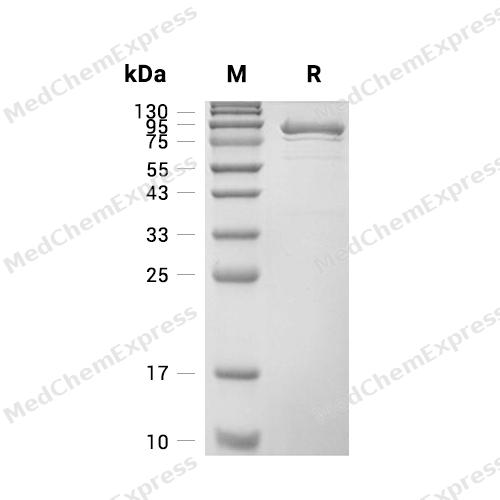
Purity - SDS-PAGE


Publications (1)
-
Journal Impact Factor
-
Most Recent
-
Adv Sci (Weinh)
A Novel tsRNA, m7G-3' tiRNA LysTTT, Promotes Bladder Cancer Malignancy Via Regulating ANXA2 Phosphorylation. [Abstract]2024 Aug;11(31):e2400115. PMID: 38894581


Technical Parameters
-
Species Human
-
Source Sf9 insect cells
-
Tag N-His;N-GST
-
Accession
P07947 (G2-L543)
-
Molecular Construction
-
N-term
-
His-GST
-
YES1 (G2-L543)
Accession # P07947 -
C-term
-
-
Protein Length
Full Length
-
Synonyms
YES1; YES Proto-Oncogene 1; Src Family Tyrosine Kinase; HsT441; C-Yes; Yes; V-Yes-1 Yamaguchi Sarcoma Viral Oncogene Homolog 1; Tyrosine-Protein Kinase Yes; Proto-Oncogene C-Yes; YES1 Proto-Oncogene; Src Family Tyrosine Kinase; Proto-Oncogene Tyrosine-Pro
-
AA Sequence
GCIKSKENKSPAIKYRPENTPEPVSTSVSHYGAEPTTVSPCPSSSAKGTAVNFSSLSMTPFGGSSGVTPFGGASSSFSVVPSSYPAGLTGGVTIFVALYDYEARTTEDLSFKKGERFQIINNTEGDWWEARSIATGKNGYIPSNYVAPADSIQAEEWYFGKMGRKDAERLLLNPGNQRGIFLVRESETTKGAYSLSIRDWDEIRGDNVKHYKIRKLDNGGYYITTRAQFDTLQKLVKHYTEHADGLCHKLTTVCPTVKPQTQGLAKDAWEIPRESLRLEVKLGQGCFGEVWMGTWNGTTKVAIKTLKPGTMMPEAFLQEAQIMKKLRHDKLVPLYAVVSEEPIYIVTEFMSKGSLLDFLKEGDGKYLKLPQLVDMAAQIADGMAYIERMNYIHRDLRAANILVGENLVCKIADFGLARLIEDNEYTARQGAKFPIKWTAPEAALYGRFTIKSDVWSFGILQTELVTKGRVPYPGMVNREVLEQVERGYRMPCPQGCPESLHELMNLCWKKDPDERPTFEYIQSFLEDYFTATEPQYQPGENL
-
Predicted Molecular Mass
88.5 kDa
-
Molecular Weight
Approximately 75 kDa, based on SDS-PAGE under reducing conditions.
-
Purity
≥ 80%, as determined by reducing SDS-PAGE.


Product Properties
Solution
1.Supplied as a 0.22 μm filtered solution of 20 mM Tris, 500 mM NaCl, 10% glycerol, 0.5 mM TCEP, pH 8.0.
2.Supplied as a 0.22 μm filtered solution of 20 mM Tris, 500 mM NaCl, 25% glycerol, 0.5 mM GSH, pH 8.0.
Please refer to the lot-specific COA for specific buffer information.
Note: For SPR assay, please replace the buffer. Primary amine components (e.g., Tris, imidazole) can affect protein-coupled chips.
<1 EU/μg, determined by LAL method.
Please use rapid thawing with running water to thaw the protein.
Stored at -80°C for 1 year from date of receipt. It is stable at -20°C for 3 months after opening. It is recommended to freeze aliquots at -80°C for extended storage. Avoid repeated freeze-thaw cycles.
Shipping with dry ice.


Documentation
-
Data Sheet (239 KB)
-
SDS (251 KB)
- English - EN (251 KB)
- Français - FR (251 KB)
- Deutsch - DE (251 KB)
- Norwegian - NO (251 KB)
- Español - ES (251 KB)
- Swedish - SV (251 KB)
- Italian - IT (251 KB)
- Korean - KR (251 KB)
- Portuguese - PT (251 KB)
-
Handling Instructions (2659 KB)

Calculators
Concentration (start) × Volume (start) = Concentration (final) × Volume (final)


 Powered by Bioz

