



RO5527239
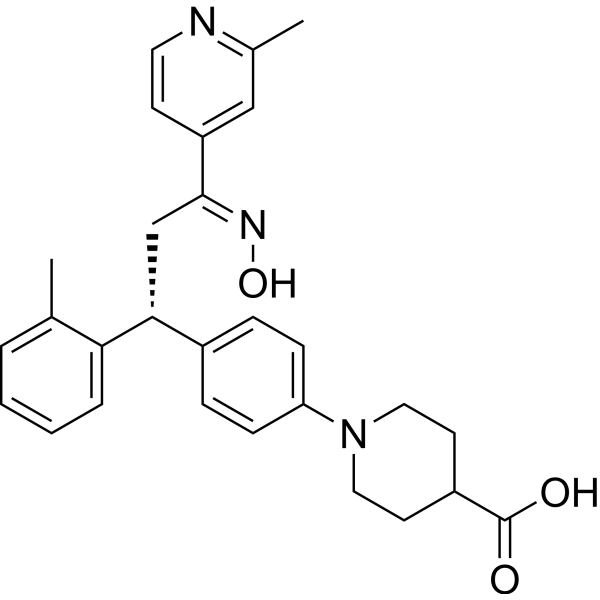
RO5527239 is an orally active TGR5 agonist, that induces a stimulatory response from intestinal L cells and specificially secrets the endogenous hormone GLP-2.
Nur für Forschungszwecke. Wir verkaufen nicht an Patienten.
- CAS. Nr.: 1354812-99-9
- Formel: C28H31N3O3
- Molecular Weight:457.56
-
Speicherung:
Please store the product under the recommended conditions in the Certificate of Analysis.

To place orders, for customer services and technical support, please contact: MedChemExpress USA
Tel: 609-228-6898 E-mail: [email protected] [email protected]


-
 Biologische Aktivität
-
Chemical Information
- Protokoll
- Reinheit & Dokumentation
- Verweise
-
 Help & FAQs




Biologische Aktivität
Beschreibung
Cellular Effect
|
Cell Line

|
Type | Value | Description | References |
|---|---|---|---|---|
| CHO | EC50 |
0.004 μM
Compound: (R)-29, RO5527239
|
Agonist activity at recombinant human GPBAR1 expressed in CHO cells
Agonist activity at recombinant human GPBAR1 expressed in CHO cells
|
[PMID: 23831134] |
| CHO | EC50 |
0.028 μM
Compound: (R)-29, RO5527239
|
Agonist activity at recombinant mouse GPBAR1 expressed in CHO cells
Agonist activity at recombinant mouse GPBAR1 expressed in CHO cells
|
[PMID: 23831134] |
| NCI-H716 | EC50 |
0.08 μM
Compound: (R)-29, RO5527239
|
Agonist activity at GPBAR1 in human NCI-H716 cells assessed as stimulation of cAMP production
Agonist activity at GPBAR1 in human NCI-H716 cells assessed as stimulation of cAMP production
|
[PMID: 23831134] |
In Vivo
MedChemExpress (MCE) has not independently confirmed the accuracy of these methods. They are for reference only.
-
Animal Model:GLP-2r-/- and GLP-2r+/+ C57Bl/6N mice[1]
-
Dosage:30 mg/kg
-
Administration:p.o. for 10 days
-
Result:Increased GLP-1 and GLP-2 concentrations in the colon, gallbladder weight with both genotype. Increased villus height in the duodenum and decreased colon length in GLP-2r+/+ mice.


Chemical Information
-
CAS. Nr. 1354812-99-9
-
Molecular Weight 457.56
-
Formel C28H31N3O3
-
SMILES
O=C(C1CCN(C2=CC=C([C@H](C3=CC=CC=C3C)C/C(C4=CC(C)=NC=C4)=N\O)C=C2)CC1)O
-
Versand
Room temperature in continental US; may vary elsewhere.
-
Speicherung
Please store the product under the recommended conditions in the Certificate of Analysis.


Reinheit & Dokumentation
Verweise

Calculators
Konzentration (Stammlösung) × Volumen (Stammlösung) = Konzentration (Ziellösung) × Volumen (Ziellösung)


RO5527239 Related Classifications
HY-116453 Related Classifications
 Powered by Bioz