



Sangivamycin
Based on 3 publication(s) in Google Scholar
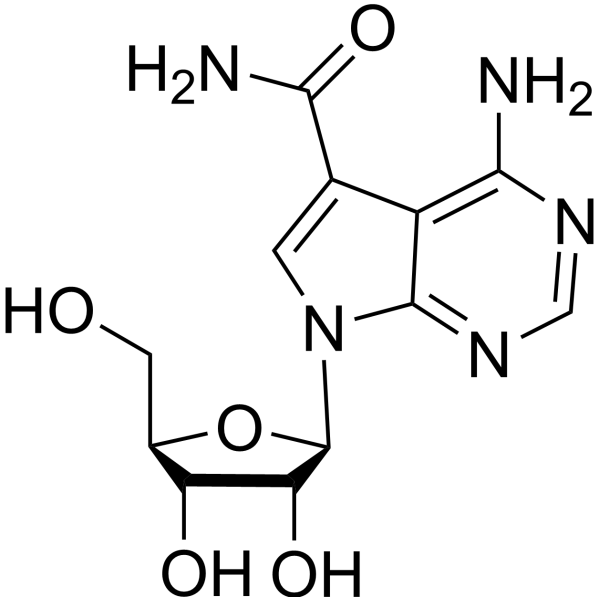
Sangivamycin (NSC 65346), a nucleoside analog, is a potent inhibitor of protein kinase C (PKC) with an Ki of 10 μM. Sangivamycin has potent antiproliferative activity against a variety of human cancers.
Nur für Forschungszwecke. Wir verkaufen nicht an Patienten.
- Reinheit : 97.68%
- CAS. Nr.: 18417-89-5
- Formel: C12H15N5O5
- Molecular Weight:309.28
-
Speicherung:Powder -20°C, 3 years , 4°C, 2 years ; In solvent -80°C, 6 months , -20°C, 1 month

To place orders, for customer services and technical support, please contact: MedChemExpress USA
Tel: 609-228-6898 E-mail: [email protected] [email protected]


-
 Biologische Aktivität
-
Chemical Information
-
Lösungsmittel & Löslichkeit
- Protokoll
- Reinheit & Dokumentation
- Verweise
-
 Help & FAQs


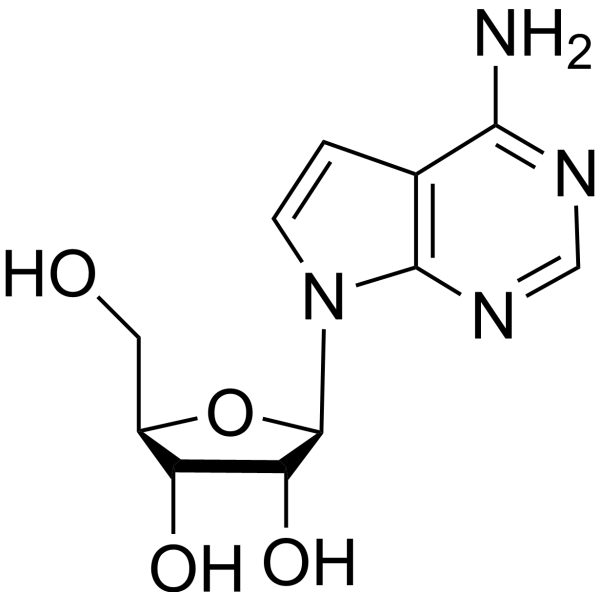
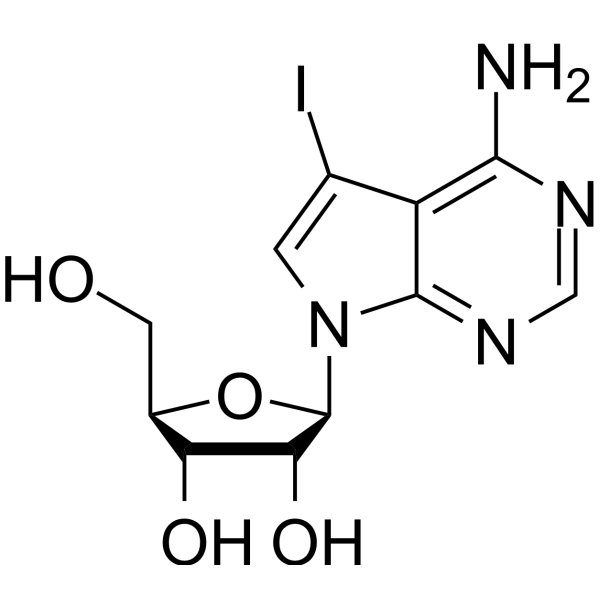
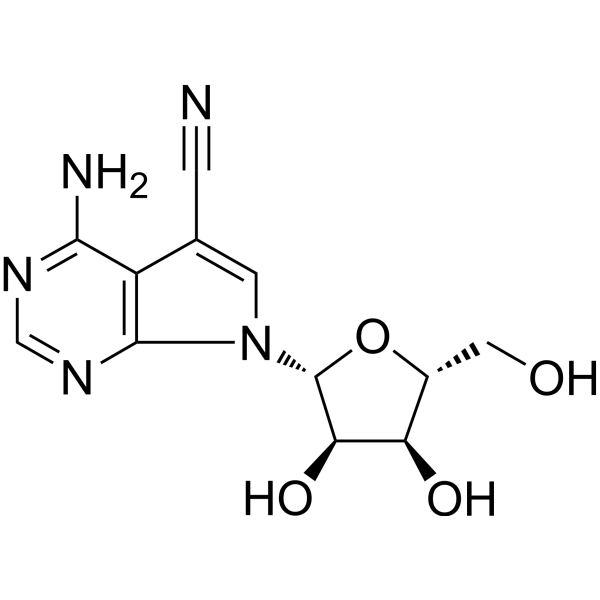

Publications Citing Use of MedChemExpress (MCE) Sangivamycin
More

Biologische Aktivität
Beschreibung
Cellular Effect
|
Cell Line

|
Type | Value | Description | References |
|---|---|---|---|---|
| BSC-1 | IC50 |
>100 μM
Compound: b
|
Tested in vitro for cytotoxicity against the monkey kidney cells (BSC-1 cells).
Tested in vitro for cytotoxicity against the monkey kidney cells (BSC-1 cells).
|
[PMID: 2175356] |
| HFF | IC50 |
<0.01 μM
Compound: II
|
Cytotoxicity against HFF cells, estimated by visual scoring of cells not affected by virus infection in the plaque reduction assay
Cytotoxicity against HFF cells, estimated by visual scoring of cells not affected by virus infection in the plaque reduction assay
|
[PMID: 8632411] |
| HFF | IC50 |
0.08 μM
Compound: 8c
|
Cytotoxicity was evaluated against the Human diploid cells (HFF)
Cytotoxicity was evaluated against the Human diploid cells (HFF)
|
[PMID: 2913300] |
| HFF | IC50 |
8 μM
Compound: b
|
Tested in vitro for cytotoxicity against the normal human diploid cells (HFF cells).
Tested in vitro for cytotoxicity against the normal human diploid cells (HFF cells).
|
[PMID: 2175356] |
| KB | IC50 |
0.08 μM
Compound: II
|
Cytotoxic activity tested against exponentially growing KB cells, determined by staining method
Cytotoxic activity tested against exponentially growing KB cells, determined by staining method
|
[PMID: 8632411] |
| KB | IC50 |
0.2 μM
Compound: 8c
|
Cytotoxicity was evaluated in Human neoplastic cell line (KB)
Cytotoxicity was evaluated in Human neoplastic cell line (KB)
|
[PMID: 2913300] |
| KB | IC50 |
30 μM
Compound: b
|
Tested in vitro for cytotoxicity against the human neoplastic cell line (KB cells).
Tested in vitro for cytotoxicity against the human neoplastic cell line (KB cells).
|
[PMID: 2175356] |
| L1210 | IC50 |
3 x 10⁻⁹M
Compound: 8c
|
In vitro cytotoxicity was evaluated against the L1210 Murine leukemic cells
In vitro cytotoxicity was evaluated against the L1210 Murine leukemic cells
|
[PMID: 2913300] |
In Vitro
Sangivamycin has differential antitumor effects in drug-sensitive MCF7/wild type (WT) cells, causing growth arrest, and in multidrug-resistant MCF7/adriamycin-resistant (ADR) human breast carcinoma cells, causing massive apoptotic cell death[2].
Sangivamycin (0.3 μM; 0-72 hours), shows almost maximal cytocidal (for MCF7/ADR) or cytostatic (for MCF7/WT) effects[2].
Sangivamycin activates caspases in MCF7/ADR cells. Upon exposure of MCF7/ADR cells to Sangivamycin (0.3 μM;), a vast amount of cleavage of lamin A to a 28-kDa fragment is detected within 48 hours[2].
MedChemExpress (MCE) has not independently confirmed the accuracy of these methods. They are for reference only. Further protocols information, click here.


Chemical Information
-
CAS. Nr. 18417-89-5
-
Appearance Solid
-
Molecular Weight 309.28
-
Formel C12H15N5O5
-
Color White to off-white
-
SMILES
OC[C@@H]1[C@@H](O)[C@@H](O)[C@H](N2C3=NC=NC(N)=C3C(C(N)=O)=C2)O1
-
Synonyms
NSC 65346; BA-90912
-
Structure Classification
-
Initial Source
Streptomyces rimosus
-
Versand
Room temperature in continental US; may vary elsewhere.
-
Speicherung
Powder -20°C 3 years 4°C 2 years In solvent -80°C 6 months -20°C 1 month


Publications (3)
-
Journal Impact Factor
-
Most Recent
-
Cell Death Dis
Identification of ATF3 as a novel protective signature of quiescent colorectal tumor cells. [Abstract]2023 Oct 13;14(10):676. PMID: 37833290 -
Biochim Biophys Acta Mol Basis Dis
Single-cell RNA sequencing and machine learning provide candidate drugs against drug-tolerant persister cells in colorectal cancer. [Abstract]2025 Mar;1871(3):167693. PMID: 39870146 -


Lösungsmittel & Löslichkeit
In Vitro:
DMSO : 100 mg/mL (323.33 mM; Need ultrasonic; Hygroscopic DMSO has a significant impact on the solubility of product, please use newly opened DMSO)
Please refer to the solubility information to select the appropriate solvent. Once prepared, please aliquot and store the solution to prevent product inactivation from repeated freeze-thaw cycles.
Storage method and period of stock solution: -80°C, 6 months; -20°C, 1 month. When stored at -80°C, please use it within 6 months. When stored at -20°C, please use it within 1 month.
Please refer to the solubility information to select the appropriate solvent. Once prepared, please aliquot and store the solution to prevent product inactivation from repeated freeze-thaw cycles.
Storage method and period of stock solution: -80°C, 6 months; -20°C, 1 month. When stored at -80°C, please use it within 6 months. When stored at -20°C, please use it within 1 month.
Konzentration (Stammlösung) × Volumen (Stammlösung) = Konzentration (Ziellösung) × Volumen (Ziellösung)
In Vivo:
Select the appropriate dissolution method based on your experimental animal and administration route.
- For the following dissolution methods, please ensure to first prepare a clear stock solution using an In Vitro approach and then sequentially add co-solvents:
- To ensure reliable experimental results, the clarified stock solution can be appropriately stored based on storage conditions. As for the working solution for In Vivo experiments, it is recommended to prepare freshly and use it on the same day.
- The percentages shown for the solvents indicate their volumetric ratio in the final prepared solution. If precipitation or phase separation occurs during preparation, heat and/or sonication can be used to aid dissolution.
Add each solvent one by one: 10% DMSO 40% PEG300 5% Tween-80 45% Saline
Solubility: ≥ 2.5 mg/mL (8.08 mM); Clear solution
This protocol yields a clear solution of ≥ 2.5 mg/mL (saturation unknown).
Taking 1 mL working solution as an example, add 100 μL DMSO stock solution (25.0 mg/mL) to 400 μL PEG300, and mix evenly; then add 50 μL Tween-80 and mix evenly; then add 450 μL Saline to adjust the volume to 1 mL.
Preparation of Saline: Dissolve 0.9 g sodium chloride in ddH₂O and dilute to 100 mL to obtain a clear Saline solution.
Add each solvent one by one: 10% DMSO 90% (20% SBE-β-CD in Saline)
Solubility: ≥ 2.5 mg/mL (8.08 mM); Clear solution
This protocol yields a clear solution of ≥ 2.5 mg/mL (saturation unknown).
Taking 1 mL working solution as an example, add 100 μL DMSO stock solution (25.0 mg/mL) to 900 μL 20% SBE-β-CD in Saline, and mix evenly.
Preparation of 20% SBE-β-CD in Saline (4°C, storage for one week): 2 g SBE-β-CD powder is dissolved in 10 mL Saline, completely dissolve until clear.
In Vivo Dissolution Calculator
Please enter the basic information of animal experiments:
-
-
-
-
Recommended: Prepare an additional quantity of animals to account for potential losses during experiments.
Please enter your animal formula composition:
-
%DMSO +
Recommended: Keep the proportion of DMSO in working solution below 2% if your animal is weak.
-
%+
-
+%Tween-80 + +
-
%Saline +
The co-solvents required include: DMSO, . All of co-solvents are available by MedChemExpress (MCE). , Tween 80. All of co-solvents are available by MedChemExpress (MCE).
Working solution concentration: 0.22 mg/mL
Method for preparing stock solution: mg drug dissolved in μL DMSO. Stock solution concentration: mg/mL.
1. Take μL DMSO stock solution;
2. Add μL .
μL , mix evenly;
3. Then add μL Tween 80, mix evenly;
4. Then add μL
Please ensure that the stock solution in the first step is dissolved to a clear state, and add co-solvents in sequence. You can use ultrasonic heating (ultrasonic cleaner, recommended frequency 20-40 kHz), vortexing, etc. to assist dissolution.

Protokoll
-
Cell Viability Determination by MTT Colorimetric Assay
The following protocol uses the MTT colorimetric assay as a classic literature-established method for assessing cell viability/metabolic activity in cultured mammalian cells. MTT[3-(4,5-dimethylthiazol-2-yl)-2,5-diphenyltetrazolium bromide] is reduced by metabolically active cells to a colored formazan product; the amount of formazan is quantified spectrophotometrically and provides an indirect measure of metabolically active viable cells. Importantly, MTT reduction reflects cellular oxidoreductase/metabolic activity rather than an absolute direct count of living cells, so changes in cellular metabolism can alter the signal independently of cell number.


Reinheit & Dokumentation
-
Data Sheet (283 KB)
-
SDS (479 KB)
- English - EN (479 KB)
- Français - FR (479 KB)
- Deutsch - DE (479 KB)
- Norwegian - NO (479 KB)
- Español - ES (479 KB)
- Swedish - SV (479 KB)
- Italian - IT (479 KB)
- Korean - KR (479 KB)
- Portuguese - PT (479 KB)
-
Handling Instructions (2659 KB)
Verweise
[1]. Loomis CR, Bell RM. Sangivamycin, a nucleoside analogue, is a potent inhibitor of protein kinase C. J Biol Chem. 1988;263(4):1682-1692. [Content Brief]
[2]. Lee SA, et al. The nucleoside analog sangivamycin induces apoptotic cell death in breast carcinoma MCF7/adriamycin-resistant cells via protein kinase Cdelta and JNK activation. J Biol Chem. 2007;282(20):15271-15283. [Content Brief]


Complete Stock Solution Preparation Table
Please refer to the solubility information to select the appropriate solvent. Once prepared, please aliquot and store the solution to prevent product inactivation from repeated freeze-thaw cycles.
Storage method and period of stock solution: -80°C, 6 months; -20°C, 1 month. When stored at -80°C, please use it within 6 months. When stored at -20°C, please use it within 1 month.
| Optional Solvent | Concentration Solvent Mass | 1 mg | 5 mg | 10 mg | 25 mg |
|---|---|---|---|---|---|
| DMSO | 1 mM | 3.2333 mL | 16.1666 mL | 32.3332 mL | 80.8329 mL |
| 5 mM | 0.6467 mL | 3.2333 mL | 6.4666 mL | 16.1666 mL | |
| 10 mM | 0.3233 mL | 1.6167 mL | 3.2333 mL | 8.0833 mL | |
| 15 mM | 0.2156 mL | 1.0778 mL | 2.1555 mL | 5.3889 mL | |
| 20 mM | 0.1617 mL | 0.8083 mL | 1.6167 mL | 4.0416 mL | |
| 25 mM | 0.1293 mL | 0.6467 mL | 1.2933 mL | 3.2333 mL | |
| 30 mM | 0.1078 mL | 0.5389 mL | 1.0778 mL | 2.6944 mL | |
| 40 mM | 0.0808 mL | 0.4042 mL | 0.8083 mL | 2.0208 mL | |
| 50 mM | 0.0647 mL | 0.3233 mL | 0.6467 mL | 1.6167 mL | |
| 60 mM | 0.0539 mL | 0.2694 mL | 0.5389 mL | 1.3472 mL | |
| 80 mM | 0.0404 mL | 0.2021 mL | 0.4042 mL | 1.0104 mL | |
| 100 mM | 0.0323 mL | 0.1617 mL | 0.3233 mL | 0.8083 mL |


Sangivamycin Related Classifications
HY-118384 Related Classifications
 Powered by Bioz