186 Results for "

detergency

" in MedChemExpress (MCE) Product Catalog:
Products (186)

186 Results for "detergency" in MCE Product Catalog:

Cat. No.: HY-W127785S
CAS No.: 161562-43-2
Synonyms: N,N-Dimethyldodecylamine N-oxide-d31; Dodecyldimethylamine oxide-d31
N-Ethyl-N-oxido-dodecan-1-amine-d31 (N,N-Dimethyldodecylamine N-oxide-d31) is the deuterium labeled N-Ethyl-N-oxido-dodecan-1-amine. N-ethyl-N-oxido-dodecan-1-amine is an amine oxide surfactant commonly used as a detergent, emulsifier and wetting agent in various industrial processes, especially in personal care products and household cleaning in the production of agents. N,N-Dimethyldodecylamine N-oxide has unique chemical properties that make it an effective ingredient in many product formulations to help reduce surface tension and enhance cleaning power.
loading...
    loading...
Cat. No.: HY-128974S
CAS No.: 849110-74-3
Synonyms: Lauryl Maltoside-d25
N-Dodecyl-β-D-maltoside-d25 (Lauryl Maltoside-d25) is deuterium labeled N-Dodecyl-β-D-maltoside (HY-128974). N-Dodecyl-β-D-maltoside is a non-ionic detergent. N-Dodecyl-β-D-maltoside has strong adsorption on alumina, titanium dioxide and hematite. N-Dodecyl-β-D-maltoside can promote the reactivation of various proteins. N-Dodecyl-β-D-maltoside can effectively stabilize photoactive reaction center complexes (RCs) and inhibit the degradation of Rhodopseudomonas spheroides R-26 reaction center in solution. N-Dodecyl-β-D-maltoside can be used for purification and stabilization of RNA polymerase and for detection of protein-lipid interactions .
loading...
    loading...
Cat. No.: HY-W013035R
CAS No.: 556-82-1
Synonyms: MBO321 (Standard)
3-Methyl-2-buten-1-ol (Standard) is the analytical standard of 3-Methyl-2-buten-1-ol. This product is intended for research and analytical applications. 3-Methyl-2-buten-1-ol (MBO321) is an orally active endogenous metabolite found in pine trees and is used as a fragrance ingredient in cosmetics and detergents. 3-Methyl-2-buten-1-ol passes cell barrier. 3-Methyl-2-buten-1-ol reduces body weight in rats[1][2][3].
loading...
    loading...
Cat. No.: HY-W739770
CAS No.: 53439-16-0
3-Methyl-2-buten-1-ol-d6 is the deuterium labeled 3-Methyl-2-buten-1-ol (HY-W013035). 3-Methyl-2-buten-1-ol (MBO321) is an orally active endogenous metabolite found in pine trees and is used as a fragrance ingredient in cosmetics and detergents. 3-Methyl-2-buten-1-ol passes cell barrier. 3-Methyl-2-buten-1-ol reduces body weight in rats .
loading...
    loading...
Cat. No.: HY-W250172
CAS No.: 92046-34-9
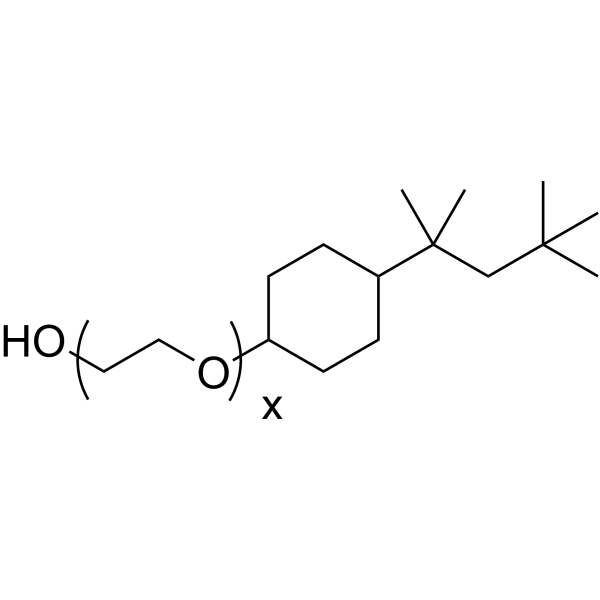
Polyethylene glycol tert-octylphenyl ether X-405 (70% in H2O) is a nonionic surfactant commonly used in a variety of industrial and research applications. Polyethylene glycol tert-octylphenyl ether X-405 (70% in H2O) belongs to the family of polyethylene glycol (PEG) ethers with a hydrophilic head and lipophilic tail and is suitable for use in emulsions, detergents and solubilizers. Polyethylene glycol tert-octylphenyl ether X-405 (70% in H2O) is particularly useful in the study of membrane proteins, where it is used to solubilize and stabilize proteins for structural analysis techniques. It is also used in a variety of other applications, including drug delivery systems, nanotechnology, and diagnostic analysis. Additionally, Polyethylene glycol tert-octylphenyl ether X-405 (70% in H2O) is used in the production of microemulsions, salves and lotions due to its emulsifying and solubilizing properties. However, it can be toxic if ingested or inhaled, so proper handling and safety precautions are required.
loading...
    loading...
Cat. No.: HY-117401
CAS No.: 107827-77-0
Purity:  99.32%
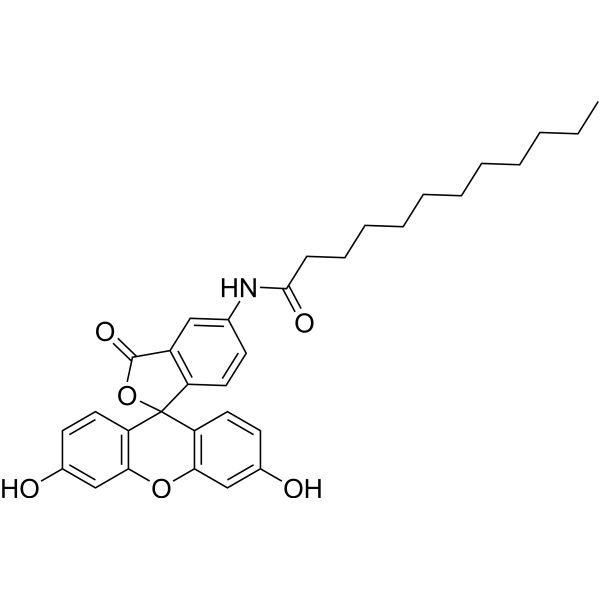
5-Dodecanoylaminofluorescein is an amphipathic (amphoteric) fluorescent probe (Ex/Em = 485 nm/515-535 nm), which consists of a hydrophilic fluorescein core and a hydrophobic dodecanoyl group (C12 fatty acid chain) linked by an amide bond. 5-Dodecanoylaminofluorescein is mainly used as an interface-localized radical trapping/indicator probe. Dodecanoylaminofluorescein can be used for the determination of the antioxidant properties of emulsions, or can serve as a lipophilic drug model for the study of passive skin penetration when encapsulated in tyrosine-derived nanospheres .
loading...
    loading...

