233 Results for "

aqueous solution

" in MedChemExpress (MCE) Product Catalog:
Products (233)

233 Results for "aqueous solution" in MCE Product Catalog:

Cat. No.: HY-W110540D
CAS No.: 25852-47-5
Poly(ethylene glycol) dimethacrylate (MW 2000) is a photopolymerizable poly(ethylene glycol)-based macromer and biocompatible crosslinking agent with a molecular weight of approximately 2000. Poly(ethylene glycol) dimethacrylate (MW 2000) can form photopolymerized hydrogels. Poly(ethylene glycol) dimethacrylate (MW 2000) can be used for research on tissue engineering and drug delivery .
loading...
    loading...
Cat. No.: HY-W110540H
CAS No.: 25852-47-5
Poly(ethylene glycol) dimethacrylate (MW 3400) is a photopolymerizable poly(ethylene glycol)-based macromer and biocompatible crosslinking agent with a molecular weight of approximately 3400. Poly(ethylene glycol) dimethacrylate (MW 3400) can form photopolymerized hydrogels. Poly(ethylene glycol) dimethacrylate (MW 3400) can be used for research on tissue engineering and drug delivery .
loading...
    loading...
Cat. No.: HY-W110540I
CAS No.: 25852-47-5
Poly(ethylene glycol) dimethacrylate (MW 4000) is a photopolymerizable poly(ethylene glycol)-based macromer and biocompatible crosslinking agent with a molecular weight of approximately 4000. Poly(ethylene glycol) dimethacrylate (MW 4000) can form photopolymerized hydrogels. Poly(ethylene glycol) dimethacrylate (MW 4000) can be used for research on tissue engineering and drug delivery .
loading...
    loading...
Cat. No.: HY-W110540J
CAS No.: 25852-47-5
Poly(ethylene glycol) dimethacrylate (MW 6000) is a photopolymerizable poly(ethylene glycol)-based macromer and biocompatible crosslinking agent with a molecular weight of approximately 6000. Poly(ethylene glycol) dimethacrylate (MW 6000) can form photopolymerized hydrogels. Poly(ethylene glycol) dimethacrylate (MW 6000) can be used for research on tissue engineering and drug delivery .
loading...
    loading...
Cat. No.: HY-W110540K
CAS No.: 25852-47-5
Poly(ethylene glycol) dimethacrylate (MW 10000) is a photopolymerizable poly(ethylene glycol)-based macromer and biocompatible crosslinking agent with a molecular weight of approximately 10000. Poly(ethylene glycol) dimethacrylate (MW 10000) can form photopolymerized hydrogels. Poly(ethylene glycol) dimethacrylate (MW 10000) can be used for research on tissue engineering and drug delivery .
loading...
    loading...
Cat. No.: HY-W110540L
CAS No.: 25852-47-5
Poly(ethylene glycol) dimethacrylate (MW 20000) is a photopolymerizable poly(ethylene glycol)-based macromer and biocompatible crosslinking agent with a molecular weight of approximately 20000. Poly(ethylene glycol) dimethacrylate (MW 20000) can form photopolymerized hydrogels. Poly(ethylene glycol) dimethacrylate (MW 20000) can be used for research on tissue engineering and drug delivery .
loading...
    loading...
Cat. No.: HY-137172
CAS No.: 61595-77-5
Target:  

Sodium Channel

Research Areas:  

Others

ETH 157 is a neutral sodium-selective carrier. ETH 157 exhibits sufficient Na +/K + selectivity and enhanced Na +/Ca 2+ selectivity, making it suitable for the detection of extracellular Na + activity .
loading...
    loading...
Cat. No.: HY-D3075
CAS No.: 2490504-23-7
Target:  

Fluorescent Dye

Research Areas:  

Others

TPE-2E N-oxide is a fluorescent probe used for hypoxia detection and tumor hypoxia imaging. Due to its active intramolecular motion, TPE-2E N-oxide shows no fluorescence in aqueous solution. In hypoxic environments, its N-oxide group undergoes two-electron reduction by CYP450 reductase and other heme protein reductases expressed under hypoxia, forming hydrophobic aggregates that trigger aggregation-induced emission through the restriction of intramolecular motion. TPE-2E N-oxide exhibits selective lipid droplet localization in cells. The absorption wavelength of TPE-2E N-oxide in dichloromethane is 313 nm; in a 99% hexane/dichloromethane mixed system, its excitation wavelength is 330 nm and emission wavelength is 460 nm. For in vitro cell imaging, excitation is performed at 405 nm, with an emission wavelength range of 430-560 nm .
loading...
    loading...
Cat. No.: HY-172754
ICAAc is a solvatochromic fluorophore with reduced basicity. ICAAc demonstrates significant solvatochromic behavior across solvents of varying polarity, with a large dipole moment difference and low quantum yield in water, making it a tunable solvatochromic fluorophore. ICAAc enables pH sensing via UV-vis/fluorescence detection and in microenvironments including sodium lauryl sulfate micelle Stern layers. ICAAc acts as a supravital cell stain for epifluorescence imaging of live cancer cells .
loading...
    loading...
Cat. No.: HY-184600
Reactive oxygen species responsive hydrogels are a novel class of smart hydrogels, formed by the cross-linking of ROS-responsive modules through covalent, coordination, or supramolecular interactions. Due to the introduction of these ROS-responsive modules, these hydrogels exhibit a sensitive response to the oxidative stress microenvironment present in organisms. PVA-TSPBA hydrogel is a hydrogel formed by the cross-linking polymerization of polyvinyl alcohol (PVA) and the reactive oxygen species-sensitive cross-linking agent N1-(4-benzyl borate)-N3-(4-phenyl borate)N1,N1,N3,N3-tetramethyl-1,3-propanediamine (TSPBA). This hydrogel consists of two parts: a boric acid precursor (TSPBA) and an aqueous solution of PVA. The boric acid bonds on TSPBA and the hydroxyl groups on PVA rapidly cross-link to form borate ester bonds, thus forming the hydrogel.
loading...
    loading...
Cat. No.: HY-D1850
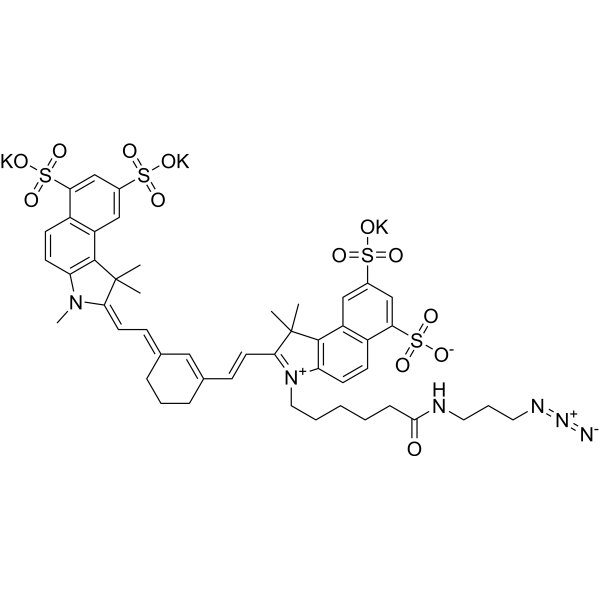
Sulfo-Cy7.5 azide is a Cyanine 7.5 (Cy7.5) (HY-D0926) dye derivative with azide and sulfonate functional groups. The sulfonate ion increases the water solubility of the compound, making it suitable for use in aqueous solutions. Cy7.5 is a near-infrared fluorescent dye commonly used for biolabeling and cell imaging. The azide group of Sulfo-Cy7.5 azide can react chemically with molecules containing alkyne functionality, such as alkyne or cyclooctyne, to form covalent bonds. Therefore, Sulfo-Cy7.5 azide can bind to biomolecules such as proteins and antibodies to track their location and dynamic changes in biological samples. It contains an azide group and can undergo copper-catalyzed azide-alkyne cycloaddition (CuAAc) with molecules containing alkyne groups. It can also undergo ring strain-promoted alkyne-azide cycloaddition (SPAAC) with molecules containing DBCO or BCN groups.
loading...
    loading...
Cat. No.: HY-L214
227 compounds

Liposomes are spherical or multilayered spherical vesicles formed by the self-assembly of diacyl chain phospholipids (lipid bilayers) in aqueous solutions, which can be made from natural or synthetic phospholipids and exhibit good biocompatibility and low toxicity. They can serve as delivery carriers for various bioactive substances (such as drugs, proteins, nucleic acids, etc.) and are widely used in biomedical and chemical research. The main advantages of liposomes include 1) Protective effect: Their bilayer structure can protect encapsulated molecules from enzymatic degradation, oxidation, and other influences, extending stability and activity; 2) Active targeting: Surface modifications enable active targeting, enhancing the concentration of drugs or molecules in specific tissues or cells; 3) Customizability: The composition and structure of liposomes can be adjusted according to needs, such as altering phospholipid types or adding targeting ligands. These properties make liposomes highly valuable in developing novel drug delivery systems, serving as nucleic acid carriers for gene transfection, studying cellular uptake mechanisms and drug release kinetics, as well as developing functional food additives to improve the bioavailability of nutritional components.

MCE contains 227 liposome compounds, which is a good tool for drug delivery-related studies.

Cat. No.: HY-D0485
CAS No.: 12224-02-1
Target:  

Fluorescent Dye

Research Areas:  

Others

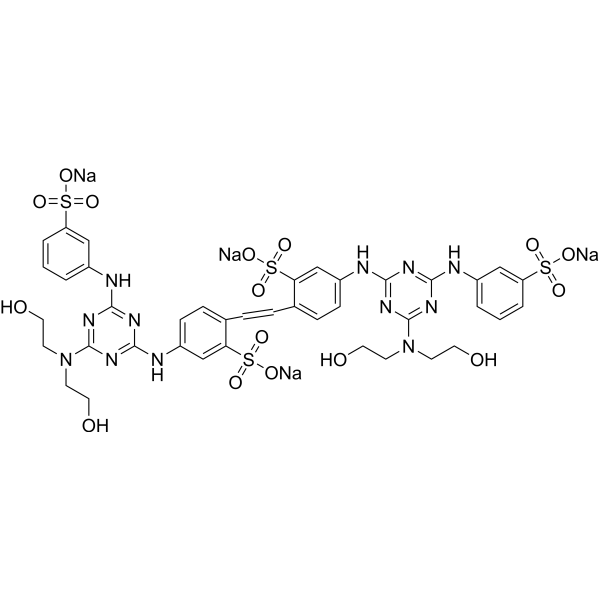
Fluorescent brightener 24 is a stilbene-type fluorescent brightener and fading regulator .
loading...
    loading...

