2858 Results for "

impurity.

" in MedChemExpress (MCE) Product Catalog:
Products (2858)

2858 Results for "impurity." in MCE Product Catalog:

製品番号: HY-129836
CAS 番号: 26889-93-0
Target:  

Antibiotic

研究分野:  

Infection

L-Amoxicillin is an antibiotic with activity against a wide range of bacterial infections. L-Amoxicillin is commonly used in antibacterial combinations when used in combination with the β-lactamase inhibitor potassium clavulanic acid. The related substances analysis method for L-Amoxicillin has been developed and validated according to the International Conference on Harmonization (ICH) guidelines, ensuring its effectiveness and accuracy in mixtures. L-Amoxicillin and some of its impurities have been further analyzed in stress testing and stability studies, providing support for optimizing its application .
loading...
    loading...
製品番号: HY-16676
CAS 番号: 153381-68-1
別名: 4-epi-Docetaxel; 7-Epidocetaxel; 7-Epitaxotere
研究分野:  

Cancer

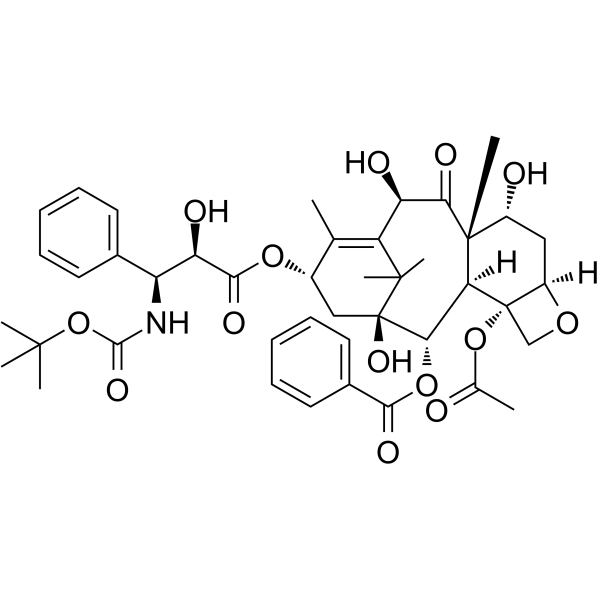
7-Epi-docetaxel (4-epi-Docetaxel; 7-Epidocetaxel; 7-Epitaxotere) is the major C7 epimeric impurity/in vivo metabolite of Docetaxel (HY-B0011). 7-Epi-docetaxel acts as a potent allosteric activator of rhCYP1B1. 7-Epi-docetaxel exhibits certain cell line-specific anti-migratory activity . 7-Epi-docetaxel can be used in research related to melanoma and lung adenocarcinoma .
loading...
    loading...
製品番号: HY-W269511
CAS 番号: 405-85-6
Target:  

Drug Derivative

研究分野:  

Neurological Disease

NW-1689 is a process-related impurity of safinamide mesilate (SAFM). SAFM can be used for the study of Parkinson's disease (PD). It is a highly selective and reversible inhibitor of monoamine oxidase-B (MAO-B) and also blocks sodium channels and N-type calcium channels. These effects of SAFM help reduce the breakdown of dopamine and inhibit the release of glutamate. NW-1689 has a similar chemical structure to SAFM and has some similar pharmacological effects as SAFM, and can be used in Parkinson's disease research .
loading...
    loading...
製品番号: HY-K3120

MCE Serum/Plasma Exosome Isolation and Purification Kit (Magnetic Beads) utilizes a magnetic bead-based method for the isolation and purification of exosomes. The underlying principle is based on the charge-dependent interaction between exosomes and functional polymers on the surface of the magnetic beads under an optimized buffer system, enabling selective adsorption of exosomes. Subsequent adjustment of the ionic strength and pH of the buffer promotes the gentle dissociation of exosomes from the magnetic beads, thereby enabling efficient exosome isolation and purification while maintaining high vesicle integrity and low impurity carryover.

loading...
    loading...
製品番号: HY-129836R
CAS 番号: 26889-93-0
研究分野:  

Infection

L-Amoxicillin (Standard) is the analytical standard of L-Amoxicillin. This product is intended for research and analytical applications. L-Amoxicillin is an antibiotic with activity against a wide range of bacterial infections. L-Amoxicillin is commonly used in antibacterial combinations when used in combination with the β-lactamase inhibitor potassium clavulanic acid. The related substances analysis method for L-Amoxicillin has been developed and validated according to the International Conference on Harmonization (ICH) guidelines, ensuring its effectiveness and accuracy in mixtures. L-Amoxicillin and some of its impurities have been further analyzed in stress testing and stability studies, providing support for optimizing its application .
loading...
    loading...
製品番号: HY-W711197
2,2'-Methylene Bis[Ranitidine]-d12 is the deuterium labeled (1Z,4Z)-N1,N5-Bis(2-(((5-((dimethylamino)methyl)furan-2-yl)methyl)thio)ethyl)-N1,N5-dimethyl-2,4-dinitropenta-1,4-diene-1,1,5,5-tetraamine (Ranitidine Impurity) (HY-Z8387).
loading...
    loading...
製品番号: HY-W743258
L-Amoxicillin-d4 sodium is the deuterium labeled L-Amoxicillin (HY-129836). L-Amoxicillin is an antibiotic with activity against a wide range of bacterial infections. L-Amoxicillin is commonly used in antibacterial combinations when used in combination with the β-lactamase inhibitor potassium clavulanic acid. The related substances analysis method for L-Amoxicillin has been developed and validated according to the International Conference on Harmonization (ICH) guidelines, ensuring its effectiveness and accuracy in mixtures. L-Amoxicillin and some of its impurities have been further analyzed in stress testing and stability studies, providing support for optimizing its application .
loading...
    loading...
loading...
    loading...
loading...
    loading...
loading...
    loading...
製品番号: HY-Z3061R
CAS 番号: 216453-74-6
Target:  

Reference Standards

(6aR,6bS,8aS,8bS,11aR,12aS,12bS)-8b-(2-Hydroxyacetyl)-6a,8a-dimethyl-10-propyl-6b,8,8a,8b,11a,12,12a,12b-octahydro-1H-naphtho[2',1':4,5]indeno[1,2-d][1,3]dioxole-4,7(2H,6aH)-dione (Budesonide Impurity) (Standard) is the analytical standard of (6aR,6bS,8aS,8bS,11aR,12aS,12bS)-8b-(2-Hydroxyacetyl)-6a,8a-dimethyl-10-propyl-6b,8,8a,8b,11a,12,12a,12b-octahydro-1H-naphtho[2',1':4,5]indeno[1,2-d][1,3]dioxole-4,7(2H,6aH)-dione (Budesonide Impurity). This product is intended for research and analytical applications.
loading...
    loading...
製品番号: HY-Z3488R
CAS 番号: 131918-64-4
Target:  

Reference Standards

(6aR,6bS,7S,8aS,8bS,11aR,12bR)-7-hydroxy-8b-(2-hydroxyacetyl)-6a,8a-dimethyl-10-propyl-6a,6b,7,8,8a,8b,11a,12b-octahydro-1H-naphtho[2',1':4,5]indeno[1,2-d][1,3]dioxol-4(2H)-one (Budesonide Impurity) (Standard) is the analytical standard of (6aR,6bS,7S,8aS,8bS,11aR,12bR)-7-hydroxy-8b-(2-hydroxyacetyl)-6a,8a-dimethyl-10-propyl-6a,6b,7,8,8a,8b,11a,12b-octahydro-1H-naphtho[2',1':4,5]indeno[1,2-d][1,3]dioxol-4(2H)-one (Budesonide Impurity). This product is intended for research and analytical applications.
loading...
    loading...
製品番号: HY-116889
CAS 番号: 369585-22-8
Target:  

Drug Metabolite

研究分野:  

Others

15-keto Latanoprost is a potential metabolite of latanoprost (HY-B0577) when administered to animals. 15-keto Latanoprost is also one of the common minor impurities found in commercial preparations of the bulk drug compound. Although much less potent that the parent compound latanoprost, 15-keto latanoprost still retains the ability to produce a small but measurable decrease (1 mm Hg) in the intraocular pressure of normal cynomolgus monkeys when administered at a dose of 1 μg/eye.1 15-keto Latanoprost is also a miotic in the normal cat eye, causing an 8 mm Hg reduction in pupillary diameter at 5 μg/eye. Again, this is not as potent as many other F-type prostaglandins; for example, prostaglandin F2α will produce this degree of miosis at a dose of less than 1 μg/eye.
loading...
    loading...
製品番号: HY-W741425
21-O-Acetyl dexamethasone 9,11-epoxide-d5 is the deuterium labeled 2-((4aS,4bS,5aS,6aS,7R,8R,9aS,9bS)-7-Hydroxy-4a,6a,8-trimethyl-2-oxo-2,4a,5a,6,6a,7,8,9,9a,9b,10,11-dodecahydrocyclopenta[1,2]phenanthro[4,4a-b]oxiren-7-yl)-2-oxoethyl acetate (Dexamethasone Acetate Impurity) (HY-Z8003).
loading...
    loading...
製品番号: HY-G0007S
CAS 番号: 2749628-17-7
別名: Omeprazole sulfone-d3; Omeprazole sulphone-d3
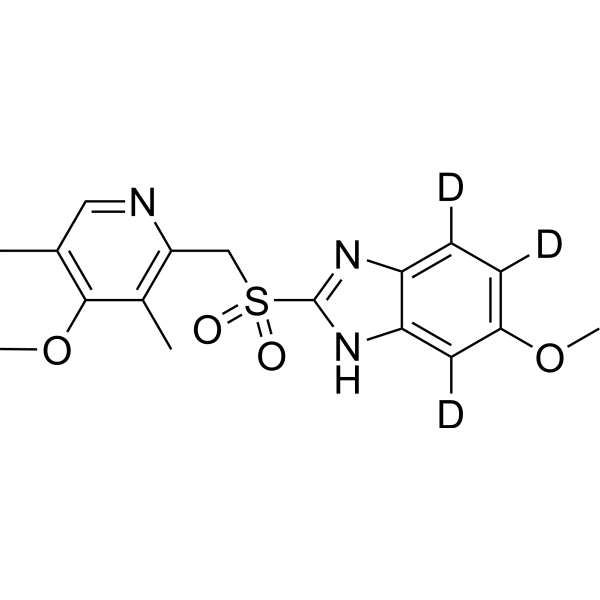
Omeprazole sulfone-d3 is the deuterium labeled Omeprazole sulfone. Omeprazole sulfone (Omeprazole sulphone) is one of the major circulating metabolites of Omeprazole (HY-B0113) in vivo, and belongs to class 4 non-mutagenic impurities. Omeprazole sulfone does not bind to the aryl hydrocarbon receptor (AhR), nor does it induce the expression of CYP1A1 or CYP1A2. However, Omeprazole sulfone promotes the migration of gastric epithelial cells under basal conditions and reverses the inhibitory effect of Indomethacin (HY-14397) on cell migration. Omeprazole sulfone does not promote cell proliferation, nor does it upregulate COX-2 expression or activate signaling pathways such as ERK, P38 MAPK and PI3K. Omeprazole sulfone maintains basal ulcer healing under non-acid-dependent conditions and can be used in studies related to gastric ulcer repair .
loading...
    loading...
製品番号: HY-G0007R
CAS 番号: 88546-55-8
別名: Omeprazole sulphone (Standard)
Omeprazole sulfone (Standard) is the analytical standard of Omeprazole sulfone. This product is intended for research and analytical applications. Omeprazole sulfone (Omeprazole sulphone) is one of the major circulating metabolites of Omeprazole (HY-B0113) in vivo, and belongs to class 4 non-mutagenic impurities. Omeprazole sulfone does not bind to the aryl hydrocarbon receptor (AhR), nor does it induce the expression of CYP1A1 or CYP1A2. However, Omeprazole sulfone promotes the migration of gastric epithelial cells under basal conditions and reverses the inhibitory effect of Indomethacin (HY-14397) on cell migration. Omeprazole sulfone does not promote cell proliferation, nor does it upregulate COX-2 expression or activate signaling pathways such as ERK, P38 MAPK and PI3K. Omeprazole sulfone maintains basal ulcer healing under non-acid-dependent conditions and can be used in studies related to gastric ulcer repair .
loading...
    loading...
製品番号: HY-G0007S1
CAS 番号: 1261393-28-5
別名: Omeprazole sulfone-13C,d3; Omeprazole sulphone-13C,d3
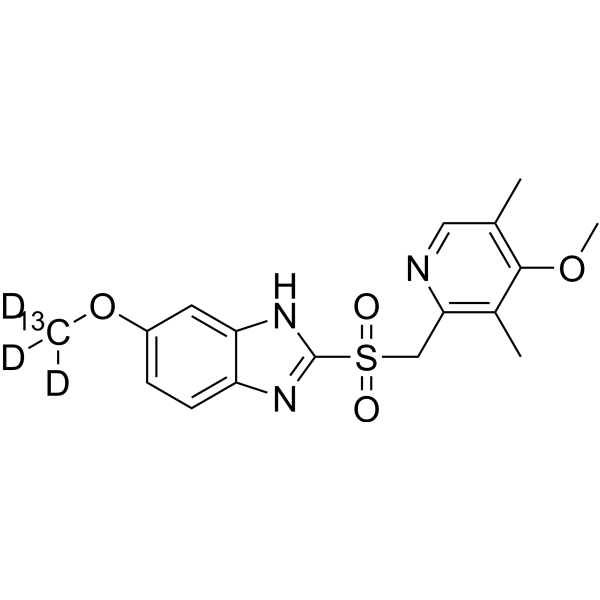
Omeprazole sulfone- 13C,d3 is the deuterium and 13C labeled Omeprazole sulfone. Omeprazole sulfone (Omeprazole sulphone) is one of the major circulating metabolites of Omeprazole (HY-B0113) in vivo, and belongs to class 4 non-mutagenic impurities. Omeprazole sulfone does not bind to the aryl hydrocarbon receptor (AhR), nor does it induce the expression of CYP1A1 or CYP1A2. However, Omeprazole sulfone promotes the migration of gastric epithelial cells under basal conditions and reverses the inhibitory effect of Indomethacin (HY-14397) on cell migration. Omeprazole sulfone does not promote cell proliferation, nor does it upregulate COX-2 expression or activate signaling pathways such as ERK, P38 MAPK and PI3K. Omeprazole sulfone maintains basal ulcer healing under non-acid-dependent conditions and can be used in studies related to gastric ulcer repair .
loading...
    loading...
製品番号: HY-116161
CAS 番号: 130273-87-9
Target:  

Drug Intermediate

研究分野:  

Cardiovascular Disease Others

15(R)-17-phenyl trinor Prostaglandin F2α isopropyl ester (15(R)-17-phenyl trinor PGF2α isopropyl ester) is the latanoprost-related isomer containing both a double bond at 13,14 and an inverted (β) hydroxyl group at C-15. Similar to 15(S)-latanoprost, 15(R)-17-phenyl trinor PGF2α isopropyl ester is a potential impurity in most commercial preparations of the latanoprost bulk drug product. The IC50 values for the free acid forms of 15(S)-17-phenyl trinor PGF2α and 15(R)-17-phenyl trinor PGF2α were determined to be 0.71 nM and 30 nM, respectively, in a FP receptor binding assay using the cat iris sphincter muscle.1 A 3 μg dose of 15(R)-17-phenyl trinor PGF2α caused a 1.9 mmHg reduction of IOP in normotensive cynomolgus monkeys.
loading...
    loading...