294 Results for "

tissue selectivity

" in MedChemExpress (MCE) Product Catalog:
Products (294)

294 Results for "tissue selectivity" in MCE Product Catalog:

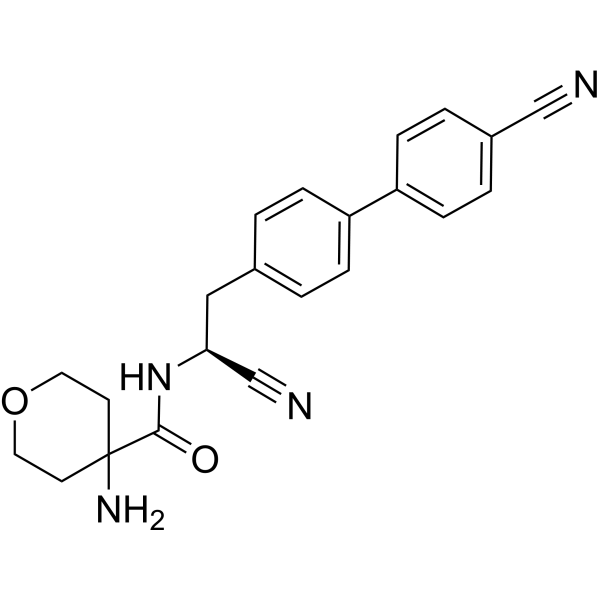
Cat. No.: HY-12733
CAS No.: 1254318-44-9
AZD5248 is an orally active, selective dipeptidyl peptidase 1 (cathepsin C) inhibitor, with IC50 values of 1 nM and 17 nM against human CatC, 44 nM against human DPP1, and 67 nM against rat DPP1. It exhibits low clearance and high bioavailability in animal models. AZD5248 forms an irreversible covalent bond with the catalytic Cys234 residue of CatC, exerts reversible inhibition via its nitrile moiety, blocks CatC-dependent amyloid formation, and reduces the activation levels of neutrophil serine proteases in bone marrow and blood. AZD5248 reacts with aortic elastin aldehydes to form stable 4-imidazolinones, induces ultrastructural changes in aortic tissue, and has an α-amino acid-based backbone. AZD5248 reduces the severity of acute pancreatitis in mouse models. AZD5248 can be used in research on chronic obstructive pulmonary disease, acute pancreatitis, neurodegenerative diseases, lysosomal storage disorders, acute lung injury, cystic fibrosis, and neutrophil-mediated inflammatory diseases .
loading...
    loading...
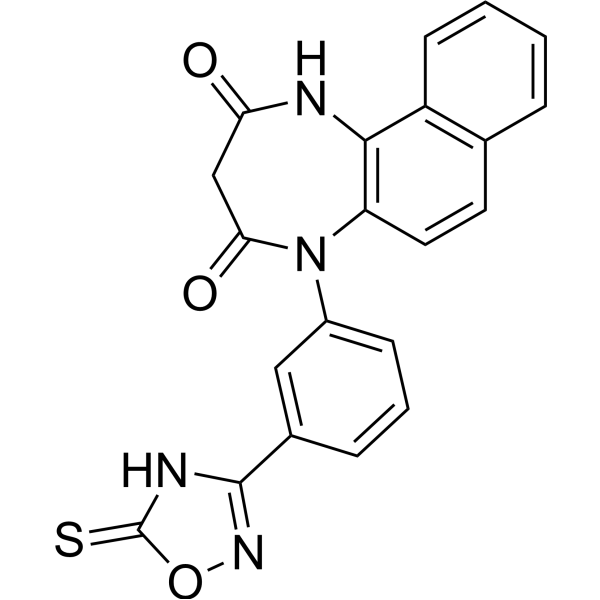
Cat. No.: HY-150270
CAS No.: 1239578-79-0
NP-1815-PX is an orally active dual inhibitor of P2X4 and prostaglandin TP receptors, with an IC50 of 0.26 μM against human P2X4 receptors. NP-1815-PX specifically inhibits ATP-mediated prostaglandin production, TP receptor-induced calcium elevation, and the canonical/non-canonical NLRP3 inflammasome signaling pathway. NP-1815-PX selectively blocks smooth muscle contractions induced by ATP, U46619 (HY-108566) and prostaglandin F2α. NP-1815-PX not only produces anti-allodynic effects in vivo, but also significantly alleviates symptoms of DNBS (HY-W324435)-induced colitis (such as weight loss and tissue damage). NP-1815-PX exerts anti-inflammatory effects by downregulating IL-1β levels and Caspase-1 activity. NP-1815-PX is used in studies related to asthma and inflammatory bowel disease (colitis) .
loading...
    loading...
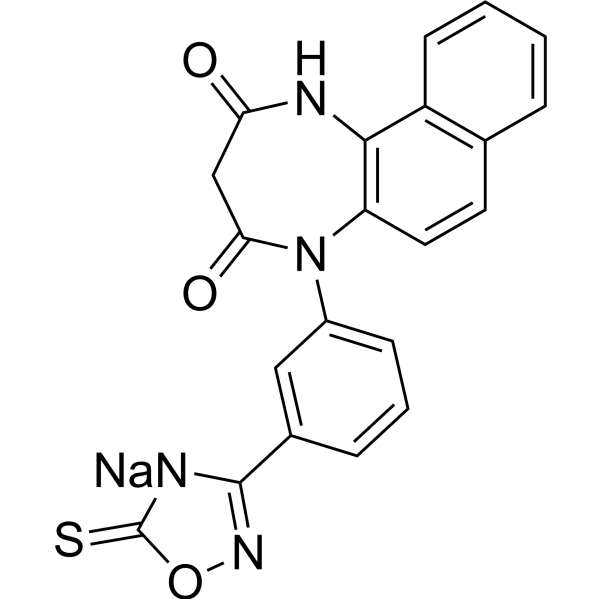
Cat. No.: HY-150270A
CAS No.: 1239578-80-3
Pureté:  99.62%
NP-1815-PX sodium is an orally active dual inhibitor of P2X4 and prostaglandin TP receptors, with an IC50 of 0.26 μM against human P2X4 receptors. NP-1815-PX sodium specifically inhibits ATP-mediated prostaglandin production, TP receptor-induced calcium elevation, and the canonical/non-canonical NLRP3 inflammasome signaling pathway. NP-1815-PX sodium selectively blocks smooth muscle contractions induced by ATP, U46619 (HY-108566) and prostaglandin F2α. NP-1815-PX sodium not only produces anti-allodynic effects in vivo, but also significantly alleviates symptoms of DNBS (HY-W324435)-induced colitis (such as weight loss and tissue damage). NP-1815-PX sodium exerts anti-inflammatory effects by downregulating IL-1β levels and Caspase-1 activity. NP-1815-PX sodium is used in studies related to asthma and inflammatory bowel disease (colitis) .
loading...
    loading...
Cat. No.: HY-B0377G
CAS No.: 76824-35-6
Synonyms: MK-208 (GMP)
Famotidine GMP (MK-208 GMP) is Famotidine (HY-B0377) produced in GMP guideline. Famotidine is an orally active and highly selective histamine H2 receptor antagonist. It inhibits gastric acid secretion by blocking the Gs signaling pathway, and regulates intracellular cAMP and ERK pathways. Famotidine inhibits TLR3-mediated inflammatory pathways, and reduces the expression of various inflammatory mediators and interferon-related genes. Famotidine scavenges DPPH and nitric oxide free radicals, alleviates oxidative stress damage in gastric tissue, inhibits proMMP-9, improves vascular endothelial permeability, and restores the normal physiological functions of neutrophils and eosinophils. Famotidine crosses intestinal epithelial cells via facilitated diffusion and passive diffusion, blocks paracellular cation transport, and increases intestinal transepithelial electrical resistance. Famotidine reduces serum levels of transaminases and alkaline phosphatase, exerts analgesic effects and gastric protective effects simultaneously. Famotidine can be used in studies related to COVID-19, liver injury and acute gastric ulcer .
loading...
    loading...
Cat. No.: HY-FLB0377
CAS No.: 76824-35-6
Synonyms: MK-208 solution
Famotidine solution is mainly composed of Famotidine (HY-B0377). Famotidine (MK-208) is an orally active and highly selective histamine H2 receptor antagonist. It inhibits gastric acid secretion by blocking the Gs signaling pathway, and regulates intracellular cAMP and ERK pathways. Famotidine inhibits TLR3-mediated inflammatory pathways, and reduces the expression of various inflammatory mediators and interferon-related genes. Famotidine scavenges DPPH and nitric oxide free radicals, alleviates oxidative stress damage in gastric tissue, inhibits proMMP-9, improves vascular endothelial permeability, and restores the normal physiological functions of neutrophils and eosinophils. Famotidine crosses intestinal epithelial cells via facilitated diffusion and passive diffusion, blocks paracellular cation transport, and increases intestinal transepithelial electrical resistance. Famotidine reduces serum levels of transaminases and alkaline phosphatase, exerts analgesic effects and gastric protective effects simultaneously. Famotidine can be used in studies related to COVID-19, liver injury and acute gastric ulcer .
loading...
    loading...
Cat. No.: HY-182361
CAS No.: 3097515-05-1
Target:  

AMPK JAK Cadherin

Domaines de recherche:  

Cancer

NUAK1-IN-3 is a potent and selective NUAK1 inhibitor with an IC50 of 0.49 nM. NUAK1-IN-3 also inhibits NUAK2 and JAK3 with IC50 values of 265 and 225 nM. NUAK1-IN-3 engages Glu139 of NUAK1, forms a salt bridge between its bicyclic ring nitrogen and Asp142, and uses a fluorine atom to enhance hydrophobic binding interactions. NUAK1-IN-3 attenuates MYPT1 phosphorylation, suppresses the NUAK1-MYPT1 signaling axis, and inhibits proliferation, migration, and invasion of triple-negative breast cancer cells. NUAK1-IN-3 reverses TGF-β1-induced epithelial-mesenchymal transition (EMT) marker alterations, downregulates Snail and N-cadherin, and upregulates E-cadherin in tumor tissues. NUAK1-IN-3 suppresses tumor growth in triple-negative breast cancer xenograft models. NUAK1-IN-3 can be used for the research of triple-negative breast cancer .
loading...
    loading...
Cat. No.: HY-B0377R
CAS No.: 76824-35-6
Synonyms: MK-208 (Standard)
Famotidine (Standard) (MK-208 (Standard)) is the analytical standard of Famotidine (HY-B0377). This product is intended for research and analytical applications. Famotidine (MK-208) is an orally active and highly selective histamine H2 receptor antagonist. It inhibits gastric acid secretion by blocking the Gs signaling pathway, and regulates intracellular cAMP and ERK pathways. Famotidine inhibits TLR3-mediated inflammatory pathways, and reduces the expression of various inflammatory mediators and interferon-related genes. Famotidine scavenges DPPH and nitric oxide free radicals, alleviates oxidative stress damage in gastric tissue, inhibits proMMP-9, improves vascular endothelial permeability, and restores the normal physiological functions of neutrophils and eosinophils. Famotidine crosses intestinal epithelial cells via facilitated diffusion and passive diffusion, blocks paracellular cation transport, and increases intestinal transepithelial electrical resistance. Famotidine reduces serum levels of transaminases and alkaline phosphatase, exerts analgesic effects and gastric protective effects simultaneously. Famotidine can be used in studies related to COVID-19, liver injury and acute gastric ulcer .
loading...
    loading...
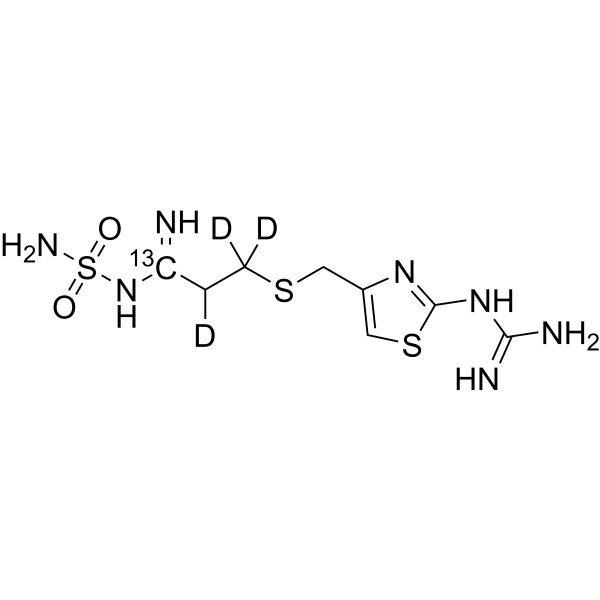
Cat. No.: HY-B0377S1
Synonyms: MK-208-13C
Famotidine- 13C (MK-208- 13C) is the 13C-labeled Famotidine (HY-B0377). Famotidine (MK-208) is an orally active and highly selective histamine H2 receptor antagonist. It inhibits gastric acid secretion by blocking the Gs signaling pathway, and regulates intracellular cAMP and ERK pathways. Famotidine inhibits TLR3-mediated inflammatory pathways, and reduces the expression of various inflammatory mediators and interferon-related genes. Famotidine scavenges DPPH and nitric oxide free radicals, alleviates oxidative stress damage in gastric tissue, inhibits proMMP-9, improves vascular endothelial permeability, and restores the normal physiological functions of neutrophils and eosinophils. Famotidine crosses intestinal epithelial cells via facilitated diffusion and passive diffusion, blocks paracellular cation transport, and increases intestinal transepithelial electrical resistance. Famotidine reduces serum levels of transaminases and alkaline phosphatase, exerts analgesic effects and gastric protective effects simultaneously. Famotidine can be used in studies related to COVID-19, liver injury and acute gastric ulcer .
loading...
    loading...
Cat. No.: HY-W707517
CAS No.: 2707433-64-3
Synonyms: MK-208-d4
Famotidine-d4 (MK-208-d4) is the deuterated-labeled Famotidine (HY-B0377). Famotidine (MK-208) is an orally active and highly selective histamine H2 receptor antagonist. It inhibits gastric acid secretion by blocking the Gs signaling pathway, and regulates intracellular cAMP and ERK pathways. Famotidine inhibits TLR3-mediated inflammatory pathways, and reduces the expression of various inflammatory mediators and interferon-related genes. Famotidine scavenges DPPH and nitric oxide free radicals, alleviates oxidative stress damage in gastric tissue, inhibits proMMP-9, improves vascular endothelial permeability, and restores the normal physiological functions of neutrophils and eosinophils. Famotidine crosses intestinal epithelial cells via facilitated diffusion and passive diffusion, blocks paracellular cation transport, and increases intestinal transepithelial electrical resistance. Famotidine reduces serum levels of transaminases and alkaline phosphatase, exerts analgesic effects and gastric protective effects simultaneously. Famotidine can be used in studies related to COVID-19, liver injury and acute gastric ulcer .
loading...
    loading...
Cat. No.: HY-W777002
CAS No.: 1185241-48-8
Synonyms: MK-208-13C3
Famotidine- 13C3 (MK-208- 13C3) is the 13C3-labeled Famotidine (HY-B0377). Famotidine (MK-208) is an orally active and highly selective histamine H2 receptor antagonist. It inhibits gastric acid secretion by blocking the Gs signaling pathway, and regulates intracellular cAMP and ERK pathways. Famotidine inhibits TLR3-mediated inflammatory pathways, and reduces the expression of various inflammatory mediators and interferon-related genes. Famotidine scavenges DPPH and nitric oxide free radicals, alleviates oxidative stress damage in gastric tissue, inhibits proMMP-9, improves vascular endothelial permeability, and restores the normal physiological functions of neutrophils and eosinophils. Famotidine crosses intestinal epithelial cells via facilitated diffusion and passive diffusion, blocks paracellular cation transport, and increases intestinal transepithelial electrical resistance. Famotidine reduces serum levels of transaminases and alkaline phosphatase, exerts analgesic effects and gastric protective effects simultaneously. Famotidine can be used in studies related to COVID-19, liver injury and acute gastric ulcer .
loading...
    loading...
Cat. No.: HY-B0377S
CAS No.: 2744683-81-4
Synonyms: MK-208-13C,d3
Famotidine- 13C,d3 (MK-208- 13C,d3) is the deuterated, 13C-labeled Famotidine (HY-B0377). Famotidine (MK-208) is an orally active and highly selective histamine H2 receptor antagonist. It inhibits gastric acid secretion by blocking the Gs signaling pathway, and regulates intracellular cAMP and ERK pathways. Famotidine inhibits TLR3-mediated inflammatory pathways, and reduces the expression of various inflammatory mediators and interferon-related genes. Famotidine scavenges DPPH and nitric oxide free radicals, alleviates oxidative stress damage in gastric tissue, inhibits proMMP-9, improves vascular endothelial permeability, and restores the normal physiological functions of neutrophils and eosinophils. Famotidine crosses intestinal epithelial cells via facilitated diffusion and passive diffusion, blocks paracellular cation transport, and increases intestinal transepithelial electrical resistance. Famotidine reduces serum levels of transaminases and alkaline phosphatase, exerts analgesic effects and gastric protective effects simultaneously. Famotidine can be used in studies related to COVID-19, liver injury and acute gastric ulcer .
loading...
    loading...
Cat. No.: HY-D3133
CAS No.: 2410296-16-9
Target:  

Fluorescent Dye

Domaines de recherche:  

Others

HS-CyBz is a Fluorescent probe for H₂S detection, enabling ratiometric optical/photoacoustic dual-modality in/ex vivo imaging. Its detection mechanism relies on nucleophilic substitution of its benzoic ester group by HS⁻, which releases an enolic meso-hydroxyltricarboheptamethine cyanine that then undergoes keto-enol tautomerization to form Cy-ketone; this tautomerization causes distinct shifts in absorption and emission spectra, producing a ratiometric response that reduces interferences from tissue scattering, autofluorescence, and probe concentration. In its initial state, HS-CyBz has an excitation wavelength of 595 nm, with emission bands centered at 805 nm (main) and 630 nm (minor); upon reaction with H₂S, the 805 nm emission band decreases while the 630 nm band drastically increases, and its absorption spectrum shows a sharp band at 775 nm and a shoulder band at 708 nm, which decrease upon H₂S reaction with a minor increase at 850 nm and an isosbestic point at 825 nm. For in vivo optical imaging, excitation at 560 nm is used with emission channels at 620 nm and 790 nm, while in vivo photoacoustic imaging uses excitation at 775 nm and 825 nm. The detection limit of HS-CyBz for H₂S is 0.5 μM, and it shows high selectivity, with only H₂S inducing a distinct enhancement of the emission ratio F₆₃₀/F₈₀₅ and PA ratio PA₈₂₅/PA₇₇₅, while other biochemical species including cations, anions, reactive oxygen species, biothiols, and carboxylesterase trigger only minor changes and do not interfere with H₂S sensing. Tail intravenous injection of HS-CyBz leads to accumulation in the liver of mice, and it can be used to verify endogenous H₂S upregulation triggered by S-adenosyl-L-methionine via ratiometric optical/photoacoustic imaging .
loading...
    loading...
Cat. No.: HY-135283
CAS No.: 212481-66-8
Synonyms: A-216546
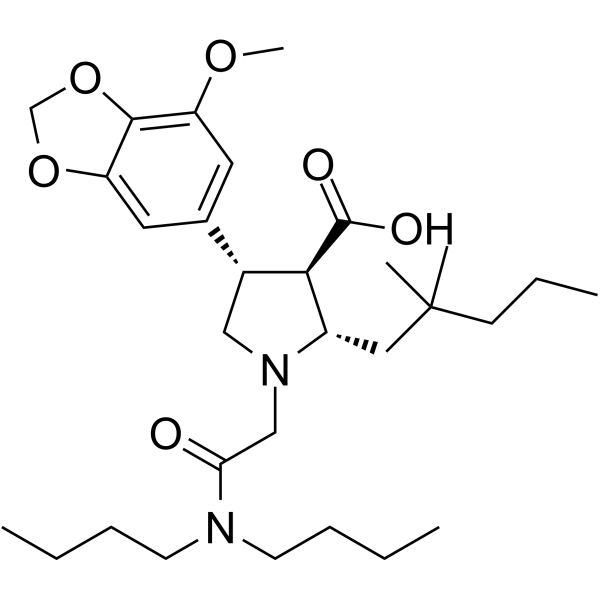
ABT-546 (A-216546) is an orally active ETA receptor antagonist, with Ki values of 0.46 nM and 13000 nM for human ETA and ETB receptors, respectively, and exhibits >25000-fold selectivity over the ETB receptor. ABT-546 effectively inhibits ET-1 (HY-P0202)-induced phosphoinositide hydrolysis (IC50 = 0.59 nM) and arachidonic acid release (IC50 = 3.03 nM), and antagonizes ET-1-induced contraction in isolated vascular rings. ABT-546 crosses the placental barrier but shows extremely low fetal exposure, with a favorable safety profile. ABT-546 inhibits ET-1-induced pressor response and downregulates the NLRP3/ROS/GSDMD-mediated pyroptosis pathway. ABT-546 can be used for research on abdominal aortic aneurysm .
loading...
    loading...
Cat. No.: HY-19309
CAS No.: 223756-43-2
Synonyms: A-216546 hydrochloride
ABT-546 (A-216546) hydrochloride is an orally active ETA receptor antagonist, with Ki values of 0.46 nM and 13000 nM for human ETA and ETB receptors, respectively, and exhibits >25000-fold selectivity over the ETB receptor. ABT-546 hydrochloride effectively inhibits ET-1 (HY-P0202)-induced phosphoinositide hydrolysis (IC50 = 0.59 nM) and arachidonic acid release (IC50 = 3.03 nM), and antagonizes ET-1-induced contraction in isolated vascular rings. ABT-546 hydrochloride crosses the placental barrier but shows extremely low fetal exposure, with a favorable safety profile. ABT-546 hydrochloride inhibits ET-1-induced pressor response and downregulates the NLRP3/ROS/GSDMD-mediated pyroptosis pathway. ABT-546 hydrochloride can be used for research on abdominal aortic aneurysm .
loading...
    loading...

