33 Results for "

FIX

" in MedChemExpress (MCE) Product Catalog:
Products (33)

33 Results for "FIX" in MCE Product Catalog:

Cat. No.: HY-P10306
Target:  

Bacterial

Research Areas:  

Infection

Cys-LL37 is a biomaterial with antimicrobial properties developed by covalently fixing to the surface of titanium. Cys-LL37 uses a flexible hydrophilic polyethylene glycol spacer and selective n-terminal coupling LL37, a surface peptide layer that kills bacteria on contact is formed. Cys-LL37 can be used in research to develop new antimicrobial biomaterials .
loading...
    loading...
Cat. No.: HY-B1937R
CAS No.: 25155-30-0
Synonyms: Bio-Soft S 101 sodium (Standard)
Sodium dodecylbenzenesulfonate (Standard) is the analytical standard of Sodium dodecylbenzenesulfonate. This product is intended for research and analytical applications. Sodium dodecylbenzenesulfonate (Bio-Soft S 101 sodium) is a nonionic surfactant commonly used in a variety of applications for cleaning and treating industrial equipment. It has good cleaning power and environmental compatibility, and can effectively remove oil, dirt and other forms of contamination. In addition, in textile, paper, leather and other industries, the compound can also be used for fixing and stabilizing dyes and colors. Although the compound has no direct application in the medical field, it plays an important role in industry and laboratory research.
loading...
    loading...
Cat. No.: HY-D2765
CAS No.: 757156-70-0
BP Fluor 405 Cadaverine is a carbonyl-reactive building block used to modify carboxylic groups in the presence of activators (e.g. EDC or DCC) or activated esters (e.g. NHS esters) through a stable amide bond. Another common application for BP Fluor 405 Cadaverine is cell fixing by treatment with formaldehyde or glutaraldehyde. BP Fluor 405 is a water-soluble, blue-fluorescent dye that is often used in multi-color applications, including flow cytometry and super-resolution microscopy using STORM. Its excitation is ideally suited for the 407 nm spectral line of the krypton laser or the 408 nm violet laser diode.
loading...
    loading...
Cat. No.: HY-172166B
TRITC-lysine-dextran (MW 70kDa) is a fluorescent label prepared by the conjugation of TRITC (HY-D0791), lysine and dextran. TRITC-lysine-dextran (MW 70kDa) serves multiple functions as an axonal tracer, non-viral nanocarrier and fixable fluorescent clonal marker. TRITC-lysine-dextran (MW 70kDa) undergoes anterograde and retrograde transport within axons of sensory neurons, and acts as a non-viral delivery system to precisely deliver biomolecules to neurons. TRITC-lysine-dextran (MW 70kDa) remains stably retained during histological preparation, thereby supporting continuous observation in live or fixed samples .
loading...
    loading...
Cat. No.: HY-N15353
CAS No.: 51621-26-2
1-Palmitoyl-2-linoleoyl-sn-glycerol is a diacylglycerol (DAG)-type lipid signaling molecule found in the coralloid roots of Cycas revoluta, and serves as a major active component of the plant-secreted hormogonium-inducing factor (HIF). At a concentration of 1 nmol/disc (approximately 0.6 µg), 1-palmitoyl-2-linoleoyl-sn-glycerol can significantly induce the differentiation of filamentous aggregates of Nostoc into motile hormogonia, thereby promoting chemotaxis toward host roots and the establishment of symbiosis. This compound holds significant research and application potential in areas such as plant–microbe interactions, rhizosphere signaling pathways, and nitrogen-fixing symbiosis .
loading...
    loading...
Cat. No.: HY-W127487
CAS No.: 479050-96-9
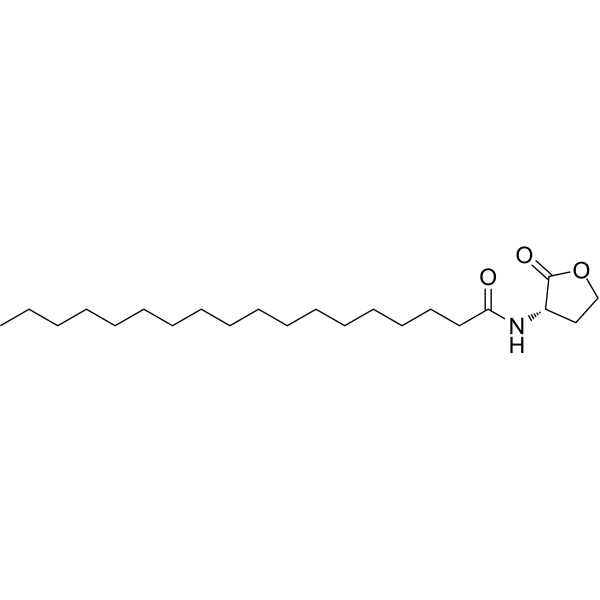
Quorum sensing is a regulatory system used by bacteria to control gene expression in response to increased cell density. This regulatory process manifests itself in a variety of phenotypes, including biofilm formation and virulence factor production. Coordinated gene expression is achieved through the production, release and detection of small diffusible signaling molecules called autoinducers. N-acylated homoserine lactones (AHLs) comprise a class of such autoinducers, each of which generally consists of a fatty acid coupled to a homoserine lactone (HSL). Modulation of bacterial quorum-sensing signaling systems to suppress pathogenesis represents a new approach to antimicrobial research for infectious diseases. AHLs differ in acyl length (C4-C18), C3 substitution (hydrogen, hydroxyl, or oxo group), and the presence or absence of one or more carbon-carbon double bonds in the fatty acid chain. These differences confer signaling specificity through the affinity of the LuxR family of transcriptional regulators. C18-HSL, one of four lipophilic long acyl side chain AHLs produced by the LuxI AHL synthase homolog SinI, is involved in quorum-sensing signaling in strains of Rhizobium meliloti (a nitrogen-fixing bacterial symbiont of the legume M. sativa) . C18-HSL and other hydrophobic AHLs tend to localize in the relatively lipophilic environment of bacterial cells and cannot diffuse freely across the cell membrane. Long-chain N-acyl homoserine lactones can be exported from cells by efflux pumps, or can be transported between communicating cells by extracellular outer membrane vesicles.
loading...
    loading...
Cat. No.: HY-P74240
Purity:  ≥ 95%, as determined by reducing SDS-PAGE.
Synonyms: F9; Autoprothrombin IIA; Coagulation Factor IX; Coagulant Factor IX; FIX; Christmas Disease; Plasma Thromboplastic Component; Hemophilia B; Plasma Thromboplastin Component; Factor IX F9; Christmas Factor; Factor IX; PTC; Factor 9; Truncated Coagulation Fa
Species:  
Mouse
Source:  
HEK293
loading...
    loading...
Cat. No.: HY-P88409
Synonyms: AK3L1; AK6; AKL3L; AKL3L1; FIX

Host:  

Mouse

Application:  

IHC-P, ICC/IF, FC

Reactivity:  

Human, Mouse, Rat

loading...
    loading...
Cat. No.: HY-D3424
Target:  

Fluorescent Dye

Research Areas:  

Others

AM3-25 is a lipophilic styrene fluorescent dye commonly used as a fixable probe for nerve endings and cell membranes. AM3‑25 bears an amino group at its hydrophilic end, enabling it to cross‑link with proteins during formaldehyde or glutaraldehyde fixation and thereby immobilizing the stained label.
loading...
    loading...
Cat. No.: HY-P88409A
Synonyms: AK3L1; AK6; AKL3L; AKL3L1; FIX

Host:  

Mouse

Application:  

IHC-P, ICC/IF, FC

Reactivity:  

Human, Mouse, Rat

loading...
    loading...
Cat. No.: HY-D3383
Target:  

Fluorescent Dye

Research Areas:  

Neurological Disease

AM4-64 is a fixable cationic styryl fluorescent dye for nerve terminals, which can be used for vesicle cycle evaluation, endocytic pathway tracing and endocytosis detection. AM4-64 inserts into the plasma membrane, is internalized via activity- or energy-dependent endocytosis, and accumulates in vesicles, endosomal compartments, vacuolar membranes, mitochondria and endolysosomal structures. The fluorescence of AM4-64 is enhanced in the membrane-bound state. AM4-64 is applicable to relevant studies on neurons, plant and fungal cells and tissues (Ex/Em = 510/750 nm) .
loading...
    loading...
Cat. No.: HY-P705987
Purity:  ≥ 95%, as determined by reducing SDS-PAGE.
Synonyms: F9; Autoprothrombin IIA; Coagulation Factor IX; Coagulant Factor IX; FIX; Christmas Disease; Plasma Thromboplastic Component; Hemophilia B; Plasma Thromboplastin Component; Factor IX F9; Christmas Factor; Factor IX; PTC; Factor 9; Truncated Coagulation Fa
Species:  
Cynomolgus
Source:  
HEK293
loading...
    loading...
Cat. No.: HY-P71645
Purity:  ≥ 90%, as determined by reducing SDS-PAGE.
Synonyms: AK3; AKL3L; Prev. AK3L1; GTP:AMP Phosphotransferase, Mitochondrial; Prev. AK6; Adenylate Kinase 3 Like 1; GTP:AMP Phosphotransferase AK3, Mitochondrial; Adenylate Kinase 6; Adenylate Kinase 3 Alpha-Like 1; AK 3; AKL3L1; FIX; Adenylate Kinase Isozyme 3; Ad
Species:  
Human
Source:  
E. coli
loading...
    loading...

