27 Results for "

Interneuron

" in MedChemExpress (MCE) Product Catalog:
Products (27)

27 Results for "Interneuron" in MCE Product Catalog:

Art. -Nr.: HY-10232R
CAS. Nr.: 64603-91-4
Synonyms: Gaboxadol (Standard)
Forschungsgebiete:  

Neurological Disease

THIP (Gaboxadol) Standard is the analytical standard of THIP (HY-10232). This product is intended for research and analytical applications. THIP (Gaboxadol) is a blood-brain barrier-penetrant, orally active selective GABAA receptor agonist. THIP exhibits EC50 values of 33 μM and 130 μM for α4β2δ and α4β1δ receptors, respectively. THIP activates extrasynaptic GABAA receptors to produce tonic inhibition and inhibits GABAergic interneurons to cause disinhibition. THIP is used in research on insomnia, sleep disorders, and addictive behaviors .
loading...
    loading...
Art. -Nr.: HY-B0194AR
CAS. Nr.: 64461-82-1
Tizanidine hydrochloride (Standard) is the analytical standard of Tizanidine hydrochloride (HY-B0194A). This product is intended for research and analytical applications. Tizanidine hydrochloride, a skeletal muscle relaxant, is an orally effective central α2-adrenoceptor agonist (IC50 = 6.9 nmol). Tizanidine hydrochloride primarily exerts muscle relaxation effects by inhibiting the release of excitatory amino acids (glutamate and aspartate) from the presynaptic terminals of spinal cord interneurons. Tizanidine hydrochloride has anti-injury activity and can inhibit gastrointestinal (GI) transport. Tizanidine hydrochloride can inhibit the proliferation, migration, and invasion of lung cancer cells and induce cell apoptosis by upregulating Nischarin and inhibiting the AKT and Wnt3a/β-catenin signaling pathways. Tizanidine hydrochloride can be used to treat spasticity caused by diseases such as multiple sclerosis (MS), stroke, and spinal cord injury (SCI).
loading...
    loading...
Art. -Nr.: HY-B0194AS
CAS. Nr.: 1188263-51-5
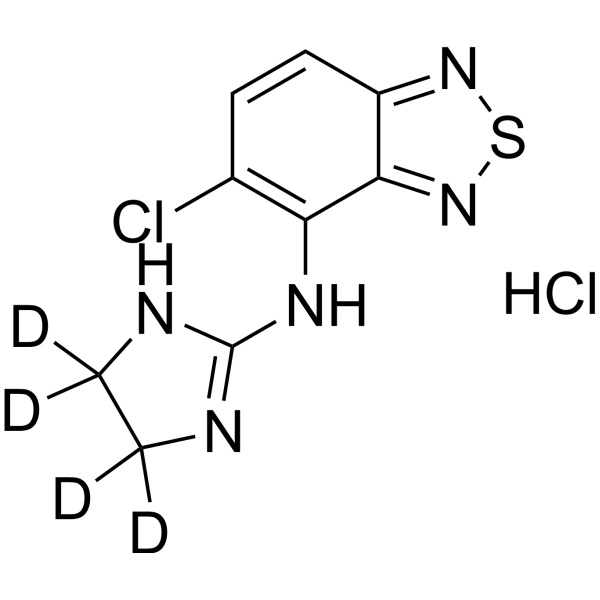
Tizanidine-d4 hydrochloride is deuterium labeled Tizanidine hydrochloride (HY-B0194A). Tizanidine hydrochloride, a skeletal muscle relaxant, is an orally effective central α2-adrenoceptor agonist (IC50 = 6.9 nmol). Tizanidine hydrochloride primarily exerts muscle relaxation effects by inhibiting the release of excitatory amino acids (glutamate and aspartate) from the presynaptic terminals of spinal cord interneurons. Tizanidine hydrochloride has anti-injury activity and can inhibit gastrointestinal (GI) transport. Tizanidine hydrochloride can inhibit the proliferation, migration, and invasion of lung cancer cells and induce cell apoptosis by upregulating Nischarin and inhibiting the AKT and Wnt3a/β-catenin signaling pathways. Tizanidine hydrochloride can be used to treat spasticity caused by diseases such as multiple sclerosis (MS), stroke, and spinal cord injury (SCI).
loading...
    loading...
Art. -Nr.: HY-B0194R
CAS. Nr.: 51322-75-9
Tizanidine (Standard) is the analytical standard of Tizanidine (HY-B0194). This product is intended for research and analytical applications. Tizanidine, a skeletal muscle relaxant, is an orally effective central α2-adrenoceptor agonist (IC50 = 6.9 nmol). Tizanidine primarily exerts muscle relaxation effects by inhibiting the release of excitatory amino acids (glutamate and aspartate) from the presynaptic terminals of spinal cord interneurons. Tizanidine has anti-injury activity and can inhibit gastrointestinal (GI) transport. Tizanidine can inhibit the proliferation, migration, and invasion of lung cancer cells and induce cell apoptosis by upregulating Nischarin and inhibiting the AKT and Wnt3a/β-catenin signaling pathways. Tizanidine can be used to treat spasticity caused by diseases such as multiple sclerosis (MS), stroke, and spinal cord injury (SCI).
loading...
    loading...
Art. -Nr.: HY-10232A
CAS. Nr.: 65202-63-3
Synonyms: Gaboxadol (hydrobromid)
Target:  

GABA Receptor

Forschungsgebiete:  

Neurological Disease

THIP (Gaboxadol) hydrobromide is a blood-brain barrier-penetrant, orally active selective GABAA receptor agonist. THIP hydrobromide exhibits EC50 values of 33 μM and 130 μM for α4β2δ and α4β1δ receptors, respectively. THIP hydrobromide activates extrasynaptic GABAA receptors to produce tonic inhibition and inhibits GABAergic interneurons to cause disinhibition. THIP hydrobromide is used in research on insomnia, sleep disorders, and addictive behaviors .
loading...
    loading...
Art. -Nr.: HY-159829A
CAS. Nr.: 3028447-14-2
Synonyms: NBI-1117568 citrate; HTL-0016878 citrate
Target:  

mAChR

Forschungsgebiete:  

Neurological Disease

Direclidine (NBI-1117568, HTL-0016878) citrate is a selective orthosteric agonist targeting the muscarinic acetylcholine M4 receptor, exhibiting very low affinity for M1, M2, M3, and M5 receptors. Direclidine citrate binds to the orthosteric site of the M4 receptor in a non-covalent, competitive manner. Direclidine citrate specifically activates the M4 receptor, inhibiting the release of acetylcholine from striatal cholinergic interneurons, thereby regulating the balance of the dopaminergic system and reducing psychiatric symptoms associated with excessive dopamine release. Direclidine citrate can improve symptoms associated with neuropsychiatric disorders and is used in research on schizophrenia and other neuropsychiatric disorders .
loading...
    loading...
Art. -Nr.: HY-L165
282 compounds

Dopamine receptor (DAR), widely distributed in the brain, plays a key role in regulating motor function, motivation, driving force and cognition. The role of DA is mediated by D1-type (D1, D5) and D2-type receptors (D2S, D2L, D3, D4), which are distributed in presynaptic, postsynaptic and extrasynaptic, projection neurons and interneurons. Each receptor has a different function. D1 and D5 receptors couple with G stimulation sites and activate Adenylyl cyclase. The activation of Adenylyl cyclase leads to the production of the second messenger cAMP, which leads to the production of protein kinase A (PKA), which leads to further transcription in the nucleus. D2 to D4 receptors are coupled to G inhibitory sites to inhibit adenylyl cyclase and activate potassium Ion channel. These receptors utilize phosphorylation cascades or direct membrane interactions to affect the functions of voltage-gated and neurotransmitter-gated channels, cytoplasmic enzymes, and transcription factors. Dopamine receptor plays an important role in daily life.

MCE designs a unique collection of 282 small molecules related to dopamine receptor. It is a good tool for screening drugs from nervous system disease.

