65 Results for "

Polymerization Reaction

" in MedChemExpress (MCE) Product Catalog:
Products (65)

65 Results for "Polymerization Reaction" in MCE Product Catalog:

Cat. No.: HY-154871
CAS No.: 2152-75-2
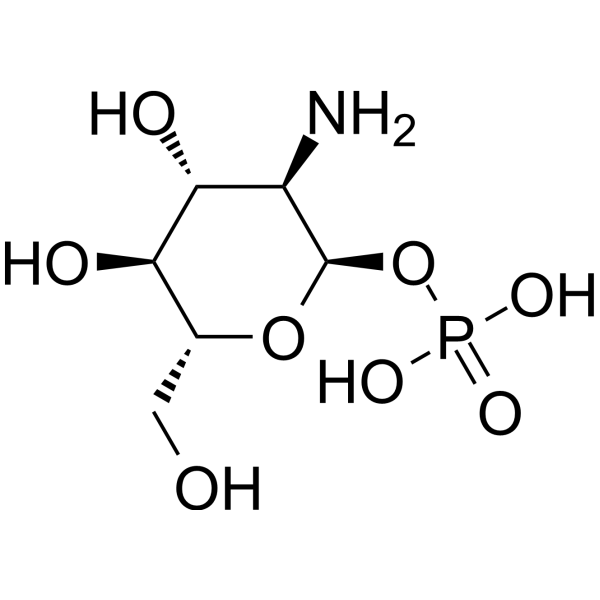
α-D-Glucosamine 1-phosphate is a glycosyl donor analog of Glc-1-P. α-D-Glucosamine 1-phosphate acts as a glycosyl donor to produce α(1→4)-linked glucosamine chains in the enzyme-catalyzed polymerization reaction mediated by thermostable α-glucan phosphorylase. α-D-Glucosamine 1-phosphate serves as a glycosyl donor analog to generate a pentasaccharide with a glucosamine residue at the non-reducing end in the maltotetraose glucosamination reaction catalyzed by potato α-glucan phosphorylase. α-D-Glucosamine 1-phosphate is used for the synthesis of amphiphilic block polysaccharides with pH-responsive assembly/disassembly properties .
loading...
    loading...
Cat. No.: HY-13325
CAS No.: 71939-12-3
Research Areas:  

Neurological Disease

Aβ aggregation modulator-1 is a stimulator of amyloid-β () fibrillogenesis. Aβ aggregation modulator-1 binds hydrophobic residues in peptides and stabilizes β-sheet-rich protofibrils and fibrils. Aβ aggregation modulator-1 accelerates polymerization and reduces concentrations of small, toxic oligomers in heterogeneous aggregation reactions. Aβ aggregation modulator-1 suppresses long-term potentiation (LTP) inhibition by oligomers in hippocampal brain slices. Aβ aggregation modulator-1 can be used for the study of Alzheimer's disease (AD) .
loading...
    loading...
Cat. No.: HY-E71146
Research Areas:  

Others

1,2-β-Oligomannan phosphorylase (EC 2.4.1.340) catalyses a reversible reaction. In the synthetic direction it produces oligosaccharides with a degree of polymerization (DP) of 3, 4 and 5. The phosphorolysis reaction proceeds to completion, although activity is highest when the substrate has at least three residues.
loading...
    loading...
Cat. No.: HY-117007
CAS No.: 106-91-2
Research Areas:  

Others

Glycidyl methacrylate is a bifunctional monomer containing both a polymerizable methacrylate double bond and a reactive epoxy group. Glycidyl methacrylate can be introduced into polymer backbones via free radical polymerization, and its epoxy group undergoes ring-opening reactions with nucleophilic groups such as amines, carboxylic acids and thiols, thus being used for the preparation of functional polymers, surface-grafted materials and crosslinkable biomaterials. Glycidyl methacrylate is applicable to research related to polymer chemistry, biomaterials, surface modification and drug delivery materials .
loading...
    loading...
Cat. No.: HY-W440949
Research Areas:  

Others

Stearic acid-PEG1000-Mal enables surface modification of various substrate through reaction between hydroxyl and ethoxyl silane. The polymer can be used for click chemistry with alkyne containing molecule.
loading...
    loading...
Cat. No.: HY-W440951
Research Areas:  

Others

Stearic acid-PEG3400-Mal enables surface modification of various substrate through reaction between hydroxyl and ethoxyl silane. The polymer can be used for click chemistry with alkyne containing molecule.
loading...
    loading...
Cat. No.: HY-174954
6-Arm-PEG400-DA is a polymer consisting of a four-arm PEG core structure with acrylate groups attached to the ends of each PEG chain by chemical reaction, which can be used for drug delivery .
loading...
    loading...
Cat. No.: HY-174954A
6-Arm-PEG600-DA is a polymer consisting of a four-arm PEG core structure with acrylate groups attached to the ends of each PEG chain by chemical reaction, which can be used for drug delivery .
loading...
    loading...
Cat. No.: HY-174954B
6-Arm-PEG1000-DA is a polymer consisting of a four-arm PEG core structure with acrylate groups attached to the ends of each PEG chain by chemical reaction, which can be used for drug delivery .
loading...
    loading...
Cat. No.: HY-174954C
6-Arm-PEG2000-DA is a polymer consisting of a four-arm PEG core structure with acrylate groups attached to the ends of each PEG chain by chemical reaction, which can be used for drug delivery .
loading...
    loading...
Cat. No.: HY-174954H
6-Arm-PEG10000-DA is a polymer consisting of a four-arm PEG core structure with acrylate groups attached to the ends of each PEG chain by chemical reaction, which can be used for drug delivery .
loading...
    loading...
Cat. No.: HY-174968
Synonyms: 4-Arm-PEG2000-Acrylate
4-Arm-PEG2000-AC (4-Arm-PEG2000-Acrylate) is a polymer consisting of a four-arm PEG core structure with acrylate groups attached to the ends of each PEG chain by chemical reaction, which can be used for drug delivery .
loading...
    loading...
Cat. No.: HY-174968C
Synonyms: 4-Arm-PEG20000-Acrylate
4-Arm-PEG20000-AC (4-Arm-PEG20000-Acrylate) is a polymer consisting of a four-arm PEG core structure with acrylate groups attached to the ends of each PEG chain by chemical reaction, which can be used for drug delivery .
loading...
    loading...
Cat. No.: HY-W700460
CAS No.: 83480-48-2
9-β-D-Arabinofuranosyl-2-fluorohypoxanthine is a nucleoside analog with activity as an inhibitor of certain enzymes. 9-β-D-Arabinofuranosyl-2-fluorohypoxanthine is useful in synthesis and, due to its structural changes, is able to cause base mispairing, thereby stopping chain polymerization reactions.
loading...
    loading...
Cat. No.: HY-W1062796
CAS No.: 63534-36-1
1-Azidomethyl-adamantane is an adamantane derivative and a click reaction guest unit. 1-Azidomethyl-adamantane can react with propargylated dextran to generate dextran polymers with adamantane side groups. 1-Azidomethyl-adamantane exhibits supramolecular host-guest interactions with β-cyclodextrin (HY-107201) .
loading...
    loading...
Cat. No.: HY-W440906
Research Areas:  

Others

DSPE-PEG3400-Vinylsulfone is a viniyl sulfone PEG lipid which can be used for bioconjugation with cysteine or other thiol molecule through thiol-ene reaction. The polymer is a self-assembling reagetn which forms lipid bilayer in water and can be used as drug carrier to delivery therapeutic agents, such as mRNA or DNA vaccine.
loading...
    loading...
Cat. No.: HY-116655A
CAS No.: 2855229-28-4
Research Areas:  

Others

Hydroxy-PEG1-acid sodium is a PEG linker containing a hydroxyl group with a terminal carboxylic acid (as sodium salt form). The free acid form is not stable due to the reaction of OH with PEG-COOH group to form polymer. The sodium salt form is stable for storage and shipping. The hydrophilic PEG spacer increases solubility in aqueous media. The hydroxyl group enables further derivatization or replacement with other reactive functional groups.
loading...
    loading...
Cat. No.: HY-B1498A
CAS No.: 5982-56-9
Synonyms: 1,2-Ethylenedisulfonic acid dihydrate
Research Areas:  

Others

Ethylenedisulfonic acid dihydrate (1,2-Ethylenedisulfonic acid dihydrate) acts as a structure-forming agent and organic modifier. Ethylenedisulfonic acid dihydrate forms hydrogen-bonded polymer structures via in situ two-component reactions with pyridine-containing compounds. Ethylenedisulfonic acid dihydrate can coat molybdenum oxide supported on carbon nanotubes for oxidative desulfurization. Ethylenedisulfonic acid dihydrate serves as a biochemical reagent for relevant research in various fields such as organic synthesis .
loading...
    loading...
Cat. No.: HY-W800833
CAS No.: 55946-27-5
Research Areas:  

Others

Benzyl N-[2-(prop-2-enamido)ethyl]carbamate is a short aliphatic linker featuring a Cbz-protected amine and an acrylamide. Acrylamide is a Michael acceptor which is a good Michael acceptor which can be used in thiol-based bioconjugation or polymerization. Meanwhile, the Cbz protecting group can be removed using Pd-C hydrogenation to reveal a free amine that can participate in a wide variety of reactions such as couplings or reductive amination.
loading...
    loading...
Cat. No.: HY-W724293
Tetrapropylammonium-d28 chloride is the deuterium labeled Tetrapropylammonium chloride (HY-W012412). Tetrapropylammonium chloride is a compound belonging to the class of quaternary ammonium compounds. It is a salt with cationic properties and is used in various industrial and biomedical applications. Tetrapropylammonium chloride is commonly used as a phase transfer catalyst to facilitate the movement of reactants between immiscible phases in organic synthesis reactions. It is also used as a surfactant in the formulation of personal care products, detergents, textiles and pharmaceuticals. Additionally, it is used in the production of certain types of polymers and resins.
loading...
    loading...

