



Glycidyl methacrylate

Based on 1 Customer Validation
Glycidyl methacrylate is a bifunctional monomer containing both a polymerizable methacrylate double bond and a reactive epoxy group. Glycidyl methacrylate can be introduced into polymer backbones via free radical polymerization, and its epoxy group undergoes ring-opening reactions with nucleophilic groups such as amines, carboxylic acids and thiols, thus being used for the preparation of functional polymers, surface-grafted materials and crosslinkable biomaterials. Glycidyl methacrylate is applicable to research related to polymer chemistry, biomaterials, surface modification and drug delivery materials.
For research use only. We do not sell to patients.
- Purity : 99.36%
- CAS No.: 106-91-2
- Formula: C7H10O3
- Molecular Weight:142.15
-
Storage:
4°C, stored under nitrogen
* In solvent : -80°C, 6 months; -20°C, 1 month (stored under nitrogen)


To place orders, for customer services and technical support, please contact: MedChemExpress USA
Tel: 609-228-6898 E-mail: [email protected] [email protected]


-
 Biological Activity
-
Chemical Information
-
Solvent & Solubility
- Purity & Documentation
- References
-
 Help & FAQs


-
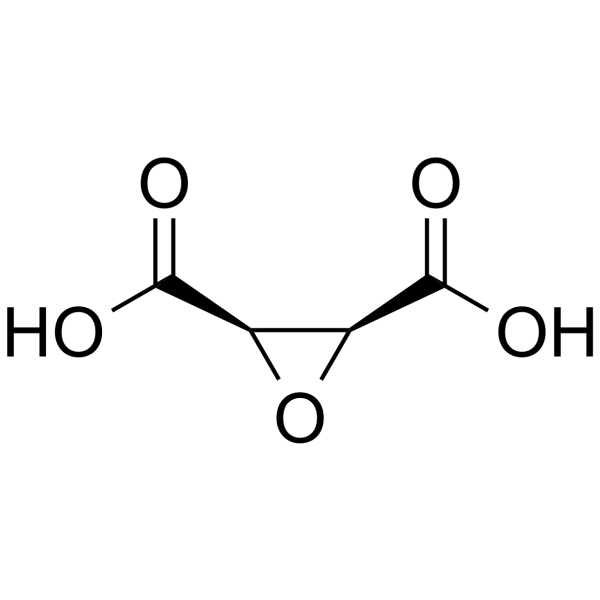
HY-125791
cis-Epoxysuccinic acidSUCNR1 Agonist -
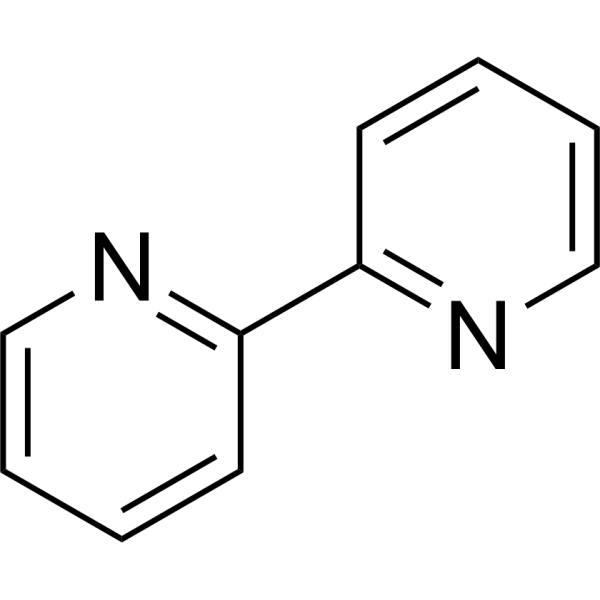
HY-D0020
2,2'-BipyridineMetal Chelating Ligand -
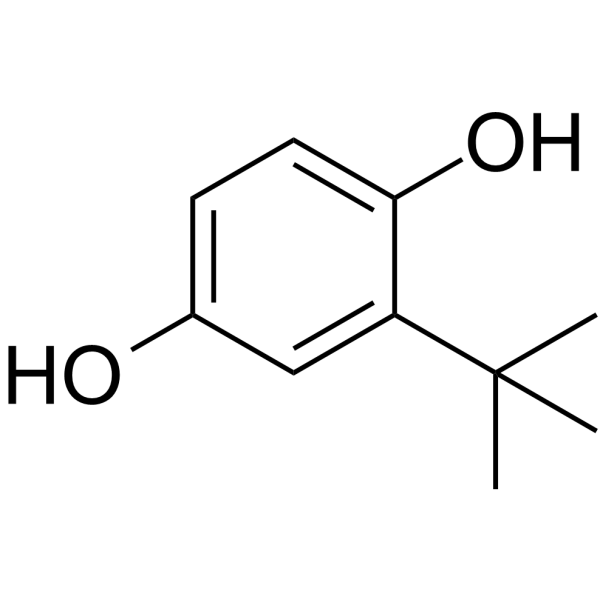
HY-100489
TBHQNrf2 Activator -
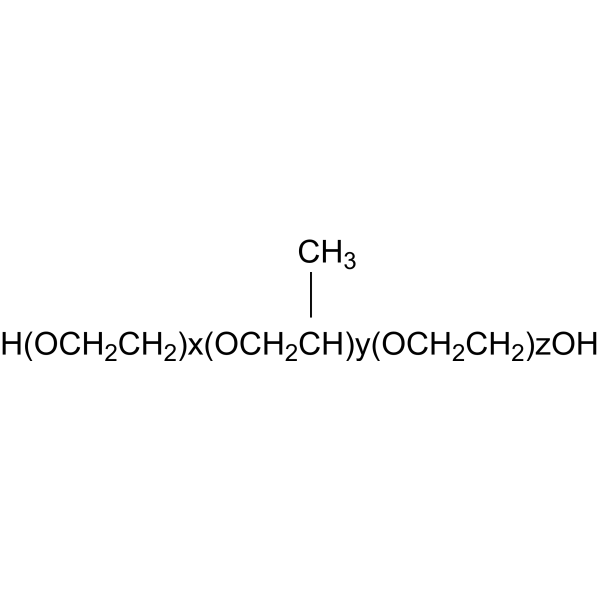
HY-D1005
Poloxamer 407 (F127)LPL Receptor Inhibitor -
HY-D1005A
Poloxamer 188Linear Copolymer -
HY-D1005H
Poloxamer 188 (F68)Nonionic Linear Copolymer -

HY-W017415
2-(3-Chloropropyl)-1,3-dioxolanePROTAC Linker -

HY-D1005A6
Poloxamer 124 (L44)Biochemical Assay Agent -
HY-100489R
TBHQ (Standard)Nrf2 Activator -
HY-D1005A22
Poloxamer 338 (F108)Biochemical Assay Agent -

HY-W011927
4,4'-SulfonyldiphenolEstrogen receptor agonist -
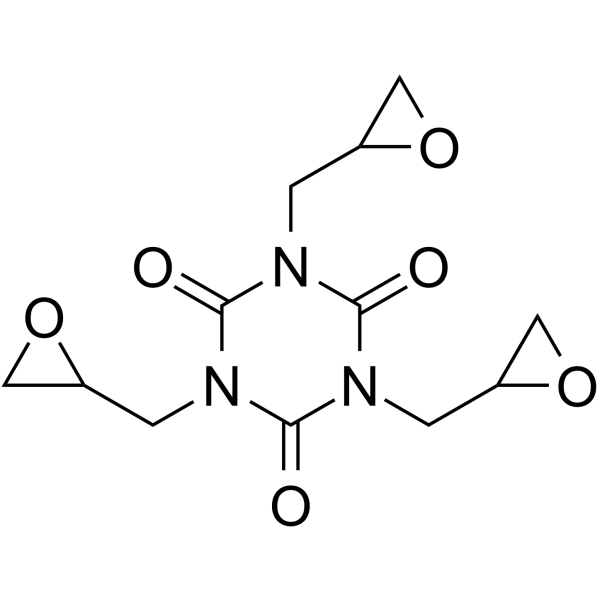
HY-W011434
Triglycidyl isocyanurateApoptosis Inducer


Biological Activity
Description
In Vitro
Glycidyl methacrylate (30-70 mol%; 24 h polymerization at 70 °C; 24 h drying at 40 °C) forms amorphous, free radical copolymerized P(BA-co-GMAy) copolymers with n-butyl acrylate, with weight-average molar masses ranging from 28,000 to 55,000 g/mol, polydispersity indices of 2.0-2.4, and glass transition temperatures from -4 °C to 29 °C depending on GMA content[1].
Glycidyl methacrylate (40-70 mol%; 24 h polymerization at 80 °C) forms semicrystalline, free radical copolymerized P(PEGMA-co-GMAy) copolymers with poly(ethylene glycol) methyl ether methacrylate, with weight-average molar masses ranging from 105,000 to 470,000 g/mol, polydispersity indices of 1.7-3.1, glass transition temperatures from -55 °C to -43 °C, and melting temperatures from 25 °C to 37 °C depending on GMA content[1].
Glycidyl methacrylate (1-2 wt%; 3 h) coated on silicone contact lenses potently kills MRSA with a log reduction of 6.3 and maintains 90% NIH-3T3 fibroblast viability; coatings with 2 wt% Glycidyl methacrylate also exhibit significant antibacterial activity against MRSA and S. aureus with high cell viability[2].
MedChemExpress (MCE) has not independently confirmed the accuracy of these methods. They are for reference only. .


Chemical Information
-
CAS No. 106-91-2
-
Appearance Liquid (Density: 1.042 g/cm³)
-
Molecular Weight 142.15
-
Formula C7H10O3
-
Color Colorless to light yellow
-
SMILES
CC(C(OCC1CO1)=O)=C
-
Shipping
Room temperature in continental US; may vary elsewhere.
-
Storage
4°C, stored under nitrogen
* In solvent : -80°C, 6 months; -20°C, 1 month (stored under nitrogen)


Solvent & Solubility
In Vitro:
DMSO : 100 mg/mL (703.48 mM; Need ultrasonic; Hygroscopic DMSO has a significant impact on the solubility of product, please use newly opened DMSO)
Please refer to the solubility information to select the appropriate solvent. Once prepared, please aliquot and store the solution to prevent product inactivation from repeated freeze-thaw cycles.
Storage method and period of stock solution: -80°C, 6 months; -20°C, 1 month (stored under nitrogen). When stored at -80°C, please use it within 6 months. When stored at -20°C, please use it within 1 month.
Please refer to the solubility information to select the appropriate solvent. Once prepared, please aliquot and store the solution to prevent product inactivation from repeated freeze-thaw cycles.
Storage method and period of stock solution: -80°C, 6 months; -20°C, 1 month (stored under nitrogen). When stored at -80°C, please use it within 6 months. When stored at -20°C, please use it within 1 month.
Concentration (start) × Volume (start) = Concentration (final) × Volume (final)
In Vivo:
Select the appropriate dissolution method based on your experimental animal and administration route.
- For the following dissolution methods, please ensure to first prepare a clear stock solution using an In Vitro approach and then sequentially add co-solvents:
- To ensure reliable experimental results, the clarified stock solution can be appropriately stored based on storage conditions. As for the working solution for In Vivo experiments, it is recommended to prepare freshly and use it on the same day.
- The percentages shown for the solvents indicate their volumetric ratio in the final prepared solution. If precipitation or phase separation occurs during preparation, heat and/or sonication can be used to aid dissolution.
Add each solvent one by one: 10% DMSO 40% PEG300 5% Tween-80 45% Saline
Solubility: ≥ 5 mg/mL (35.17 mM); Clear solution
This protocol yields a clear solution of ≥ 5 mg/mL (saturation unknown).
Taking 1 mL working solution as an example, add 100 μL DMSO stock solution (50.0 mg/mL) to 400 μL PEG300, and mix evenly; then add 50 μL Tween-80 and mix evenly; then add 450 μL Saline to adjust the volume to 1 mL.
Preparation of Saline: Dissolve 0.9 g sodium chloride in ddH₂O and dilute to 100 mL to obtain a clear Saline solution.
Add each solvent one by one: 10% DMSO 90% (20% SBE-β-CD in Saline)
Solubility: ≥ 5 mg/mL (35.17 mM); Clear solution
This protocol yields a clear solution of ≥ 5 mg/mL (saturation unknown).
Taking 1 mL working solution as an example, add 100 μL DMSO stock solution (50.0 mg/mL) to 900 μL 20% SBE-β-CD in Saline, and mix evenly.
Preparation of 20% SBE-β-CD in Saline (4°C, storage for one week): 2 g SBE-β-CD powder is dissolved in 10 mL Saline, completely dissolve until clear.
In Vivo Dissolution Calculator
Please enter the basic information of animal experiments:
-
-
-
-
Recommended: Prepare an additional quantity of animals to account for potential losses during experiments.
Please enter your animal formula composition:
-
%DMSO +
Recommended: Keep the proportion of DMSO in working solution below 2% if your animal is weak.
-
%+
-
+%Tween-80 + +
-
%Saline +
The co-solvents required include: DMSO, . All of co-solvents are available by MedChemExpress (MCE). , Tween 80. All of co-solvents are available by MedChemExpress (MCE).
Working solution concentration: 0.22 mg/mL
Method for preparing stock solution: mg drug dissolved in μL DMSO. Stock solution concentration: mg/mL. * In solvent : -80°C, 6 months; -20°C, 1 month (stored under nitrogen)
1. Take μL DMSO stock solution;
2. Add μL .
μL , mix evenly;
3. Then add μL Tween 80, mix evenly;
4. Then add μL
Please ensure that the stock solution in the first step is dissolved to a clear state, and add co-solvents in sequence. You can use ultrasonic heating (ultrasonic cleaner, recommended frequency 20-40 kHz), vortexing, etc. to assist dissolution.


Purity & Documentation
-
Data Sheet (273 KB)
-
SDS (809 KB)
- English - EN (809 KB)
- Français - FR (809 KB)
- Deutsch - DE (809 KB)
- Norwegian - NO (809 KB)
- Español - ES (809 KB)
- Swedish - SV (809 KB)
- Italian - IT (809 KB)
- Korean - KR (809 KB)
- Portuguese - PT (809 KB)
-
Handling Instructions (2659 KB)
References
[1]. Tzoumani I, et al. Glycidyl Methacrylate-Based Copolymers as Healing Agents of Waterborne Polyurethanes. International journal of molecular sciences. 2022 Jul 23;23(15):8118. [Content Brief]
[2]. Pillai SKR, et al. Novel Antimicrobial Coating on Silicone Contact Lens Using Glycidyl Methacrylate and Polyethyleneimine Based Polymers. Macromolecular rapid communications. 2020 Nov;41(21):e2000175. [Content Brief]
[3]. Zhu W, et al. A composite hydrogel containing resveratrol-laden nanoparticles and platelet-derived extracellular vesicles promotes wound healing in diabetic mice. Acta biomaterialia. 2022 Dec;154:212-230. [Content Brief]
[4]. Fernandes BJD, et al. Toxicological alert: Exposure to glycidyl methacrylate and cancer risk. Toxicology and industrial health. 2020 Dec;36(12):937-939. [Content Brief]


Complete Stock Solution Preparation Table
Please refer to the solubility information to select the appropriate solvent. Once prepared, please aliquot and store the solution to prevent product inactivation from repeated freeze-thaw cycles.
Storage method and period of stock solution: -80°C, 6 months; -20°C, 1 month (stored under nitrogen). When stored at -80°C, please use it within 6 months. When stored at -20°C, please use it within 1 month.
| Optional Solvent | Concentration Solvent Mass | 1 mg | 5 mg | 10 mg | 25 mg |
|---|---|---|---|---|---|
| DMSO | 1 mM | 7.0348 mL | 35.1741 mL | 70.3482 mL | 175.8706 mL |
| 5 mM | 1.4070 mL | 7.0348 mL | 14.0696 mL | 35.1741 mL | |
| 10 mM | 0.7035 mL | 3.5174 mL | 7.0348 mL | 17.5871 mL | |
| 15 mM | 0.4690 mL | 2.3449 mL | 4.6899 mL | 11.7247 mL | |
| 20 mM | 0.3517 mL | 1.7587 mL | 3.5174 mL | 8.7935 mL | |
| 25 mM | 0.2814 mL | 1.4070 mL | 2.8139 mL | 7.0348 mL | |
| 30 mM | 0.2345 mL | 1.1725 mL | 2.3449 mL | 5.8624 mL | |
| 40 mM | 0.1759 mL | 0.8794 mL | 1.7587 mL | 4.3968 mL | |
| 50 mM | 0.1407 mL | 0.7035 mL | 1.4070 mL | 3.5174 mL | |
| 60 mM | 0.1172 mL | 0.5862 mL | 1.1725 mL | 2.9312 mL | |
| 80 mM | 0.0879 mL | 0.4397 mL | 0.8794 mL | 2.1984 mL | |
| 100 mM | 0.0703 mL | 0.3517 mL | 0.7035 mL | 1.7587 mL |


Glycidyl methacrylate Related Classifications
HY-117007 Related Classifications
 Powered by Bioz