
113 Results for "

persistent

" in MedChemExpress (MCE) Product Catalog:
Products (113)

113 Results for "persistent" in MCE Product Catalog:

Cat. No.: HY-119417A
CAS No.: 1954-81-0
Target:  

Herbicide

Research Areas:  

Others

Chloramben sodium is a herbicide with anti-growth activity against plants. Chloramben sodium can be effectively removed by photo-Fenton reaction under natural pH conditions, showing good degradation performance. The removal rate of chloramben sodium is consistent with different electrodes, mainly due to the oxidation mediated by the hydroxyl ions formed in the Fenton reaction. Chloramben sodium is almost completely mineralized using IrO2-based electrodes at high current density, indicating that it can be effectively degraded under light. Chloramben sodium leads to the formation of persistent chlorine derivatives in chlorine-containing environments, so the removal rate and mineralization rate are slightly reduced. Chloramben sodium can form intermediates with a variety of aromatic compounds and organic acids, reflecting the complexity of its transformation in the environment .
loading...
    loading...
Cat. No.: HY-P11594
Target:  

Neurotensin Receptor

Research Areas:  

Cancer

JMV 7490 is a highly potent and highly hydrophilic neurotensin receptor NTS1 probe that can be successfully labeled with 68Ga and 111In. JMV 7490 acts as an efflux inhibitor to reduce its efflux in NTS1-positive cancer cells; it also serves as an internalization inducer and is efficiently and continuously internalized by NTS1-positive cancer cells. 111In-radiolabeled JMV 7490 shows persistent uptake in NTS1-positive xenografts in nude mice, but no significant uptake in NTS1-negative xenografts. JMV 7490 can be used for in vivo tracer applications of NTS1-positive tumors and supports related research on colorectal cancer .
loading...
    loading...
Cat. No.: HY-182365
EED-IN-4 is an orally active, EZH2-selective immunomodulator and EED-H3K27me3 inhibitor (EED, IC50=28.21 nM) with anti-inflammatory activity. In mouse models, EED-IN-4 preferentially and persistently accumulates in lymph nodes after oral administration. By reducing the H3K27me3 level of dendritic cells and inhibiting their migration, EED-IN-4 reduces the infiltration of immune cells into the central nervous system and effectively alleviates spinal cord inflammation. EED-IN-4 shows weak inhibitory activity against hERG channels and is non-mutagenic, with no obvious toxicity observed upon long-term oral administration. EED-IN-4 can be used for the research of multiple sclerosis .
loading...
    loading...
Cat. No.: HY-L210
2,023 compounds

Rheumatoid Arthritis (RA) is a autoimmune disease characterized by persistent joint inflammation. The pathology of RA includes immune cell infiltration, synovial lining proliferation, pannus formation, and the destruction of joint cartilage and bone, which is highly disabling. Due to long-term chronic inflammation, RA not only severely affects the quality of life of patients but can also damage multiple organs, leading to lung diseases, cardiovascular diseases, and malignant tumors. The pathogenesis of RA is complex, involving genetic, environmental, and immune factors. With the advancement of high-throughput screening technology, screening for compounds targeting JAK, CCR, MEK, MMP targets may contribute to the development of more effective drugs against Rheumatoid Arthritis (RA).

MCE has collected 2,023 small molecule compounds with definite or potential anti-rheumatoid arthritis activity. This library is of significant value for researching the anti-RA drugs.

Cat. No.: HY-182366
EED-IN-5 is an orally active, EZH2-selective trisubstituted pyridine-based EED-H3K27me3 inhibitor and immunomodulator with anti-inflammatory activity. The IC50 value of EED-IN-5 against EED is 28.21 nM. In mouse models, EED-IN-5 preferentially and persistently accumulates in lymph nodes after oral administration. By reducing the H3K27me3 level of dendritic cells and inhibiting their migration, EED-IN-5 decreases the infiltration of specific dendritic cells, macrophages and T cells into the spinal cord and brain. EED-IN-5 exhibits hERG inhibitory activity, shows negative results in the Mini-Ames test, and causes no obvious toxicity upon long-term high-dose administration. EED-IN-5 can be used for the research of multiple sclerosis .
loading...
    loading...
Cat. No.: HY-189470
Nav1.2-IN-4 is a blood-brain barrier-penetrant NaV1.2 inhibitor (IC50 = 31.21 μM). Nav1.2-IN-4 preferentially blocks the inactivated state of the neuronal voltage-gated sodium channel NaV1.2, inhibiting persistent and resurgent sodium currents associated with epileptogenesis. Nav1.2-IN-4 restores the GABA-glutamate balance by enhancing GABA and reducing glutamate. Nav1.2-IN-4 reduces oxidative stress in brain tissue by increasing GSH and decreasing MDA. Nav1.2-IN-4 protects mice against MES-induced tonic hindlimb extensor seizures and attenuates hippocampal neuronal degeneration in the PTZ kindling model. Nav1.2-IN-4 can be used for research on epilepsy .
loading...
    loading...
Cat. No.: HY-19261
CAS No.: 169042-78-8
Research Areas:  

Metabolic Disease

T-0632 is a CCK A receptor antagonist that exhibits significant pharmacological properties in in vitro studies. T-0632 competitively inhibits the binding of [125I]CCK-8 to rat pancreatic CCK A receptors with a K_i value of 0.24 nM, which is significantly lower than the K_i value for guinea pig CCK B receptors. T-0632 has higher selectivity in inhibiting CCK-8-stimulated pancreatic enzyme release, with an IC_50 value of 5.0 nM, which is more advantageous than L-364,718 and loxiglumide. In rabbit gallbladder smooth muscle, the antagonistic effects of T-0632 and loxiglumide are reversible, while L-364,718 shows a persistent inhibitory effect. These results indicate that T-0632 is a highly potent, reversible and more selective CCK A receptor antagonist.
loading...
    loading...
Cat. No.: HY-P2866
CAS No.: 9012-33-3
β-N-Acetylhexosaminidase, Streptococcus pneumoniae is a cell surface virulence factor of Streptococcus pneumoniae, which contains two synergistically acting GH20 domains (with higher activity in GH20-2). β-N-Acetylhexosaminidase, Streptococcus pneumoniae specifically recognizes and hydrolyzes substrates with β(1,2) glycosidic bonds via Trp-443 and Tyr-482 residues. β-N-Acetylhexosaminidase, Streptococcus pneumoniae catalyzes the hydrolysis of β(1,2)-linked N-acetylglucosamine groups and related disaccharides, and promotes persistent colonization of bacteria in the airway by modifying host defense molecules and releasing monosaccharides for bacterial growth. β-N-Acetylhexosaminidase, Streptococcus pneumoniae can be used in studies related to Streptococcus pneumoniae infection, acute pneumonia, otitis media and meningitis .
loading...
    loading...
Cat. No.: HY-W012813
CAS No.: 1193-79-9
2-Acetyl-5-methylfuran is a growth inhibitor of Mycobacterium tuberculosis, exhibiting an in vitro anti-tubercular activity with an MIC of 322.58 μM. 2-Acetyl-5-methylfuran demonstrates high safety and can be used for research related to tuberculosis .
loading...
    loading...
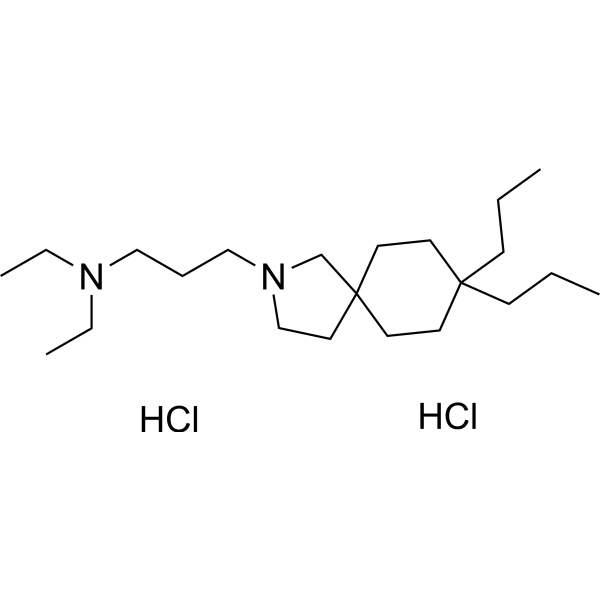
Cat. No.: HY-110102
CAS No.: 130065-61-1
Synonyms: Azaspirane hydrochloride; SKF 106615-12 hydrochloride; SKF 106615
Atiprimod (Azaspirane) hydrochloride is a STAT3 inhibitor with antitumor, anti-inflammatory, and anti-angiogenic activities. Atiprimod blocks the signaling pathways of IL-6 and VEGF by inhibiting the phosphorylation of signal transducer and activator of STAT3. Atiprimod blocks the JAK-STAT signaling pathway by inhibiting the phosphorylation of JAK2 and JAK3. Atiprimod also inhibits cell proliferation, induces cell cycle arrest, and induces autophagy and apoptosis. Atiprimod triggers persistent ER stress-mediated apoptosis in breast cancer cells by activating the PERK/eIF2α/ATF4/CHOP axis and inhibiting the nuclear translocation of STAT3/NF-κB. Atiprimod shows great anti-tumor activities in tumor xenograft mouse models. Atiprimod can be used for the study of pituitary adenoma, breast cancer, multiple myeloma and acute myeloid leukemia (AML) .
loading...
    loading...
Cat. No.: HY-13559
CAS No.: 123018-47-3
Synonyms: Azaspirane ; SKF 106615-12; SKF 106615A12
Atiprimod (Azaspirane) is a STAT3 inhibitor with antitumor, anti-inflammatory, and anti-angiogenic activities. Atiprimod blocks the signaling pathways of IL-6 and VEGF by inhibiting the phosphorylation of signal transducer and activator of STAT3. Atiprimod blocks the JAK-STAT signaling pathway by inhibiting the phosphorylation of JAK2 and JAK3. Atiprimod also inhibits cell proliferation, induces cell cycle arrest, and induces autophagy and apoptosis. Atiprimod triggers persistent ER stress-mediated apoptosis in breast cancer cells by activating the PERK/eIF2α/ATF4/CHOP axis and inhibiting the nuclear translocation of STAT3/NF-κB. Atiprimod shows great anti-tumor activities in tumor xenograft mouse models. Atiprimod can be used for the study of pituitary adenoma, breast cancer, multiple myeloma and acute myeloid leukemia (AML) .
loading...
    loading...
Cat. No.: HY-13559A
CAS No.: 183063-72-1
Synonyms: Azaspirane dimaleate; SKF 106615-12 dimaleate; SKF 106615A12 dimaleate
Atiprimod (Azaspirane) (dimaleate) is a STAT3 inhibitor with antitumor, anti-inflammatory, and anti-angiogenic activities. Atiprimod blocks the signaling pathways of IL-6 and VEGF by inhibiting the phosphorylation of signal transducer and activator of STAT3. Atiprimod blocks the JAK-STAT signaling pathway by inhibiting the phosphorylation of JAK2 and JAK3. Atiprimod also inhibits cell proliferation, induces cell cycle arrest, and induces autophagy and apoptosis. Atiprimod triggers persistent ER stress-mediated apoptosis in breast cancer cells by activating the PERK/eIF2α/ATF4/CHOP axis and inhibiting the nuclear translocation of STAT3/NF-κB. Atiprimod shows great anti-tumor activities in tumor xenograft mouse models. Atiprimod can be used for the study of pituitary adenoma, breast cancer, multiple myeloma and acute myeloid leukemia (AML) .
loading...
    loading...
Cat. No.: HY-184158
HATC is a HIF-1α AUTAC degrader. HATC links HIF-1α to LC3 to form a ternary complex that undergoes degradation via the autophagy-lysosome fusion pathway. HATC induces dose-dependent HIF-1α degradation in multiple cell types. HATC reduces visceral fat accumulation, hepatic lipid deposition, senescent cell aggregation, and bone loss; alleviates age-related intervertebral disc degeneration, liver dysfunction, kyphosis, and alveolar dilation; decreases circulating lactic acid levels; improves physical performance; and reverses age-related changes in granulocyte proportions. HATC extends median and maximum lifespan, reduces transcriptomic age, and causes no obvious persistent toxicity. HATC can be used in the research of age-related diseases (pink: LC3 ligand (HY-50759); blue: HIF-1α ligand (HY-P10426); Linker: (HY-W008264)) .
loading...
    loading...

