


1. Search Result
Search Result
Results for "

APL

" in MedChemExpress (MCE) Product Catalog:

21

Inhibitors & Agonists

1

Fluorescent Dye

4

Peptides

1

Inhibitory Antibodies

4

Natural
Products

1

Isotope-Labeled Compounds

2

Antibodies

1

Oligonucleotides

Cat. No. Product Name Target Research Areas Chemical Structure
  • HY-A0009
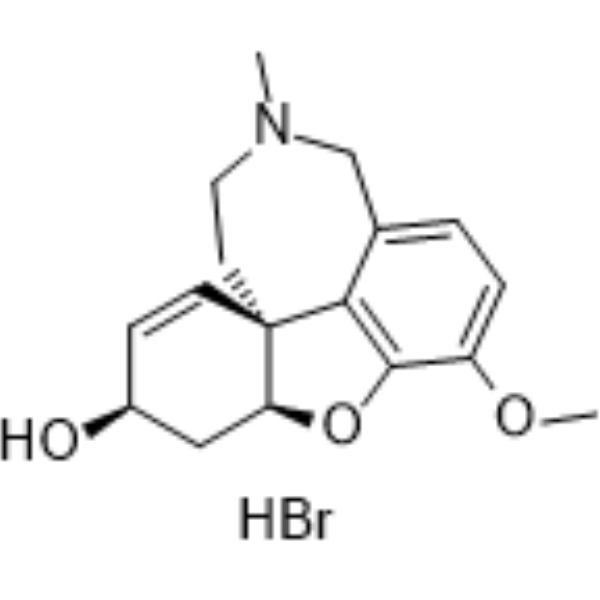
    Galanthamine hydrobromide
    10+ Cited Publications

    Galantamine hydrobromide

    Cholinesterase (ChE) nAChR Neurological Disease
    Galanthamine hydrobromide (Galantamine hydrobromide) is a selective, reversible, competitive, alkaloid AChE inhibitor, with an IC50 of 0.35 µM. Galanthamine hydrobromide is a potent allosteric potentiating ligand (APL) of human α3β4, α4β2, α6β4 nicotinic receptors ( nAChRs). Galanthamine hydrobromide is developed for the research of Alzheimer's disease (AD) .
    Galanthamine hydrobromide
  • HY-118590
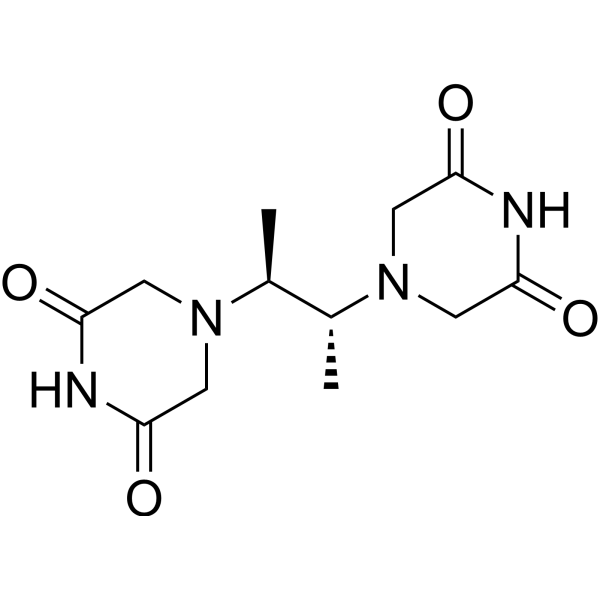
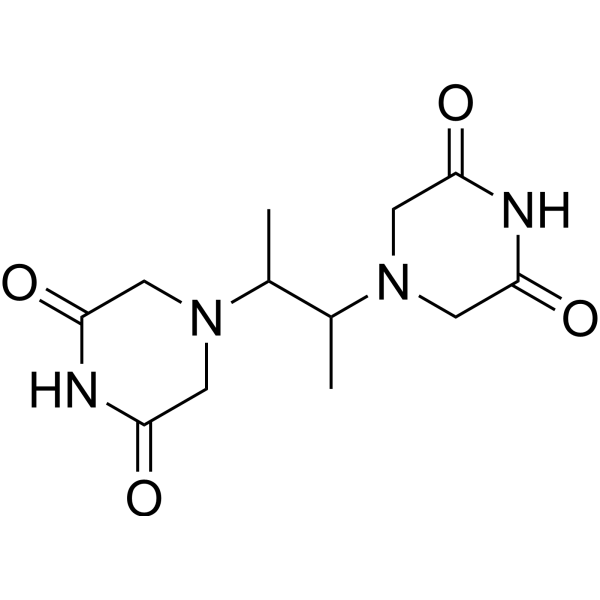
    ICRF-193
    2 Publications Verification

    Topoisomerase DNA/RNA Synthesis Apoptosis Fungal Infection Cardiovascular Disease Inflammation/Immunology Cancer
    ICRF-193 is a DNA Topoisomerase II inhibitor. (S,S)- and (R,R)-isomers ICRF-193 make up an racemic mixture, ICRF-196 (HY-118590A). ICRF-193 can inhibit DNA syntheses and induces apoptosis. ICRF-193 exhibits anti-cancer and anti-inflammation effects. ICRF-193 shows cardioprotective effect against anthracycline toxicity to cardiomyocytes. ICRF-193 can be used for the researches of cancer, infection, inflammation and cardiovascular disease, such as acute promyelocytic leukemia .
    ICRF-193
  • HY-169322

    Mal-Exo-EVC-MMAE

    Drug-Linker Conjugates for ADC Microtubule/Tubulin Cancer
    APL-1081 (Mal-Exo-EVC-MMAE) is part of an antibody-conjugated active molecule (ADC). APL-1081 is conjugated with an ADC linker (peptide Mal-Exo-EEVC) and a potent tubulin polymerization inhibitor, MMAE (HY-15162) .
    APL-1081
  • HY-175888

    Mc-exo-EVC-Exatecan

    Drug-Linker Conjugates for ADC Cancer
    APL-1082 is a drug-Linker conjugate that can be used for ADC synthesis. APL-1082 contains Exatecan (HY-13631) and Linker (HY-175929). APL-1082 reduces aggregation and hydrophobicity in Trastuzumab (HY-P9907) ADCs, enables production of high-DAR (10) ADCs with homogeneity and defined physicochemical properties. APL-1082 forms a Trastuzumab ADC with enhanced stability, showing greater DAR retention over time. APL-1082 can be used for the research of gastric cancer .
    APL-1082
  • HY-P6365

    L-4F TFA

    Apolipoprotein Cardiovascular Disease
    APL180 TFA (L-4F) is an apolipoprotein AI mimetic peptide that enhances the anti-inflammatory activity of high-density lipoprotein (HDL). APL180 can be used in the study of cardiovascular diseases.
    APL180 TFA
  • HY-173614

    Molecular Glues E1/E2/E3 Enzyme Cancer
    CC-647 is a molecular glue modulator targeting Cereblon (CRBN) E3 ubiquitin ligase. CC-647 promotes the interaction between CRBN and ZBTB16 as well as its oncogenic fusion protein RARα-ZBTB16 (with a DC50 of 103 nM). CC-647 is promising for research of ZBTB16-RARα-associated acute promyelocytic leukemia (APL) .
    CC-647
  • HY-169323

    Mal-Exo-EEVC-MMAE

    Drug-Linker Conjugates for ADC Cancer
    APL-1091 (Mal-Exo-EEVC-MMAE) is part of a Drug-linker conjugate for ADC. APL-1091 contains a Mal-Exo-EEVC (HY-169353) linker and MMAE (HY-15162) (Microtubule inhibitor). APL-1091 can be used for ADC synthesis .
    APL-1091
  • HY-178980

    Casein Kinase Cancer
    APL-5125 (Compound 61f) is a potent, selective and orally active ATP-competitive CK2α inhibitor with an IC50 of 0.348 nM and a Ki of 0.095 nM. APL-5125 binds to CK2α in a bivalent manner, simultaneously interacting with the ATP-binding site and the αD pocket. APL-5125 exhibits antitumor activity and can be used for the research of cancer, such as colon cancer .
    APL-5125
  • HY-169324

    Mal-Exo-EEVC-Exatecan

    Drug-Linker Conjugates for ADC Cancer
    APL-1092 (Mal-Exo-EEVC-Exatecan) is a drug-linker conjugate for ADC, which contains Exatecan (HY-13631) (ADC payload) and a linker .
    APL-1092
  • HY-P6365A

    L-4F

    Apolipoprotein Cardiovascular Disease
    APL180 (L-4F) is an apolipoprotein A-I mimic peptide, that improves the anti-inflammatory activity of high-density lipoprotein (HDL). APL180 can be used in researches of cardiovascular diseases .
    APL180
  • HY-P99639

    Genolimzumab; APL-501; CBT-501; GB-226

    PD-1/PD-L1 Cancer
    Geptanolimab (CBT-501) is a humanized IgG4k monoclonal antibody against programmed death-1 (PD-1). Siplizumab inhibits the binding of PD-L1/L2 to PD-1 through a competitive action. Siplizumab can be used in research of cancer .
    Geptanolimab
  • HY-N15852

    Biochemical Assay Reagents Others
    APL-719 is a cationic lipid that can be used to synthesize lipid nanoparticles for drug delivery.
    APL-719
  • HY-D0153

    Fluorescent Dye Cancer
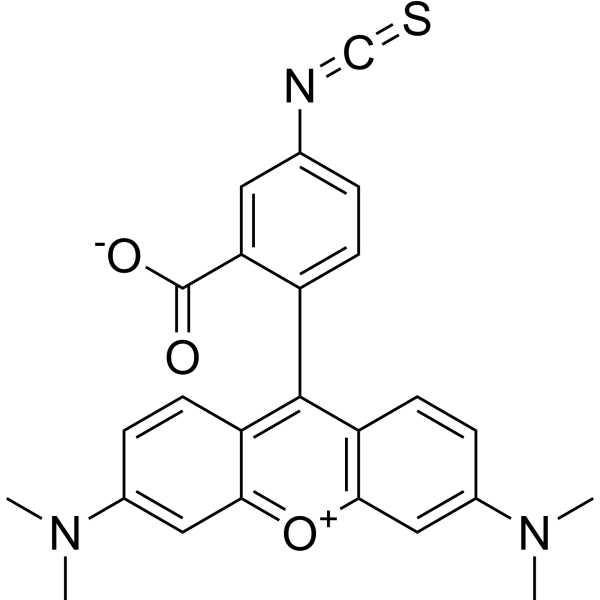
    Tetramethylrhodamine-5-isothiocyanate is a potent fluorescent dye. Tetramethylrhodamine-5-isothiocyanate can be used for label PG-M3 antibody for rapid diagnosis of acute promyelocytic leukemia (APL). Tetramethylrhodamine-5-isothiocyanate can be used as probe to quantify in vivo the biodistribution of PLGA (poly(lactic-co-glycolic) acid) and PLGA/chitosan nanoparticles .
    Tetramethylrhodamine-5-isothiocyanate
  • HY-A0009R

    Galantamine hydrobromide (Standard)

    nAChR Cholinesterase (ChE) Reference Standards Neurological Disease
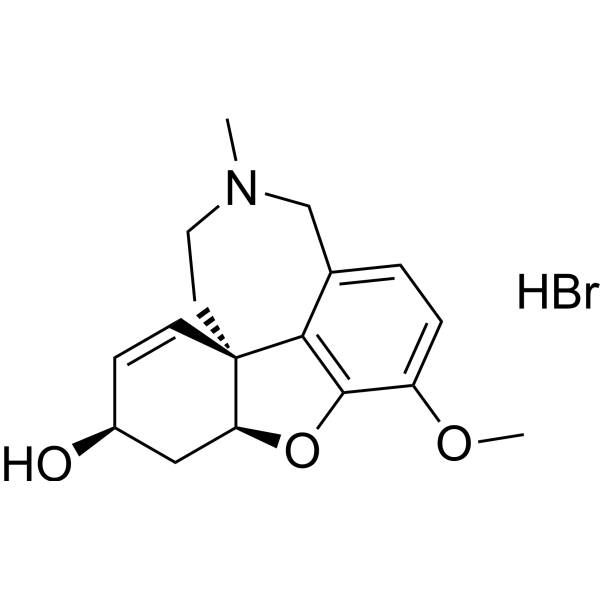
    Galanthamine (hydrobromide) (Standard) is the analytical standard of Galanthamine (hydrobromide). This product is intended for research and analytical applications. Galanthamine hydrobromide (Galantamine hydrobromide) is a selective, reversible, competitive, alkaloid AChE inhibitor, with an IC50 of 0.35 µM. Galanthamine hydrobromide is a potent allosteric potentiating ligand (APL) of human α3β4, α4β2, α6β4 nicotinic receptors ( nAChRs). Galanthamine hydrobromide is developed for the research of Alzheimer's disease (AD) .
    Galanthamine hydrobromide (Standard)
  • HY-W856819

    Opioid Receptor Cholinesterase (ChE) Drug Metabolite nAChR Neurological Disease
    Eseroline is a potent μ-opioid receptor agonist, which is the hydrolytic metabolite of Physostigmine (HY-N6608). Eseroline is a selective and competitive acetylcholinesterase (AChE) inhibitor, with its Ki values for AChE and BuChE being 0.1 μM and 200 μM respectively. Eseroline has nicotinic acetylcholine receptor allosteric enhancing ligand (nAChR-APL) activity, meaning it does not activate the receptor but significantly enhances the signal transduction of Ach triggered by the receptor. Eseroline is neurotoxic, causing cell membrane damage (LDH leakage) and energy metabolism collapse (ATP depletion). Eseroline can be used for the study of Alzheimer's disease .
    Eseroline
  • HY-118590A

    Topoisomerase DNA/RNA Synthesis Apoptosis Fungal Infection Cardiovascular Disease Inflammation/Immunology Cancer
    ICRF-196 is an racemic mixture of the (S,S)- and (R,R)-isomers of ICRF-193 (HY-118590). ICRF-193 is a DNA Topoisomerase II inhibitor. ICRF-193 can inhibit DNA syntheses and induces apoptosis. ICRF-193 exhibits anti-cancer and anti-inflammation effects. ICRF-193 shows cardioprotective effect against anthracycline toxicity to cardiomyocytes. ICRF-193 can be used for the researches of cancer, infection, inflammation and cardiovascular disease, such as acute promyelocytic leukemia .
    ICRF-196
  • HY-106171

    Insulin Receptor Metabolic Disease
    NBI-6024, an altered peptide ligand (APL), is an epitope recognized by inflammatory interferon-gamma-producing T helper lymphocytes in type 1 diabetic patients .
    NBI-6024
  • HY-RS18959

    Small Interfering RNA (siRNA) Others

    Neu1 Mouse Pre-designed siRNA Set A contains three designed siRNAs for Neu1 gene (Mouse), as well as a negative control, a positive control, and a FAM-labeled negative control.

    Neu1 Mouse Pre-designed siRNA Set A
    Neu1 Mouse Pre-designed siRNA Set A
  • HY-181959

    Eukaryotic Initiation Factor (eIF) Cancer
    APL-4098 is an orally active, selective, ATP-competitive GCN2 inhibitor with a Ki of 4.39 nM and a Kd of 2.9 nM. APL-4098 reduces the phosphorylation level of eIF2α and the expression level of ATF4. APL-4098 impairs mitochondrial function and exerts cytotoxic effects on primary acute myeloid leukemia cells. APL-4098 is applicable to research related to acute myeloid leukemia .
    APL-4098
  • HY-N15802

    Biochemical Assay Reagents Others
    APL-718 chloride is a fixed cationic lipid.
    APL-718 chloride
  • HY-A0009S

    Galantamine-d3 hydrobromide

    Isotope-Labeled Compounds Cholinesterase (ChE) nAChR Neurological Disease
    Galanthamine-d3 (hydrobromide) is deuterium labeled Galanthamine (hydrobromide). Galanthamine hydrobromide (Galantamine hydrobromide) is a selective, reversible, competitive, alkaloid AChE inhibitor, with an IC50 of 0.35 μM. Galanthamine hydrobromide is a potent allosteric potentiating ligand (APL) of human α3β4, α4β2, α6β4 nicotinic receptors ( nAChRs). Galanthamine hydrobromide is developed for the research of Alzheimer's disease (AD) .
    Galanthamine-d3 hydrobromide

Inquiry Online

Your information is safe with us. * Required Fields.

Salutation


Country or Region *

Applicant Name *


Organization Name *

Department *


Email Address *


Product Name *

Cat. No.


Requested quantity *

Phone Number *


Remarks

Inquiry Online

Inquiry Information

Product Name:
Cat. No.:
Quantity:
MCE Japan Authorized Agent:

