13 Results for "

Carbazole derivatives

" in MedChemExpress (MCE) Product Catalog:
Products (13)

13 Results for "Carbazole derivatives" in MCE Product Catalog:

2
2 Cited Publications
Cat. No.: HY-108637
CAS No.: 880813-36-5
Purity:  98.93%
Target:  

MDM-2/p53

Research Areas:  

Cancer

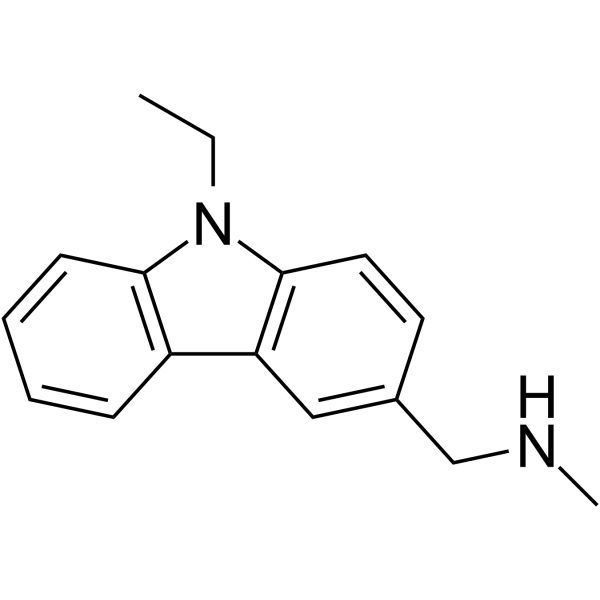
PhiKan 083 is a carbazole derivative, which binds to the surface cavity and stabilizes Y220C (a p53 mutant), with a Kd of 167 μM. PhiKan 083 can be used for cancer research .
loading...
    loading...
2
2 Cited Publications
Cat. No.: HY-108637A
CAS No.: 1050480-30-2
Purity:  99.01%
Target:  

MDM-2/p53

Research Areas:  

Cancer

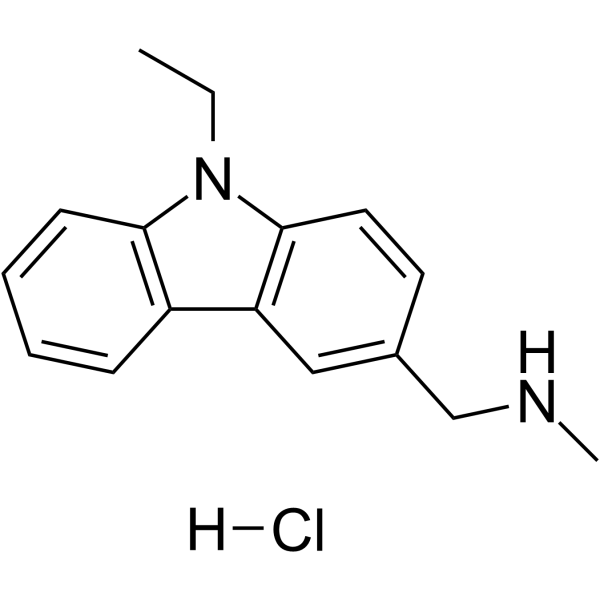
PhiKan 083 hydrochloride is a carbazole derivative, which binds to the surface cavity and stabilizes Y220C (a p53 mutant), with a Kd of 167 μM , and a relative binding affinity (Kd) of 150 μM in Ln229 cells .
loading...
    loading...
1
1 Cited Publications
Cat. No.: HY-W022224
CAS No.: 57103-02-3
Target:  

Endogenous Metabolite

Research Areas:  

Others

3,6-Diiodo-9H-carbazole is an organic compound that can be used for the design and synthesis of carbazole derivatives .
loading...
    loading...
Cat. No.: HY-135776
CAS No.: 850559-51-2
Purity:  99.89%
Synonyms: o-BMVC
Target:  

G-quadruplex

Research Areas:  

Cancer

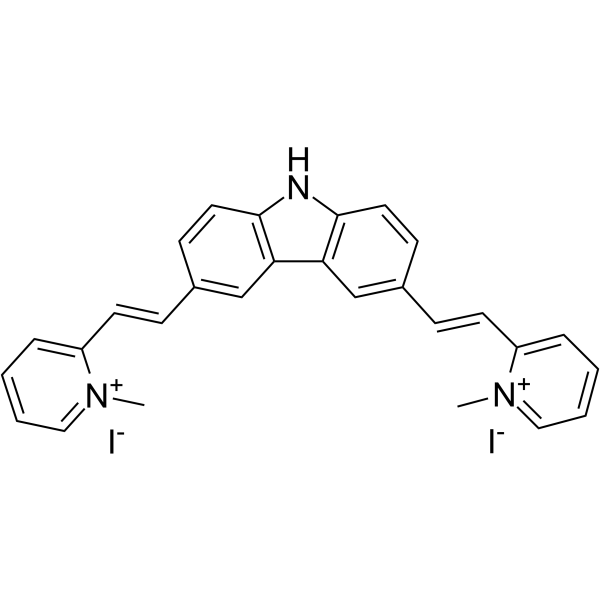
BMVC2 (o-BMVC) is a bisubstitute carbazole derivative of BMVC. BMVC2 is a G-quadruplex (G4) stabilizer .
loading...
    loading...
Cat. No.: HY-108510
CAS No.: 75859-03-9
Purity:  99.96%
Synonyms: BW 234U dihydrochloride
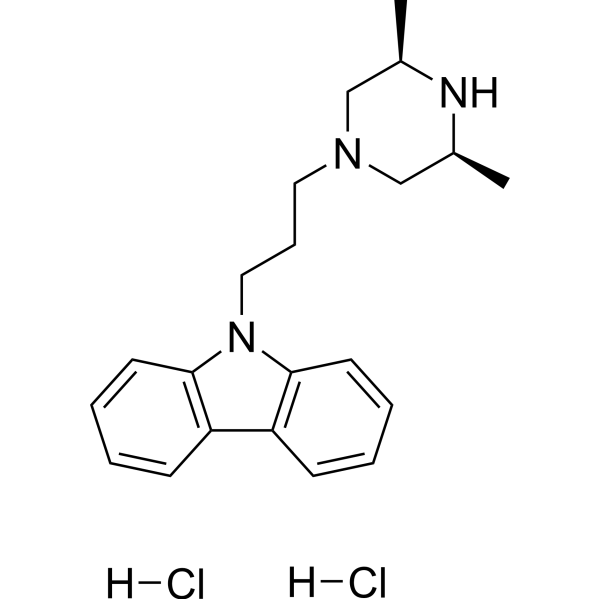
Rimcazole (BW 234U) dihydrochloride is a carbazole derivative that acts in part as a sigma (σ) receptor antagonist. Rimcazole dihydrochloride also binds with moderate affinity to the dopamine transporter and inhibit dopamine uptake. Rimcazole dihydrochloride can reduce locomotor activity and sensitization. Rimcazole dihydrochloride also can be used for the research of cancer .
loading...
    loading...
Cat. No.: HY-148179
CAS No.: 322723-35-3
Purity:  ≥98.0%
Research Areas:  

Neurological Disease

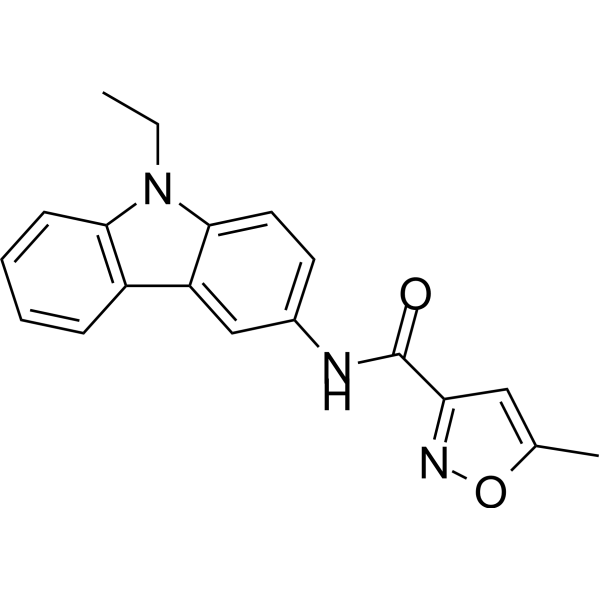
Neuropeptide Y5 receptor ligand-1 (compound 54), a carbazole derivative, is a potent neuropeptide Y5 (NPY-5) receptor antagonist .
loading...
    loading...
Cat. No.: HY-U00323
CAS No.: 164914-28-7
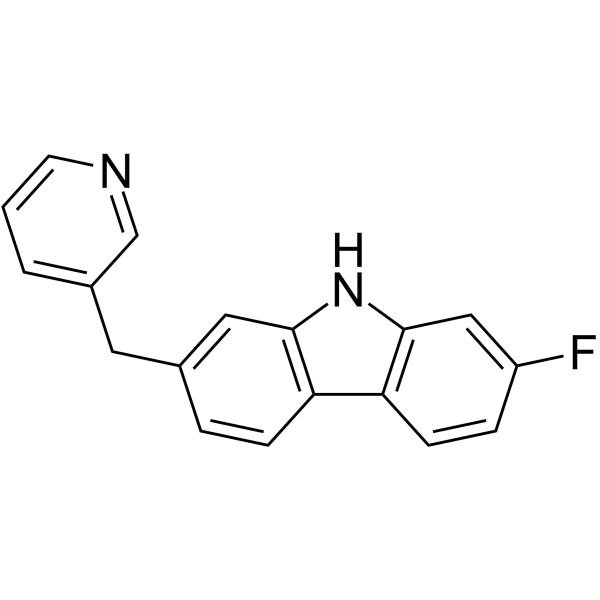
Synonyms: 2-Fluoro-7-[(3-pyridinyl)methyl]-9H-Carbazole
Carbazole derivative 1 is a carbazole derivative which can be used to reduce androgen or oestrogen levels in mammals, including humans.
loading...
    loading...
Cat. No.: HY-163775
Target:  

MyD88 NF-κB

Research Areas:  

Inflammation/Immunology

Anti-inflammatory agent 88 (compound 6) is a carbazole derivative with anti-inflammatory activity found in marine Streptomyces. It exerts its anti-inflammatory effect by inhibiting pro-inflammatory factors and enhancing the expression of anti-inflammatory factors in the Myd88/Nf-κB pathway. Anti-inflammatory agent 88 can be used for the development of anti-inflammatory drugs .
loading...
    loading...
Cat. No.: HY-108637R
CAS No.: 880813-36-5
Research Areas:  

Cancer

PhiKan 083 (Standard) is the analytical standard of PhiKan 083 (HY-108637). This product is intended for research and analytical applications. PhiKan 083 is a carbazole derivative, which binds to the surface cavity and stabilizes Y220C (a p53 mutant), with a Kd of 167 μM. PhiKan 083 can be used for cancer research .
loading...
    loading...
Cat. No.: HY-108510R
CAS No.: 75859-03-9
Synonyms: BW 234U dihydrochloride (Standard)
Rimcazole dihydrochloride (Standard) is the analytical standard of Rimcazole (dihydrochloride) (HY-108510). This product is intended for research and analytical applications. Rimcazole (BW 234U) dihydrochloride is a carbazole derivative that acts in part as a sigma (σ) receptor antagonist. Rimcazole dihydrochloride also binds with moderate affinity to the dopamine transporter and inhibit dopamine uptake. Rimcazole dihydrochloride can reduce locomotor activity and sensitization. Rimcazole dihydrochloride also can be used for the research of cancer .
loading...
    loading...
Cat. No.: HY-179523
CAS No.: 2635394-10-2
Carba1 is a bifunctional Carbazole (HY-D0204) derivative that activates nicotinamide phosphoribosyltransferase (NAMPT) and enhances NAD biosynthesis. Carba1 binds to colchicine site of tubulin, enhancing the anti-tumor effect of various chemotherapy drugs, such as Paclitaxel (HY-B0015). Carba1 exerts neuroprotective effect and can regulate cell energy metabolism. Carba1 can be used for the researches of cancer and chemotherapy-induced peripheral neuropathy (CIPN) .
loading...
    loading...
Cat. No.: HY-179670
CAS No.: 2771231-72-0
Target:  

Bacterial

Research Areas:  

Infection

Antibacterial agent 304 (Compound 3a) is an antibacterial agent with a minimum inhibitory concentration (MIC) of 8 μg/mL against S. aureus and P. aeruginosa. This antibacterial agent has a bactericidal effect and can disrupt the integrity of the cell wall. Antibacterial agent 304 has the potential to be a sustainable organic photocatalyst .
loading...
    loading...
Cat. No.: HY-D3117
CAS No.: 2146114-18-1
Target:  

Fluorescent Dye

Research Areas:  

Others

MBCB is a two-photon Fluorescent probe for dual-detection of mitochondrial SO₂ derivatives and viscosity. For SO₂ derivatives detection, the probe utilizes a Michael addition mechanism: nucleophilic addition of SO₂ derivatives to the C=C bond between the carbazole skeleton and 3-methylbenzothiazolium moiety destroys the strong intramolecular charge transfer (ICT) system between these groups, while enhancing the weak ICT system between the benzothiazole group and carbazole framework; this causes the red emission at 600 nm to decrease and the blue emission at 434 nm to increase, creating a ratiometric response based on the I₄₃₄ₙₘ/I₆₀₀ₙₘ intensity ratio. For viscosity detection, in low-viscosity environments, steric hindrance creates a twisted ICT (TICT) system with weak fluorescence, while in high-viscosity environments, intramolecular rotation is blocked, the TICT state is disrupted, and the strong ICT system is recovered, leading to a strong red emission at 567 nm with negligible change to the short-wavelength emission at 415 nm, creating a ratiometric response based on the I₅₆₇ₙₘ/I₄₁₅ₙₘ intensity ratio that has a logarithmic linear relationship with viscosity. The probe has excitation/emission wavelengths of Ex/Em = 351/434, 600 nm for SO₂ derivatives detection and Ex/Em = 351/567 nm for viscosity detection, with two-photon excitation at 740 nm for bioimaging; it also exhibits good mitochondrial targeting ability with a Pearson's colocalization coefficient of 0.93 when paired with Mito-Tracker Green. The probe shows high sensitivity and selectivity for SO₂ derivatives, has low cell cytotoxicity, and can be applied to detect exogenous/endogenous HSO₃⁻ in living cells and in vivo, as well as visualize mitochondrial viscosity changes induced by nystatin[1].
loading...
    loading...
  • 1

