10 Results for "

GTP trisodium

" in MedChemExpress (MCE) Product Catalog:
Products (10)

10 Results for "GTP trisodium" in MCE Product Catalog:

9
9 Publications Verification
Cat. No.: HY-12695B
CAS No.: 207300-85-4
Purity:  ≥95.0%
Synonyms: GTP trisodium salt hydrate
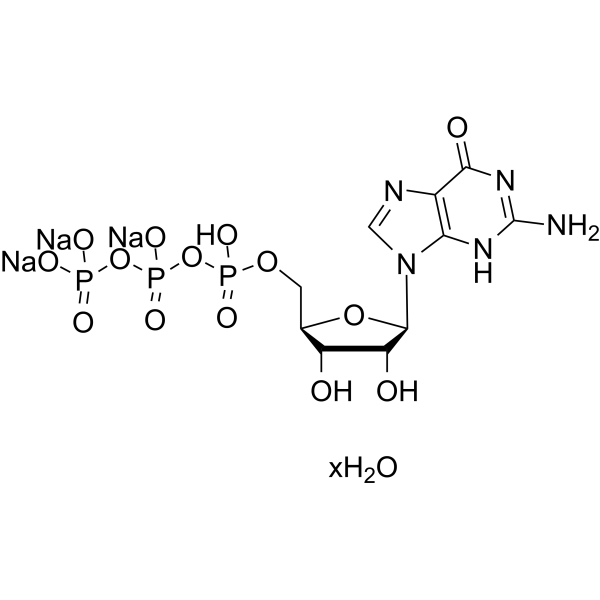
Guanosine triphosphate (GTP) trisodium salt hydrate is a critical nucleotide and regulator of cellular metabolism. Guanosine triphosphate trisodium salt hydrate promotes ribosomal DNA localization, pre-rRNA transcription and ribosome biogenesis by binding to RNA polymerase I and GPN proteins (GPN1/3). Guanosine triphosphate trisodium salt hydrate links MYC-dependent ribosome biogenesis to nucleotide sufficiency, acts as a metabolic gatekeeper supporting protein synthesis, DNA/RNA synthesis and cellular signal transduction, while also participating in the physiological activities of pancreatic β-cells and serving as an oxidative substrate for reactive oxygen species. In small cell lung cancer with high MYC expression, Guanosine triphosphate trisodium salt hydrate accumulates through the IMPDH-driven synthetic pathway, thereby affecting apoptosis and mitotic processes. Guanosine triphosphate trisodium salt hydrate is used in the research of small cell lung cancer, hepatoblastoma and cellular metabolism .
loading...
    loading...
6
6 Cited Publications
Cat. No.: HY-12695
CAS No.: 36051-31-7
Purity:  ≥95.0%
Synonyms: GTP trisodium
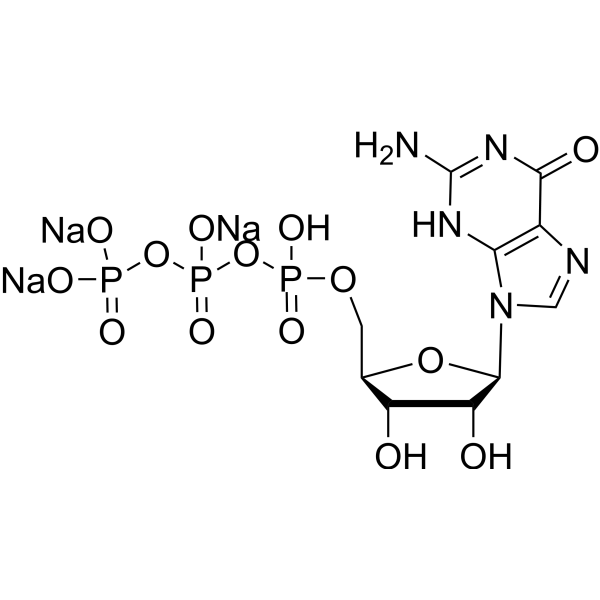
Guanosine triphosphate (GTP) trisodium is a critical nucleotide and regulator of cellular metabolism. Guanosine triphosphate trisodium promotes ribosomal DNA localization, pre-rRNA transcription and ribosome biogenesis by binding to RNA polymerase I and GPN proteins (GPN1/3). Guanosine triphosphate trisodium links MYC-dependent ribosome biogenesis to nucleotide sufficiency, acts as a metabolic gatekeeper supporting protein synthesis, DNA/RNA synthesis and cellular signal transduction, while also participating in the physiological activities of pancreatic β-cells and serving as an oxidative substrate for reactive oxygen species. In small cell lung cancer with high MYC expression, Guanosine triphosphate trisodium accumulates through the IMPDH-driven synthetic pathway, thereby affecting apoptosis and mitotic processes. Guanosine triphosphate trisodium is used in the research of small cell lung cancer, hepatoblastoma and cellular metabolism .
loading...
    loading...
2
2 Cited Publications
Cat. No.: HY-113225H
CAS No.: 36051-31-7
Synonyms: Guanosine triphosphate trisodium salt, 100 mM Solution, PCR Grade
GTP trisodium salt, 100 mM Solution, PCR Grade (Guanosine triphosphate trisodium salt, 100 mM Solution, PCR Grade) is a solution prepared from GTP at a concentration of 100 mM, free of DNase, RNase and phosphatase contamination, and suitable for molecular biology research .
loading...
    loading...
Cat. No.: HY-W013706
CAS No.: 35908-31-7
Synonyms: ITP trisodium salt; Inosine triphosphate trisodium salt
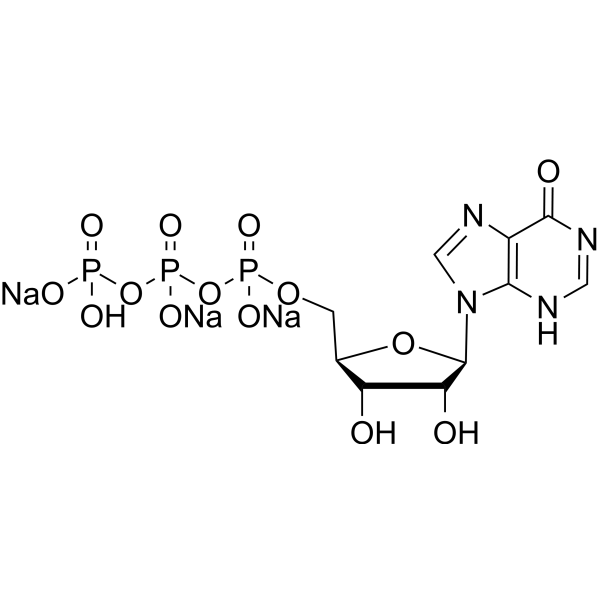
Inosine-5'-triphosphate trisodium salt is a nucleotide analogue that acts on multiple G proteins and is widely used in G protein-related research. It can bind to the α -subunit of G proteins and participate in G protein-mediated signal transduction as a substitute for GTP. Its mechanism of action is to interact with the nucleotide-binding site of the G protein α -subunit, affecting the activity and function of G proteins. In the research field, it is mainly used to explore the role of the G protein signaling pathway in cellular physiological and pathological processes. For example, in HL-60 leukemia cells, its impact on G protein-mediated signal transduction can be studied .
loading...
    loading...
Cat. No.: HY-100767
CAS No.: 148892-91-5
Synonyms: Guanosine 5'-[β,γ-imido]triphosphate trisodium
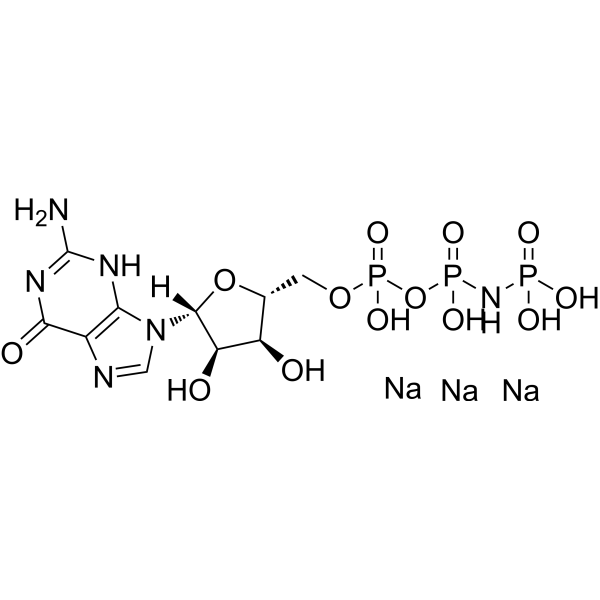
Guanylyl Imidodiphosphate (Guanosine 5'-[β,γ-imido]triphosphate) trisodium is a non-hydrolysable GTP analogue, an activator of ADP-ribosylation factor (ARF) and a potent stimulator of adenylate cyclase. Imidodiphosphate trisodium can be used in protein synthesis studies .
loading...
    loading...
Cat. No.: HY-108656A
Purity:  ≥99.0%
Target:  

P2Y Receptor Arrestin

Research Areas:  

Cardiovascular Disease

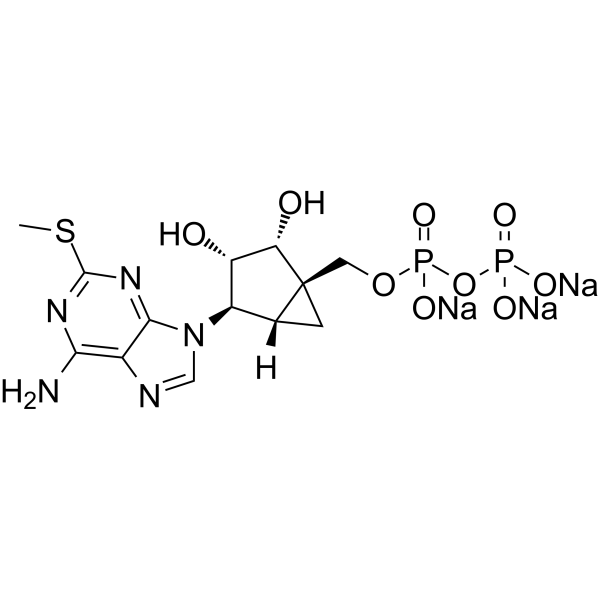
MRS2365 trisodium is a potent and selective P2Y1 receptor (EC50=0.4 nM)/[ 35S]GTPγS binding/β-arrestin 2 recruitment agonist. MRS2365 trisodium relieves mechanical allodynia and increases mechanical sensitivity .
loading...
    loading...
Cat. No.: HY-134991A
Synonyms: 3′-Deoxyguanosine 5′-triphosphate trisodium
3'-Deoxy-GTP (3′-Deoxyguanosine 5′-triphosphate) trisodium, an analog of GTP, is a RNA chain terminator and suppresses RNA synthesis. 3'-Deoxy-GTP trisodium inhibits DENV NS5 RdRp (IC50: 0.02 μM) .
loading...
    loading...
Cat. No.: HY-137678A
Research Areas:  

Others

GTP-γ-AmNS (trisodium) is a fluorescent derivative of GTPexc 320 nm; λem 460 nm). GTP-γ-AmNS (trisodium) can be used in assays of enzymes specialized to cleave α-β-phosphodiester bonds .
loading...
    loading...
Cat. No.: HY-137615A
Research Areas:  

Others

Sp-GDPαS trisodium is a regulator of GDP-binding proteins. Sp-GDPαS trisodium is metabolically more stable than GTP .
loading...
    loading...
Cat. No.: HY-W013706R
CAS No.: 35908-31-7
Synonyms: ITP trisodium salt (Standard); Inosine triphosphate trisodium salt (Standard)
Inosine-5'-triphosphate (trisodium salt) (Standard) is the analytical standard of Inosine-5'-triphosphate (trisodium salt) (HY-W013706). This product is intended for research and analytical applications. Inosine-5'-triphosphate trisodium salt is a nucleotide analogue that acts on multiple G proteins and is widely used in G protein-related research. It can bind to the α -subunit of G proteins and participate in G protein-mediated signal transduction as a substitute for GTP. Its mechanism of action is to interact with the nucleotide-binding site of the G protein α -subunit, affecting the activity and function of G proteins. In the research field, it is mainly used to explore the role of the G protein signaling pathway in cellular physiological and pathological processes. For example, in HL-60 leukemia cells, its impact on G protein-mediated signal transduction can be studied .
loading...
    loading...

