





1. Search Result
Search Result
Results for "

Inositol trisphosphate

" in MedChemExpress (MCE) Product Catalog:

19

Inhibitors & Agonists

4

Biochemical Assay Reagents

2

Peptides

3

Natural
Products

4

Recombinant Proteins

4

Antibodies

2

Oligonucleotides

Targets Recommended:
Cat. No. Product Name Target Research Areas Chemical Structure
  • HY-103312
    Xestospongin C
    5+ Cited Publications

    (-)-Xestospongin C

    Calcium Channel Apoptosis Neurological Disease
    Xestospongin C ((-)-Xestospongin C) is a selective, reversible inositol 1,4,5-trisphosphate receptor (IP3R) inhibitor. Xestospongin C acts as an inhibitor of the sarcoplasmic/endoplasmic reticulum Ca 2+ ATPase (SERCA) pump of internal stores. Xestospongin C blocks IP3-induced Ca 2+ release from cerebellar microsomes with an IC50 of 358 nM. Xestospongin C is a valuable tool for investigating the structure and function of IP3Rs and Ca 2+ signaling in neuronal and nonneuronal cells .
    Xestospongin C
  • HY-103642A

    Inositol 1,4,5-trisphosphate trisodium; Ins(1,4,5)-P3 trisodium

    Calcium Channel Metabolic Disease
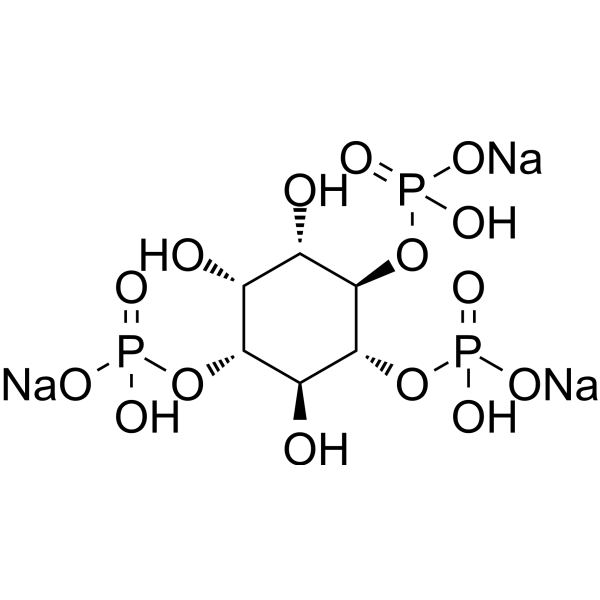
    D-myo-Inositol-1,4,5-triphosphate sodium salt is the trisodium salt of D-myo-Inositol 1,4,5-trisphosphate (1,4,5-IP3), which is a second messenger that stimulates the discharge of calcium from the endoplasmic reticulum.
    D-myo-Inositol-1,4,5-triphosphate trisodium
  • HY-126750
    GNF362
    2 Publications Verification

    Phosphatase Inflammation/Immunology
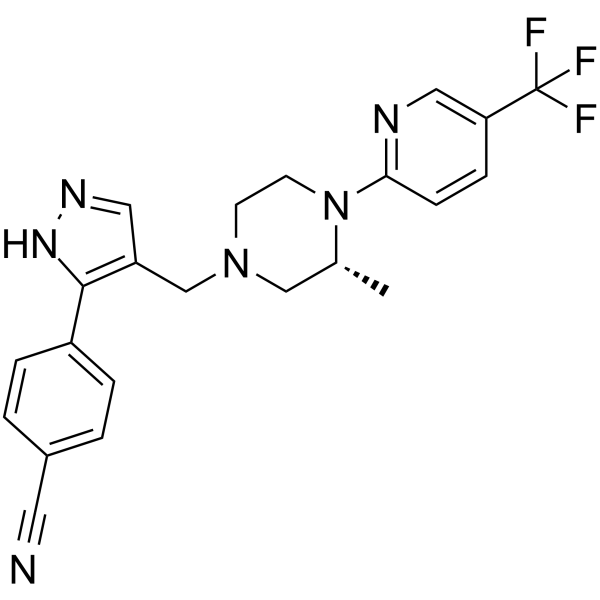
    GNF362 is a selective, potent, and orally bioavailable inhibitor of inositol trisphosphate 3’ kinase B (Itpkb) with an IC50 of 9 nM. GNF362 also inhibits Itpka and Itpkc with IC50 values of 20 nM and 19 nM, respectively. Inositol trisphosphate 3’ kinase B (Itpkb) is a Ca 2+-dependent kinase, which phosphorylates the 3’ position of Ins (1,4,5) P3 to generate inositol 1,3,4,5-tetrakisphosphate [Ins (1,3,4,5) P4] .
    GNF362
  • HY-16694
    BAMB-4
    1 Publications Verification

    ITPKA-IN-C14

    Phosphatase Cancer
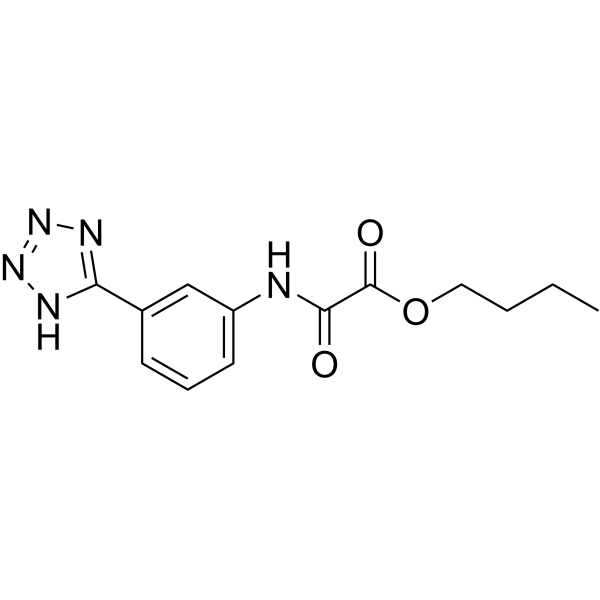
    BAMB-4 (ITPKA-IN-C14) is a specific and membrane-permeable ITPKA inhibitor. BAMB-4 has high stability and membrane permeability and against the inositol-1,4,5-trisphosphate (InsP3) kinase activity of inositol-1,4,5-trisphosphate-3-kinase A (ITPKA) with an IC50 value of 20 μM. BAMB-4 can be used for the research of metastasis of lung cancer .
    BAMB-4
  • HY-142117

    Calcium Channel Chloride Channel Others
    Adenophostin A is an IP3 receptor (inositol 1,4,5-trisphosphate receptors) modulator and Ca 2+ releaser, with an IC50 of 1.3 nM, an EC50 of 1.4 nM, and a Ki of 0.18 nM in rats, and an IC50 of 0.95 nM in humans. Adenophostin A activates IP3 receptors, stimulates Ca 2+ release from intracellular stores and microsomes, inhibits the binding of [ 3H]IP3 to plasma membrane receptors, and activates chloride channels. Adenophostin A resists phosphorylation and dephosphorylation by IP3 metabolic enzymes to maintain its activity, and increases cytoplasmic [Ca 2+] levels via calcium mobilization from the endoplasmic reticulum of vascular smooth muscle cells. Adenophostin A is applicable to research related to hemorrhagic shock .
    Adenophostin A
  • HY-103642

    Inositol 1,4,5-trisphosphate hexapotassium salt; Ins(1,4,5)-P3 hexapotassium salt

    Calcium Channel Metabolic Disease
    D-myo-Inositol 1,4,5-trisphosphate hexapotassium salt is the hexapotassium salt of D-myo-Inositol 1,4,5-trisphosphate (1,4,5-IP3), which is a second messenger that stimulates the discharge of calcium from the endoplasmic reticulum.
    D-myo-Inositol 1,4,5-trisphosphate hexapotassium salt
  • HY-114457

    L-alpha-PhosphatidylInositol-4,5-bisphosphate; (PtdIns)-(4,5)-P2

    Phospholipase Inflammation/Immunology
    Phosphatidylinositol 4,5-bisphosphate (L-alpha-Phosphatidylinositol-4,5-bisphosphate) is a plasma membrane lipid that is enriched in the cytoplasmic leaflet of the plasma membrane. Phosphatidylinositol 4,5-bisphosphate serves as a substrate for phospholipase C and class I PI3K, generating diacylglycerol, inositol (1,4,5)-trisphosphate, and phosphatidylinositol (3,4,5)-trisphosphate. Phosphatidylinositol 4,5-bisphosphate contributes to lamellipodial protrusion, directional cell migration, focal adhesion lipid generation, and trafficking of the GABAA receptor. Phosphatidylinositol 4,5-bisphosphate can be used in research related to acute lung injury and pulmonary edema .
    Phosphatidylinositol 4,5-bisphosphate
  • HY-P1341

    Orexin A (17-33) (human, mouse, rat, bovine)

    Orexin Receptor (OX Receptor) Sigma Receptor Phospholipase Neurological Disease
    OXA (17-33) (Orexin A (17-33) (human, mouse, rat, bovine)) is the shortest active orexin peptide that selectively targets OX1 (EC50=8.29 nM), with 23-fold selectivity for the OX1 receptor over the OX2 receptor. The activity of OXA (17-33) depends on the Tyr17, Leu20, Asn25, His26 residues and the spatial conformation of the α-helix. OXA (17-33) activates signaling pathways involving inositol-1,4,5-trisphosphate receptor (IP3R), phospholipase D (PL-D) and choline-Sigma-1R, thereby increasing the cytoplasmic Ca 2+ level in nucleus accumbens neurons, an effect that is blocked by Sigma-1R antagonists. OXA (17-33) serves as an important biological probe for investigating the function of the OX1 receptor. OXA (17-33) can be modified via incorporation of mixed disulfide bonds of homocysteine and cysteamine, and is widely used in studies related to insomnia and narcolepsy .
    OXA(17-33)
  • HY-W795960

    Biochemical Assay Reagents Calcium Channel Phospholipase Neurological Disease Metabolic Disease
    D-myo-inositol 1,4,5-trisphosphate sodium salt is a widely distributed intracellular second messenger. D-myo-inositol 1,4,5-trisphosphate sodium salt acts as a potent agonist of the Ins (1,4,5) P3 receptor with an EC50 of 0.12 μM and inhibits bovine PLC-δ1, with an IC50 of 5.4 μM for binding and an IC50 of 12.4 μM for hydrolysis. D-myo-inositol 1,4,5-trisphosphate sodium saltis metabolized into Ins (1,4) P2 and Ins (1,3,4,5) P4. D-myo-inositol 1,4,5-trisphosphate sodium salt mediates various cellular processes, including growth, development, fertilization, secretion, contraction and neuromodulation. D-myo-inositol 1,4,5-trisphosphate sodium salt inhibits PIP2 hydrolysis and Ca 2+-ATPase activity. D-myo-inositol 1,4,5-trisphosphate sodium salt is used for cardiac preconditioning, exerts cardioprotective effects and mimics ischemic preconditioning. D-myo-inositol 1,4,5-trisphosphate sodium salt is applied in studies related to intracellular calcium and phosphoinositol signaling pathways .
    D-myo-Inositol 1,4,5-trisphosphate sodium salt
  • HY-W127317

    Biochemical Assay Reagents Others
    Inositol 1,3,4,5-tetraphosphate is the head group of PIP3 (phosphatidylinositol 3,4,5-trisphosphate) .
    Inositol 1,3,4,5-tetraphosphate
  • HY-150135B

    Inositol 1,4,5-trisphosphate tripotassium; Ins(1,4,5)-P3 tripotassium

    Calcium Channel Neurological Disease
    D-myo-Inositol 1,4,5-trisphosphate tripotassium, a second messenger, elicits Ca 2+ mobilization. D-myo-Inositol 1,4,5-trisphosphate tripotassium inhibits the binding of phosphoinositide-specific phospholipase C-delta 1 (PLC-delta 1) to bilayer membranes composed of phosphatidylcholine (PC) and phosphatidylinositol 4,5-bisphosphate (PIP2) .
    D-myo-Inositol 1,4,5-trisphosphate tripotassium
  • HY-120985

    Calcium Channel Neurological Disease
    Xestospongins and araguspongins are marine natural products first isolated from Pacific basin sponges, and noted to have vasodilatory properties.1 Inositol phosphates (IP) are important signal transduction messengers acting via IP3 receptors to promote the mobilization of Ca2+ from intracellular stores.2 Araguspongin B antagonizes the calcium-releasing action of inositol 1,4,5-trisphosphate at the receptor level in cerebral microsomes, with an IC50 of 0.6 μM. It is nearly as potent as xestospongin C as an antagonist of the IP3 receptor.
    Araguspongin B
  • HY-157652

    1-Stearoyl-2-arachidonoyl-sn-glycero-3-phospho-1′-myo-Inositol-3′,4′,5′-trisphosphate ammonium

    Biochemical Assay Reagents
    18:0-20:4 PI(3,4,5)P3 (1-Stearoyl-2-arachidonoyl-sn-glycero-3-phospho-(1′-myo-inositol-3′,4′,5′-trisphosphate) (ammonium)) is a kind of biochemical reagent.
    18:0-20:4 PI(3,4,5)P3
  • HY-W403046A

    Drug Metabolite Calcium Channel Neurological Disease
    D-myo-Inositol-4-phosphate monoammonium is a metabolite of D-myo-Inositol 1,4,5-trisphosphate. D-myo-Inositol 1,4,5-trisphosphate, a second messenger, elicits Ca 2+ mobilization. D-myo-Inositol 1,4,5-trisphosphate inhibits the binding of phosphoinositide-specific phospholipase C-delta 1 (PLC-delta 1) to bilayer membranes composed of phosphatidylcholine (PC) and phosphatidylinositol 4,5-bisphosphate (PIP2) .
    D-myo-Inositol-4-phosphate monoammonium
  • HY-P5866

    Manse-AT

    Endogenous Metabolite Endocrinology
    Allatotropin (Manse-AT) is a 13 amino acid neuropeptide. Allatotropin activates inositol 1,4,5-trisphosphate (IP3) pathway, and the biosynthesis of juvenile hormone (JH) in Manduca sexta .
    Allatotropin
  • HY-157715

    Biochemical Assay Reagents
    1,2-Dioctanoyl-sn-glycero-3-phospho-(1'-myo-inositol-3',4',5'-trisphosphate) ammonium is a membrane-bound signaling molecule with activities that regulate cell growth, metabolism, proliferation, and survival. 1,2-Dioctanoyl-sn-glycero-3-phospho-(1'-myo-inositol-3',4',5'-trisphosphate) ammonium plays an important role in cell physiology and participates in multiple signal transduction pathways. 1,2-Dioctanoyl-sn-glycero-3-phospho-(1'-myo-inositol-3',4',5'-trisphosphate) ammonium has a profound effect on intracellular signaling.
    1,2-Dioctanoyl-sn-glycero-3-phospho-1'-myo-inositol-3',4',5'-trisphosphate ammonium
  • HY-172803

    Ferroptosis ERK MEK p38 MAPK Inflammation/Immunology
    Ferroptosis inducer-7 is an orally active and selective ferroptosis inducer via inositol 1,4,5-trisphosphate receptor (IP3R)/calcium release-activated calcium channel protein (ORAI). Ferroptosis inducer-7 exhibits a notable effect in alleviating anemia symptoms, suppressing bone marrow CTLs activation, and improving hematopoietic function in immune-mediated bone marrow failure. Ferroptosis inducer-7 can be studied in research for aplastic anemia .
    Ferroptosis inducer-7
  • HY-W790474

    Biochemical Assay Reagents Others
    D-myo-Inositol 1,3,4-tris-phosphate is a biochemical assay reagent.
    D-myo-Inositol 1,3,4-tris-phosphate
  • HY-179543

    Endogenous Metabolite Others
    PtdIns-(3,4,5)-P3-(1-stearoyl, 2-arachidonoyl) sodium is a specific molecular form of phosphatidylinositol-3,4,5-trisphosphate (PIP3). PIP3 is the core lipid messenger in the tyrosine kinase pathway, regulating cell proliferation, survival and metabolism by recruiting effector proteins. Its abnormality is associated with cancer. PtdIns-(3,4,5)-P3-(1-stearoyl, 2-arachidonoyl) sodium can be used for studying lipid signal transduction .
    PtdIns-(3,4,5)-P3-(1-stearoyl, 2-arachidonoyl) sodium

Inquiry Online

Your information is safe with us. * Required Fields.

Salutation


Country or Region *

Applicant Name *


Organization Name *

Department *


Email Address *


Product Name *

Cat. No.


Requested quantity *

Phone Number *


Remarks

Inquiry Online

Inquiry Information

Product Name:
Cat. No.:
Quantity:
MCE Japan Authorized Agent:

