
15 Results for "

chemiluminescent substrate

" in MedChemExpress (MCE) Product Catalog:
Products (15)

15 Results for "chemiluminescent substrate" in MCE Product Catalog:

189
189 Publications Verification
Cat. No.: HY-K1005

MCE Ultra High Sensitivity ECL Kit is an ultra-sensitive, luminol-based enhanced chemiluminescent substrate for detecting horseradish peroxidase (HRP) labeled antibodies on western blots. The 100 mL is defined as the base specification. All larger sizes correspond to incremental volumes of this base.

loading...
    loading...
126
126 Cited Publications
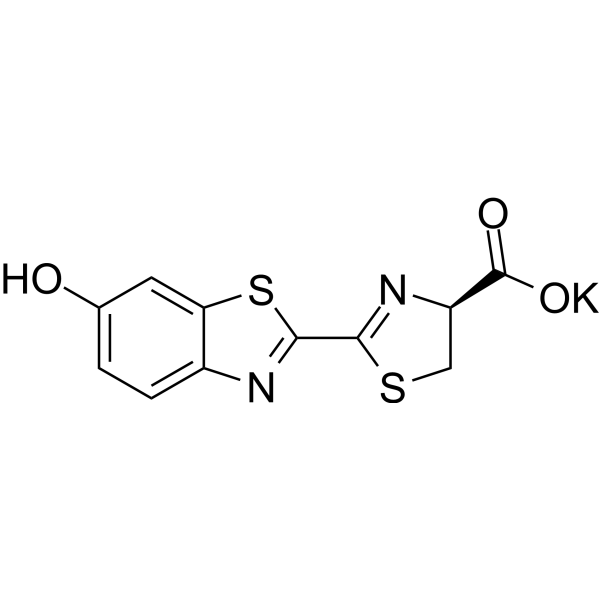
Cat. No.: HY-12591B
CAS No.: 115144-35-9
Purity:  99.97%
Synonyms: D-(-)-Luciferin potassium; Firefly luciferin potassium; Beetle Luciferin potassium
D-luciferin potassium is the natural substrate of the enzyme luciferase (Luc) that catalyzes the production of the typical yellowgreen light of fireflies. The 560 nm chemiluminescence from this reaction peaks within seconds, with light output that is proportional to luciferase concentration when the substrate luciferin is present in excess. The luciferase (luc) gene is a popular reporter gene for research and agent screening. Chemiluminescent techniques are virtually background-free, making the luc reporter gene ideal for detecting low-level gene expression. As little as 0.02 pg of luciferase can be reliably measured in a standard scintillation counter. In addition to its role as a reporter of gene expression, luciferase is commonly used in an extremely sensitive assay for ATP . We offer the firefly luciferase (HY-P1004A), luciferin free acid (HY-12591A), as well as its water-soluble sodium salts (HY-12591) and potassium salts (HY-12591B) .
loading...
    loading...
126
126 Cited Publications
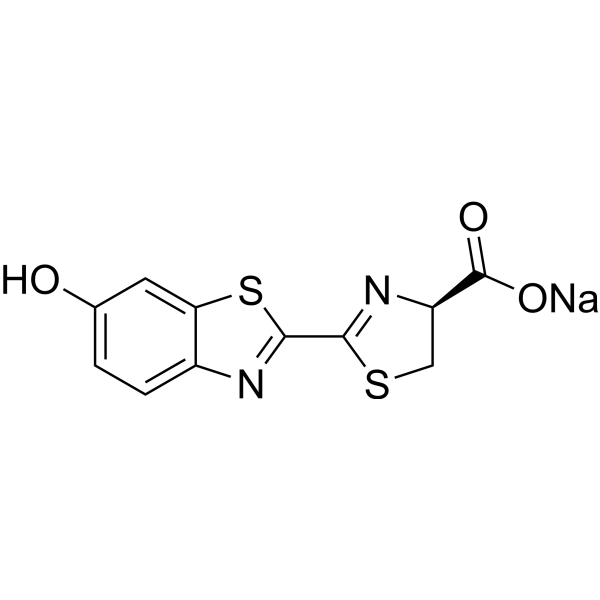
Cat. No.: HY-12591
CAS No.: 103404-75-7
Purity:  99.92%
Synonyms: D-(-)-Luciferin sodium; Firefly luciferin sodium; Beetle Luciferin sodium
D-luciferin sodium is the natural substrate of the enzyme luciferase (Luc) that catalyzes the production of the typical yellowgreen light of fireflies. The 560 nm chemiluminescence from this reaction peaks within seconds, with light output that is proportional to luciferase concentration when the substrate luciferin is present in excess. The luciferase (luc) gene is a popular reporter gene for research and agent screening. Chemiluminescent techniques are virtually background-free, making the luc reporter gene ideal for detecting low-level gene expression. As little as 0.02 pg of luciferase can be reliably measured in a standard scintillation counter. In addition to its role as a reporter of gene expression, luciferase is commonly used in an extremely sensitive assay for ATP . We of er the firefly luciferase (HY-P1004A), luciferin free acid (HY-12591A), as well as its water-soluble sodium salts (HY-12591) and potassium salts (HY-12591B) .
loading...
    loading...
126
126 Cited Publications
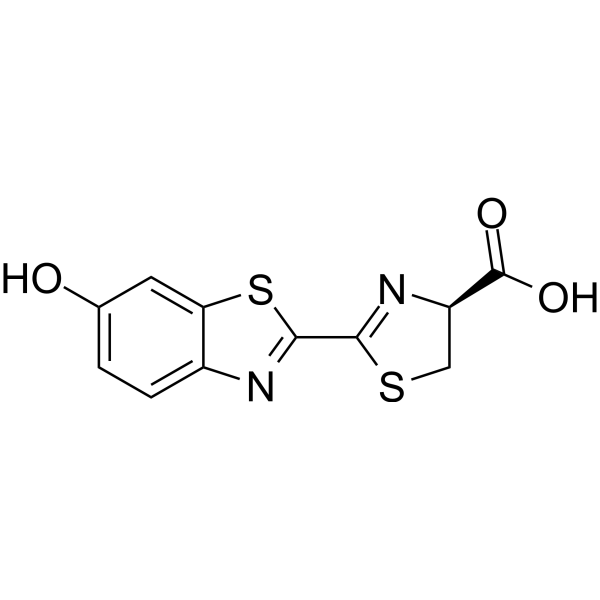
Cat. No.: HY-12591A
CAS No.: 2591-17-5
Purity:  99.54%
Synonyms: D-(-)-Luciferin; Firefly luciferin; Beetle Luciferin
D-luciferin is the natural substrate of the enzyme luciferase (Luc) that catalyzes the production of the typical yellowgreen light of fireflies. The 560 nm chemiluminescence from this reaction peaks within seconds, with light output that is proportional to luciferase concentration when the substrate luciferin is present in excess. The luciferase (luc) gene is a popular reporter gene for research and agent screening. Chemiluminescent techniques are virtually background-free, making the luc reporter gene ideal for detecting low-level gene expression. As little as 0.02 pg of luciferase can be reliably measured in a standard scintillation counter. In addition to its role as a reporter of gene expression, luciferase is commonly used in an extremely sensitive assay for ATP . We of er the firefly luciferase (HY-P1004A), luciferin free acid (HY-12591A), as well as its water-soluble sodium salts (HY-12591) and potassium salts (HY-12591B) .
loading...
    loading...
6
6 Cited Publications
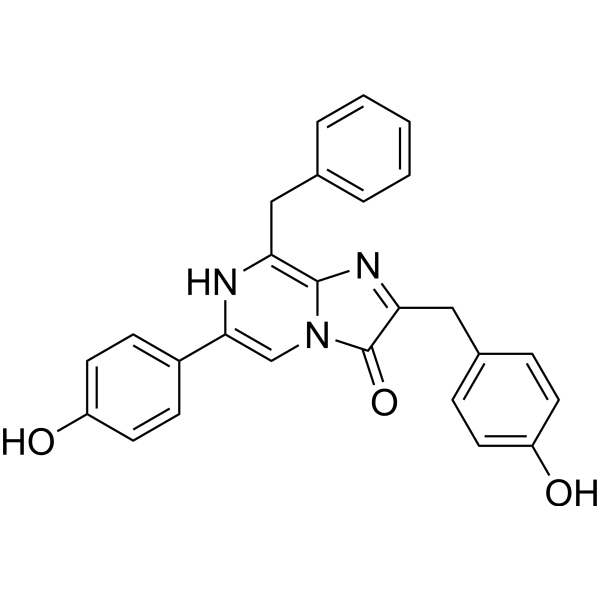
Cat. No.: HY-18743
CAS No.: 55779-48-1
Coelenterazine is a luminescent enzyme substrate for apoaequorin and Renilla luciferase. Renilla luciferase and substrate coelenterazine has been used as the bioluminescence donor in bioluminescence resonance energy transfer (BRET) to detect protein-protein interactions. Coelenterazine is a superoxide anion-sensitive chemiluminescent probe and it can also be used in chemiluminescent detection of peroxynitrite (Ex/Em = 429/466 nm) .
loading...
    loading...
6
6 Cited Publications
Cat. No.: HY-18743A
Research Areas:  

Cancer

Coelenterazine TFA is a luminescent enzyme substrate for apoaequorin and Renilla luciferase. Renilla luciferase and substrate Coelenterazine TFA has been used as the bioluminescence donor in bioluminescence resonance energy transfer (BRET) to detect protein-protein interactions. Coelenterazine TFA is a superoxide anion-sensitive chemiluminescent probe and it can also be used in chemiluminescent detection of peroxynitrite (Ex/Em = 429/466 nm) .
loading...
    loading...
1
1 Cited Publications
Cat. No.: HY-15906
CAS No.: 122341-56-4
Purity:  99.93%
Synonyms: Lumi-Phos Plus; Lumigen PPD; PPD
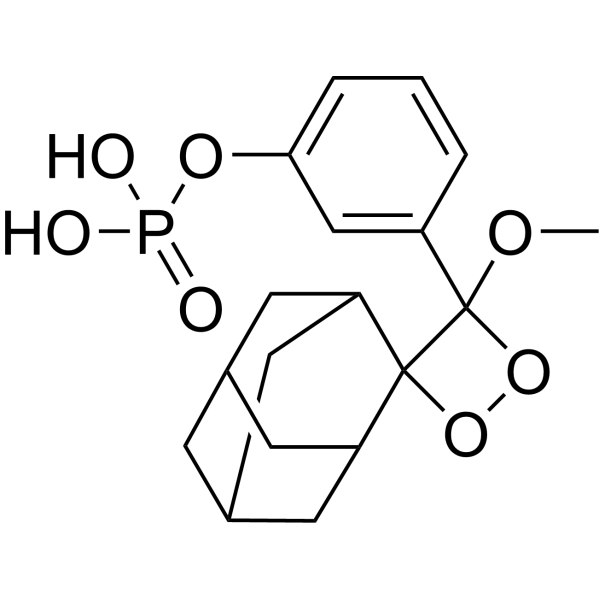
AMPPD (Lumi-Phos Plus; Lumigen PPD) is a chemiluminescent substrate for alkaline phosphatase (APase). AMPPD is hydrolyzed by APase to generate an unstable dioxetane intermediate, and the intermediate releases a chemiluminescent signal when it decomposes. The luminescent signal of AMPPD can be detected by highly sensitive equipment, thereby achieving quantitative analysis of the target molecule. AMPPD can be used in ultrasensitive enzyme-linked immunosorbent assays (such as quantitative detection of human tissue kininogen), chemiluminescent detection of proteins and nucleic acids, and other fields .
loading...
    loading...
Cat. No.: HY-D1208
CAS No.: 160081-62-9
Alkaline phosphatase substrate is a chemiluminescent substrate for alkaline phosphatase. Alkaline phosphatase substrate can be used for enzyme-linked immunoassays .
loading...
    loading...
Cat. No.: HY-170462
CAS No.: 142849-53-4
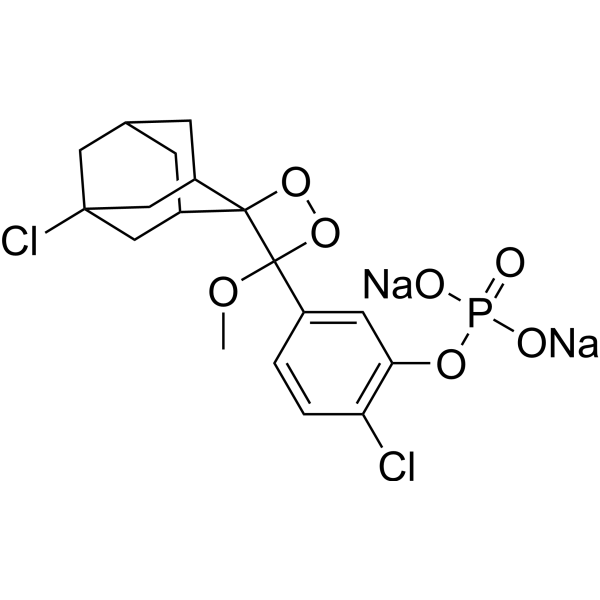
CSPD substrate is a chemiluminescent substrate of alkaline phosphatase. CSPD substrate provides the enhanced alkaline phosphatase sensitivity and a more simplified assay .
loading...
    loading...
Cat. No.: HY-160841
CAS No.: 2567941-52-8
Research Areas:  

Others

Biotin-16-dCTP is a biotinylated deoxycytidine triphosphate that serves as an important DNA labeling substrate. Biotin-16-dCTP can be enzymatically incorporated into the 3' end of DNA probes via terminal deoxynucleotidyl transferase, forming a 1-3 nucleotide-long tail to achieve biotinylation of the probes. Biotin-16-dCTP enhances chemiluminescent detection of low-abundance targets such as specific tRNA isoacceptors through Northern blotting. Biotin-16-dCTP can also replace conventional dCTP to be integrated into single-stranded DNA generated by asymmetric polymerase chain reaction, which is applicable for bioconjugation or pull-down assays. Repeated freeze-thaw cycles of Biotin-16-dCTP should be avoided to prevent degradation of its function for probe biotinylation .
loading...
    loading...
Cat. No.: HY-W351759
CAS No.: 133950-66-0
3-Indoxyl caprylate is a chemiluminescent substrate used to detect bacterial activity, which can be used together with appropriate enzyme reactions.
loading...
    loading...
Cat. No.: HY-D0891
CAS No.: 211106-69-3
Target:  

Fluorescent Dye

Research Areas:  

Others

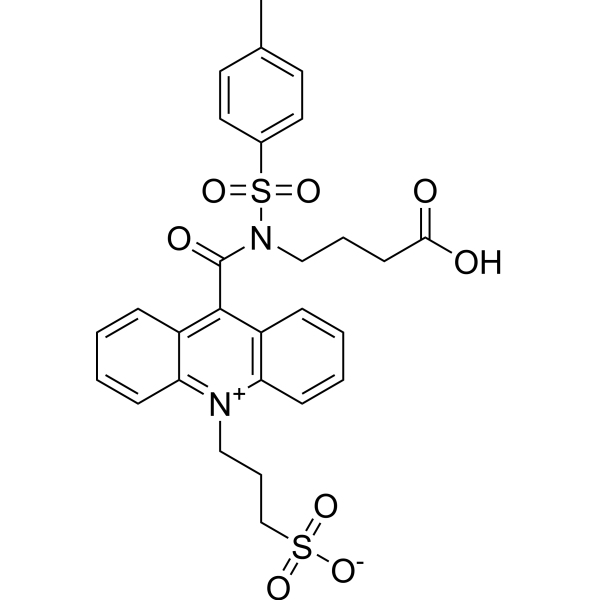
NSP-AS is chemiluminescent acridinium substrate II and can be used in homo geneous assays .
loading...
    loading...
Cat. No.: HY-W116598
CAS No.: 80008-69-1
5-Bromo-3-indolyl phosphate p-toluidine is an indolyl derivative that can be used as a substrate for chemiluminescent assay of alkaline phosphatase .
loading...
    loading...
Cat. No.: HY-W550907
CAS No.: 341972-94-9
5-Bromo-4-chloro-3-indolyl-α-D-maltotrioside is an enzyme substrate with chemiluminescent properties. It is used in diagnostic assays to detect bacterial and fungal infections and other diseases.
loading...
    loading...
Cat. No.: HY-115692
CAS No.: 1887057-34-2
2-Coumaranone-1-L serves as a chemiluminescent probe. Under alkaline conditions and in the presence of oxygen, 2-Coumaranone-1-L is capable of undergoing chemiluminescence, which enables its application as a chemiluminescent substrate in biochemical assays. 2-Coumaranone-1-L exhibits its maximum emission wavelength at 442 nm. 2-Coumaranone-1-L is utilized in research within the realm of bioanalysis .
loading...
    loading...
  • 1

