10 Results for "

healthy adults

" in MedChemExpress (MCE) Product Catalog:
Products (10)

10 Results for "healthy adults" in MCE Product Catalog:

Cat. No.: HY-N7120
CAS No.: 6130-64-9
Synonyms: PGP hydrate
Target:  

Bacterial Antibiotic

Research Areas:  

Infection

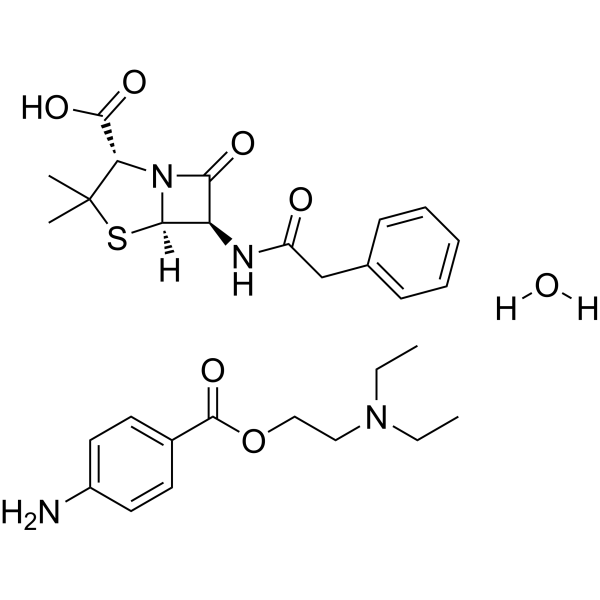
Penicillin G Procaine hydrate (PGP hydrate) is a β-lactam antibiotic and sustained-release formulation. Penicillin G procaine (hydrate) hydrolyzes in vivo to release penicillin G (HY-N7139) and Procaine (HY-B0546), thereby delaying the absorption of penicillin G .
loading...
    loading...
Cat. No.: HY-164221A
CAS No.: 2755197-77-2
Synonyms: ALN-HSD sodium
Rapirosiran (ALN-HSD) sodium is a HSD17β13-targeting siRNA. Rapirosiran sodium can be used for the research of metabolic dysfunction-associated steatohepatitis .
loading...
    loading...
Cat. No.: HY-142117S
Purity:  99.25%
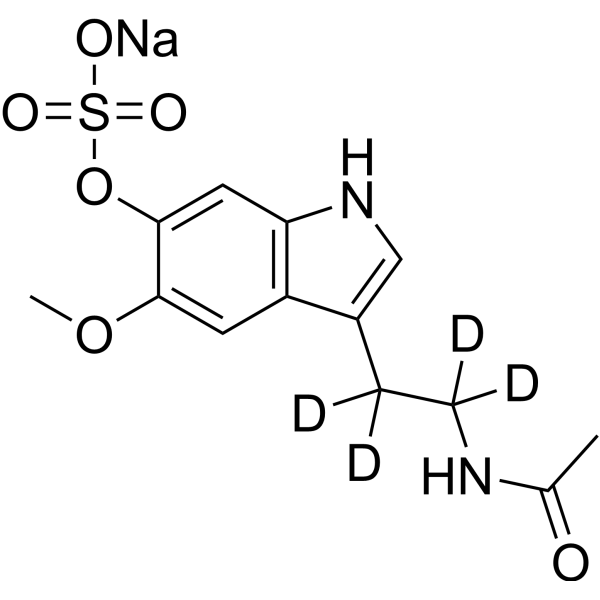
6-Sulfatoxymelatonin-d4 sodium is the deuterated-labeled 6-Sulfatoxymelatonin sodium (HY-W587817). 6-Sulfatoxymelatonin sodium is a metabolite of Melatonin (HY-B0075) and serves as a detection marker for Melatonin. 6-Sulfatoxymelatonin sodium shows a decreasing trend with increasing age, and its urinary excretion is closely correlated with plasma Melatonin levels, which can reflect changes in the secretion phase of melatonin. 6-Sulfatoxymelatonin sodium is associated with reduced risks of diabetic retinopathy and coronary heart disease, and can act as a biomarker for microvascular and macrovascular complications of type 2 diabetes mellitus. 6-Sulfatoxymelatonin sodium can be used in studies related to type 2 diabetes mellitus and coronary heart disease .
loading...
    loading...
Cat. No.: HY-164221
CAS No.: 2755196-97-3
Synonyms: ALN-HSD; ALN-288996; AD-288996
Rapirosiran (ALN-HSD) is a HSD17β13-targeting siRNA. Rapirosiran can be used for the research of metabolic dysfunction-associated steatohepatitis .
loading...
    loading...
Cat. No.: HY-117272A
CAS No.: 488-16-4
Target:  

Endogenous Metabolite

Research Areas:  

Others

(2R,3R)-2,3,4-Trihydroxybutanoic acid, also known as erythronic acid, is a naturally occurring organic acid found in the aqueous humor of the eye, as well as in urine, plasma, cerebrospinal fluid, and synovial fluid, prevalent in both healthy adults and children; it is produced through the oxidation of GlcNAc.
loading...
    loading...
Cat. No.: HY-142117S1
CAS No.: 1309935-98-5
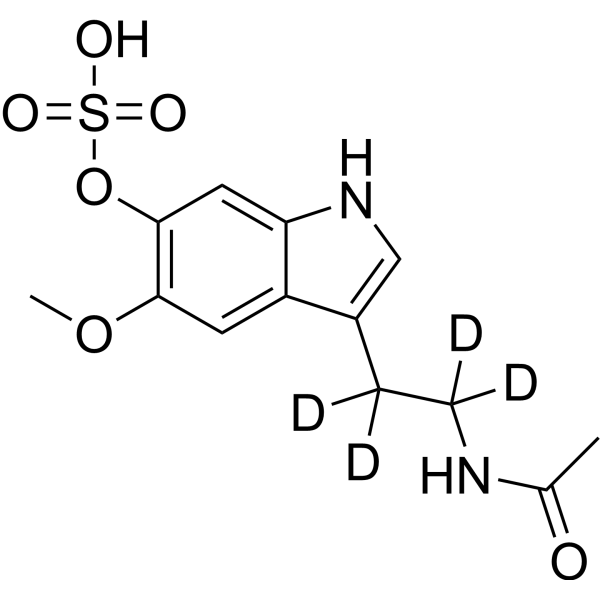
6-Sulfatoxymelatonin-d4 is the deuterated-labeled 6-Sulfatoxymelatonin. 6-Sulfatoxymelatonin is a metabolite of Melatonin (HY-B0075) and serves as a detection marker for Melatonin. 6-Sulfatoxymelatonin shows a decreasing trend with increasing age, and its urinary excretion is closely correlated with plasma Melatonin levels, which can reflect changes in the secretion phase of melatonin. 6-Sulfatoxymelatonin is associated with reduced risks of diabetic retinopathy and coronary heart disease, and can act as a biomarker for microvascular and macrovascular complications of type 2 diabetes mellitus. 6-Sulfatoxymelatonin can be used in studies related to type 2 diabetes mellitus and coronary heart disease .
loading...
    loading...
Cat. No.: HY-W587817
CAS No.: 76290-78-3
Target:  

Drug Metabolite

Research Areas:  

Metabolic Disease

6-Sulfatoxymelatonin sodium is a metabolite of Melatonin (HY-B0075) and serves as a detection marker for Melatonin. 6-Sulfatoxymelatonin sodium shows a decreasing trend with increasing age, and its urinary excretion is closely correlated with plasma Melatonin levels, which can reflect changes in the secretion phase of melatonin. 6-Sulfatoxymelatonin sodium is associated with reduced risks of diabetic retinopathy and coronary heart disease, and can act as a biomarker for microvascular and macrovascular complications of type 2 diabetes mellitus. 6-Sulfatoxymelatonin sodium can be used in studies related to type 2 diabetes mellitus and coronary heart disease .
loading...
    loading...
Cat. No.: HY-Y1150
CAS No.: 75-98-9
Synonyms: Trimethylmethanecarboxylic acid; Versatic 5 acid; tert-Pentanoic acid
Target:  

Antibiotic

Research Areas:  

Inflammation/Immunology

Pivalic acid (Trimethylmethanecarboxylic acid) is a carboxylic acid. Pivalic acid induces Carnitine deficiency. Pivalic acid conjugated with Antibiotics, such as Pivmecillinam (HY-B0810) and Pivampicillin (HY-119011), are used in urinary tract infection. Pivalic acid can be used in physical exercise research .
loading...
    loading...
Cat. No.: HY-N11875S
6-Sulfatoxymelatonin-d4 ammonium hydrate is the deuterated-labeled 6-Sulfatoxymelatonin ammonium hydrate. 6-Sulfatoxymelatonin ammonium hydrate is a metabolite of Melatonin (HY-B0075) and serves as a detection marker for Melatonin. 6-Sulfatoxymelatonin ammonium hydrate shows a decreasing trend with increasing age, and its urinary excretion is closely correlated with plasma Melatonin levels, which can reflect changes in the secretion phase of melatonin. 6-Sulfatoxymelatonin ammonium hydrate is associated with reduced risks of diabetic retinopathy and coronary heart disease, and can act as a biomarker for microvascular and macrovascular complications of type 2 diabetes mellitus. 6-Sulfatoxymelatonin ammonium hydrate can be used in studies related to type 2 diabetes mellitus and coronary heart disease .
loading...
    loading...
Cat. No.: HY-187014
CAS No.: 141360-03-4
NNC 09-0026 is a neuronal calcium channel inhibitor. NNC 09-0026 exhibits IC50 values of 10 μM and 13 μM against neuronal L-type voltage-gated calcium channels, and an IC50 value of 13 μM against rat neuronal N-type voltage-gated calcium channels, with higher selectivity for neuronal L-type channels over peripheral L-type channels. NNC 09-0026 inhibits voltage-dependent Ca 2+ channel currents, blocks Ca 2+ influx through neuronal L-type and N-type voltage-gated calcium channels, and reduces potassium-stimulated calcium uptake in rat cerebral cortex synaptosomes. NNC 09-0026 inhibits TTX-sensitive Na + channel currents in rat cerebellar Purkinje neurons. NNC 09-0026 attenuates ischemia-induced neuronal death, infarct volume and neurological deficits in rat models of cerebral ischemia. NNC 09-0026 can be used for studies on global cerebral ischemia, focal ischemia and cerebral ischemia-related research .
loading...
    loading...

