20 Results for "

human cholangiocarcinoma

" in MedChemExpress (MCE) Product Catalog:
Products (20)

20 Results for "human cholangiocarcinoma" in MCE Product Catalog:

2
2 Cited Publications
Cat. No.: HY-13242
CAS No.: 1258861-20-9
Purity:  99.92%
Synonyms: LY2940680
Target:  

Smo Gli

Research Areas:  

Cancer

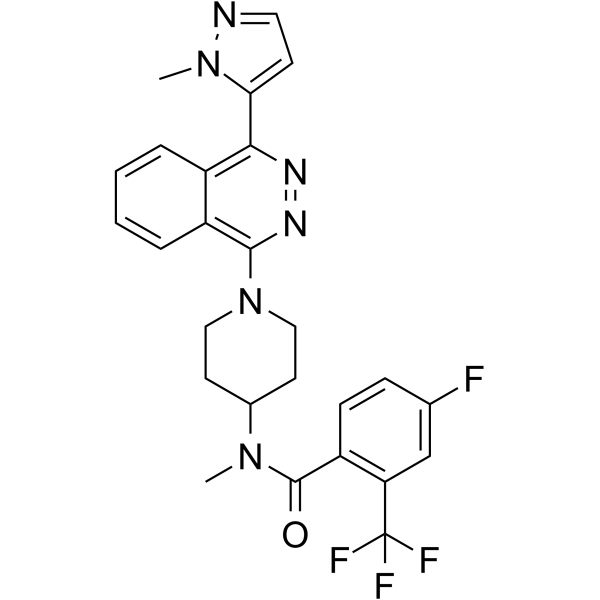
Taladegib is a Smoothened (SMO) antagonist. Taladegib hydrochloride inhibits the Hedgehog signaling pathway, with an IC50 of 5.5 nM for suppressing GLI1 mRNA expression in DAOY cells and an IC50 of 7.6 nM in CGNP cell proliferation assays. Taladegib binds to the extracellular loop region (site 1) of the transmembrane domain of the SMO receptor, competes with cyclopamine for SMO binding, and thereby inhibits Gli-dependent transcription. Taladegib can be used in studies of Hedgehog pathway-related cancers .
loading...
    loading...
2
2 Cited Publications
Cat. No.: HY-13242A
CAS No.: 1258861-21-0
Synonyms: LY2940680 hydrochloride
Target:  

Smo Gli

Research Areas:  

Cancer

Taladegib (LY2940680) hydrochloride is a Smoothened (SMO) antagonist. Taladegib hydrochloride inhibits the Hedgehog signaling pathway, with an IC50 of 5.5 nM for suppressing GLI1 mRNA expression in DAOY cells and an IC50 of 7.6 nM in CGNP cell proliferation assays. Taladegib hydrochloride binds to the extracellular loop region (site 1) of the transmembrane domain of the SMO receptor, competes with cyclopamine for SMO binding, and thereby inhibits Gli-dependent transcription. Taladegib hydrochloride can be used in studies of Hedgehog pathway-related cancers .
loading...
    loading...
1
1 Cited Publications
Cat. No.: HY-N0819
CAS No.: 89412-79-3
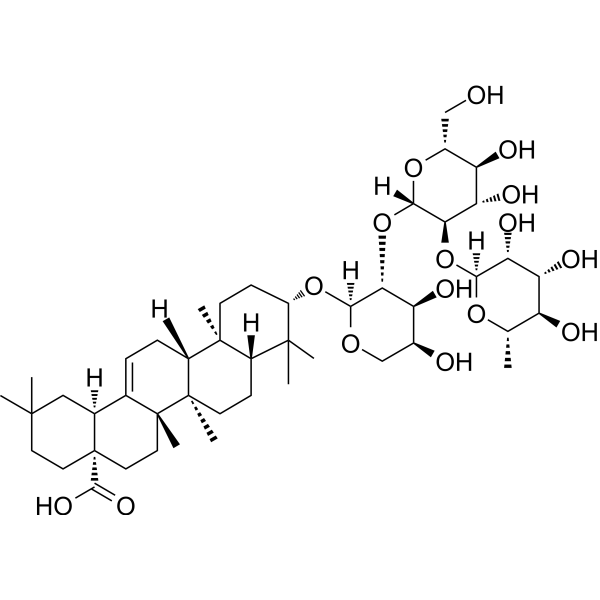
Raddeanin A is an oleanane-type triterpenoid saponin with oral activity. Raddeanin A inhibits SRC, mTOR, JNK, VEGFR2, NLRP3 inflammasome, Wnt/β-catenin, Wee1, PI3K/AKT signaling pathway, MAPK/ERK signaling pathway, AR-FL, AR-Vs, and downregulates the expression of p-PI3K and p-AKT. Raddeanin A inhibits osteoclast formation, bone resorption, osteolysis, cancer cell invasion, migration, proliferation, angiogenesis and epithelial-mesenchymal transition, while induces apoptosis, cell cycle arrest, ROS production, immunogenic cell death and dendritic cell maturation. Raddeanin A improves blood-retinal barrier function, alleviates inflammation, regulates the tumor microenvironment, and enhances the activity of anti-PD-1 antibody. Raddeanin A is applicable to the research of breast cancer-associated osteolysis, human osteosarcoma, colorectal cancer, glioblastoma, Alzheimer's disease, cholangiocarcinoma, melanoma, non-small cell lung cancer, castration-resistant prostate cancer and multiple myeloma .
loading...
    loading...
Cat. No.: HY-E70823
Target:  

FGFR

Research Areas:  

Cancer

FGFR2 is a receptor tyrosine kinase that is involved in many human cancers such as intrahepatic cholangiocarcinomas and hepatocellular carcinomas. FGFR2 N549K is a mutant of FGFR3. FGFR2 N549K Recombinant Human Active Protein Kinase is a recombinant FGFR4 N535K protein that can be used to study FGFR4 N535K-related functions .
loading...
    loading...
Cat. No.: HY-E70827
Target:  

FGFR

Research Areas:  

Cancer

FGFR2 is a receptor tyrosine kinase that is involved in many human cancers such as intrahepatic cholangiocarcinomas and hepatocellular carcinomas. FGFR2 V564L is a mutant of FGFR3. FGFR2 V564L Recombinant Human Active Protein Kinase is a recombinant FGFR2 V564L protein that can be used to study FGFR2 V564L-related functions .
loading...
    loading...
Cat. No.: HY-E70814
Target:  

FGFR

Research Areas:  

Cancer

FGFR2 is a receptor tyrosine kinase that is involved in many human cancers such as intrahepatic cholangiocarcinomas and hepatocellular carcinomas. FGFR2 C491S is a mutant of FGFR3. FGFR2 C491S Recombinant Human Active Protein Kinase is a recombinant FGFR2 C491S protein that can be used to study FGFR2 C491S-related functions .
loading...
    loading...
Cat. No.: HY-E70815
Target:  

FGFR

Research Areas:  

Cancer

FGFR2 is a receptor tyrosine kinase that is involved in many human cancers such as intrahepatic cholangiocarcinomas and hepatocellular carcinomas. FGFR2 K526E is a mutant of FGFR3. FGFR2 K526E Recombinant Human Active Protein Kinase is a recombinant FGFR2 K526E protein that can be used to study FGFR2 K526E-related functions .
loading...
    loading...
Cat. No.: HY-E70816
Target:  

FGFR

Research Areas:  

Cancer

FGFR2 is a receptor tyrosine kinase that is involved in many human cancers such as intrahepatic cholangiocarcinomas and hepatocellular carcinomas. FGFR2 K641N is a mutant of FGFR3. FGFR2 K641N Recombinant Human Active Protein Kinase is a recombinant FGFR2 K641N protein that can be used to study FGFR2 K641N-related functions .
loading...
    loading...
Cat. No.: HY-E70818
Target:  

FGFR

Research Areas:  

Cancer

FGFR2 is a receptor tyrosine kinase that is involved in many human cancers such as intrahepatic cholangiocarcinomas and hepatocellular carcinomas. FGFR2 K659M is a mutant of FGFR3. FGFR2 K659M Recombinant Human Active Protein Kinase is a recombinant FGFR2 K659M protein that can be used to study FGFR2 K659M-related functions .
loading...
    loading...
Cat. No.: HY-E70819
Target:  

FGFR

Research Areas:  

Cancer

FGFR2 is a receptor tyrosine kinase that is involved in many human cancers such as intrahepatic cholangiocarcinomas and hepatocellular carcinomas. FGFR2 K659N is a mutant of FGFR3. FGFR2 K659N Recombinant Human Active Protein Kinase is a recombinant FGFR2 K659N protein that can be used to study FGFR2 K659N-related functions .
loading...
    loading...
Cat. No.: HY-E70821
Target:  

FGFR

Research Areas:  

Cancer

FGFR2 is a receptor tyrosine kinase that is involved in many human cancers such as intrahepatic cholangiocarcinomas and hepatocellular carcinomas. FGFR2 M537I is a mutant of FGFR3. FGFR2 M537I Recombinant Human Active Protein Kinase is a recombinant FGFR2 M537I protein that can be used to study FGFR2 M537I-related functions .
loading...
    loading...
Cat. No.: HY-E70822
Target:  

FGFR

Research Areas:  

Cancer

FGFR2 is a receptor tyrosine kinase that is involved in many human cancers such as intrahepatic cholangiocarcinomas and hepatocellular carcinomas. FGFR2 N549H is a mutant of FGFR3. FGFR2 N549H Recombinant Human Active Protein Kinase is a recombinant FGFR4 N535H protein that can be used to study FGFR4 N535H-related functions .
loading...
    loading...
Cat. No.: HY-E70825
Target:  

FGFR

Research Areas:  

Cancer

FGFR2 is a receptor tyrosine kinase that is involved in many human cancers such as intrahepatic cholangiocarcinomas and hepatocellular carcinomas. FGFR2 V564F is a mutant of FGFR3. FGFR2 V564F Recombinant Human Active Protein Kinase is a recombinant FGFR2 V564F protein that can be used to study FGFR2 V564F-related functions .
loading...
    loading...
Cat. No.: HY-E70826
Target:  

FGFR

Research Areas:  

Cancer

FGFR2 is a receptor tyrosine kinase that is involved in many human cancers such as intrahepatic cholangiocarcinomas and hepatocellular carcinomas. FGFR2 V564I is a mutant of FGFR3. FGFR2 V564I Recombinant Human Active Protein Kinase is a recombinant FGFR2 V564I protein that can be used to study FGFR2 V564I-related functions .
loading...
    loading...
Cat. No.: HY-N0819R
CAS No.: 89412-79-3
Raddeanin A (Standard) is the analytical standard of Raddeanin A (HY-N0819). This product is intended for research and analytical applications. Raddeanin A is an oleanane-type triterpenoid saponin with oral activity. Raddeanin A inhibits SRC, mTOR, JNK, VEGFR2, NLRP3 inflammasome, Wnt/β-catenin, Wee1, PI3K/AKT signaling pathway, MAPK/ERK signaling pathway, AR-FL, AR-Vs, and downregulates the expression of p-PI3K and p-AKT. Raddeanin A inhibits osteoclast formation, bone resorption, osteolysis, cancer cell invasion, migration, proliferation, angiogenesis and epithelial-mesenchymal transition, while induces apoptosis, cell cycle arrest, ROS production, immunogenic cell death and dendritic cell maturation. Raddeanin A improves blood-retinal barrier function, alleviates inflammation, regulates the tumor microenvironment, and enhances the activity of anti-PD-1 antibody. Raddeanin A is applicable to the research of breast cancer-associated osteolysis, human osteosarcoma, colorectal cancer, glioblastoma, Alzheimer's disease, cholangiocarcinoma, melanoma, non-small cell lung cancer, castration-resistant prostate cancer and multiple myeloma.
loading...
    loading...
Cat. No.: HY-K6106

MCE Human Cholangiocarcinoma Organoid Kit contains Cholangiocarcinoma Organoid Basal Medium A, Cholangiocarcinoma Organoid Supplement B (50×), Cholangiocarcinoma Organoid Supplement C (250×). This product can be used to efficiently construct human cholangiocarcinoma organoid.

loading...
    loading...
Cat. No.: HY-E70817
Target:  

FGFR

Research Areas:  

Cancer

FGFR2 is a receptor tyrosine kinase that is involved in many human cancers such as intrahepatic cholangiocarcinomas and hepatocellular carcinomas. FGFR2 K641R is a mutant of FGFR3. FGFR2 K641R Recombinant Human Active Protein Kinase is a recombinant FGFR2 K641R protein that can be used to study FGFR2 K641R-related functions .
loading...
    loading...
Cat. No.: HY-E70820
Target:  

FGFR

Research Areas:  

Cancer

FGFR2 is a receptor tyrosine kinase that is involved in many human cancers such as intrahepatic cholangiocarcinomas and hepatocellular carcinomas. FGFR2 L617V is a mutant of FGFR3. FGFR2 L617V Recombinant Human Active Protein Kinase is a recombinant FGFR2 L617V protein that can be used to study FGFR2 L617V-related functions .
loading...
    loading...
Cat. No.: HY-E70824
Target:  

FGFR

Research Areas:  

Cancer

FGFR2 is a receptor tyrosine kinase that is involved in many human cancers such as intrahepatic cholangiocarcinomas and hepatocellular carcinomas. FGFR2 R612T is a mutant of FGFR3. FGFR2 R612T Recombinant Human Active Protein Kinase is a recombinant FGFR2 R612T protein that can be used to study FGFR2 R612T-related functions .
loading...
    loading...
Cat. No.: HY-N19127
CAS No.: 1454586-51-6
Aspergillusidone E is an aromatase inhibitor with an aromatase IC50 of 1.0 μM. Aspergillusidone E exhibits cytotoxicity against cancer cells. Aspergillusidone E can be used in research related to various cancers such as breast cancer and liver cancer .
loading...
    loading...
  • 1

