
1. Search Result
Search Result
Results for "

inositol phospholipid

" in MedChemExpress (MCE) Product Catalog:

14

Inhibitors & Agonists

1

Biochemical Assay Reagents

1

Peptides

1

Natural
Products

7

Oligonucleotides

Targets Recommended:
Cat. No. Product Name Target Research Areas Chemical Structure
  • HY-P2817

    PLCs

    Phospholipase Infection Metabolic Disease
    Phospholipase C (PLCs) is a class of phospholipases. Phospholipase C participates in cellular signaling and regulation by virtue of its ability to hydrolyze membrane phospholipids into di-acyl-glycerol (DAG) and inositol triphosphate (IP3), which further causes the activation of other signaling pathways involved in various processes, including immune response .
    Phospholipase C
  • HY-W145699

    Biochemical Assay Reagents Endogenous Metabolite Others
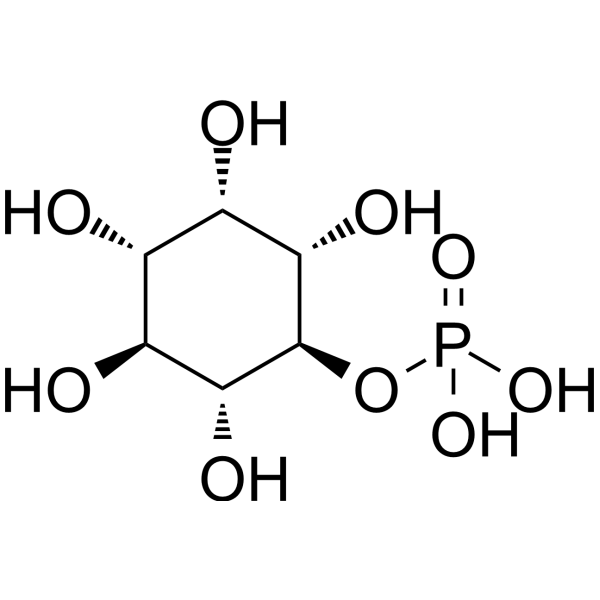
    D-myo-Inositol 4-mono-phosphate, also known as IMP, is a phosphorylated form of inositol that is commonly found in various metabolic pathways, especially in the biosynthesis of phospholipids and cell signaling molecules. D-myo-Inositol 4-mono-phosphate has unique chemical properties that make it an important intermediate in the production of second messengers, such as inositol triphosphate (IP3) and diacylglycerol (DAG), which signal in cells plays a key role in. D-myo-Inositol 4-mono-phosphate is also used in dietary supplements and pharmaceuticals because of its potential health benefits, including improved insulin sensitivity and cognitive function.
    D-myo-Inositol 4-monophosphate
  • HY-175086

    DOPI-3,4,5-P3-fluorescein triethylammonium; PI(3,4,5)P3-fluorescein triethylammonium; PIP3[3',4',5']-fluorescein triethylammonium

    Fluorescent Dye Others
    PtdIns-(3,4,5)-P3 is a second messenger. PtdIns-(3,4,5)-P3-fluorescein triethylammonium is a fluorescent probe that can detect any protein that has a high-affinity binding interaction with inositol-(3,4,5)-triphosphate phospholipids .
    PtdIns-(3,4,5)-P3-fluorescein triethylammonium
  • HY-101607A

    Calcium Channel Cardiovascular Disease
    KT-362 free acid is an intracellular calcium antagonist with antiarrhythmic and vasodilatory effects. KT-362 free acid shows an antagonistic effect against norepinephrine (NE) induced vasoconstriction response, achieved by reducing inositol phospholipid hydrolysis, thereby reducing intracellular calcium mobilization. KT-362 free acid can be used to study the contraction and relaxation mechanisms of vascular smooth muscle, especially in exploring the role of intracellular calcium mobilization and inositol phospholipid hydrolysis in vascular contraction .
    KT-362 free acid
  • HY-W414697

    D-Ribo-phytosphingosine (C17 base)

    Bacterial Others
    4-Hydroxysphinganine C17 base (D-Ribo-phytosphingosine C17 base), also known as D-ribo-phytosphingosine or PHS, is a crucial compound present in the membranes of fungi, plants, bacteria, marine organisms, and mammalian tissues. It plays a vital role in preserving the structural integrity of membranes, regulating cellular growth, and mediating the heat stress response in yeast. Additionally, PHS serves as a precursor for the synthesis of important lipid mediators such as PHS 1-phosphate, inositol phosphorylceramide, and KRN7000 (the α-anomer of galactosylceramide). Furthermore, this phospholipid promotes keratinocyte differentiation, making it a valuable active ingredient in cosmetic formulations.
    4-Hydroxysphinganine (C17 base)
  • HY-148972

    Liposome Others
    PI(3,5)P2 diC16 is a synthetic inositol phospholipid. PI(3,5)P2 diC16 is a lipid molecule .
    PI(3,5)P2 diC16
  • HY-P2593

    Neurokinin Receptor Neurological Disease
    L-659874 is a selective NK2 receptor antagonist with an IC50 value of 0.49 μM in hamsters. L-659874 inhibits NK2 receptor-mediated hydrolysis of inositol phospholipids. L-659874 could be used for research on the correlation between pain signal transduction and smooth muscle responses. .
    L-659874
  • HY-W788040

    Others Others
    Inositol 1,3,4,5-tetraphosphate (tetraammonium) is a phosphoinositide. Phosphoinositides (PI) are similar to other phospholipids, but the head group is the cyclic myo-inositol.
    Inositol 1,3,4,5-tetraphosphate tetraammonium
  • HY-150135A

    Others Metabolic Disease
    D-myo-Inositol-1,4,5-triphosphate (triammonium) is a phosphoinositide. Phosphoinositides (PI) are similar to other phospholipids, but the head group is the cyclic myo-inositol.
    D-myo-Inositol-1,4,5-triphosphate triammonium
  • HY-N16138

    DSPI (18:0/18:0)

    Others Metabolic Disease
    18:0 PI is a phosphoinositide. Phosphoinositides (PI) are similar to other phospholipids, but the head group is the cyclic myo-inositol.
    18:0 PI
  • HY-W725804

    Others Metabolic Disease
    15:0-18:1 PI (ammonium) is a phosphoinositide. Phosphoinositides (PI) are similar to other phospholipids, but the head group is the cyclic myo-inositol.
    15:0-18:1 PI ammonium
  • HY-157619

    1-Palmitoyl-2-oleoyl-sn-glycero-3-phosphoinositol ammonium

    Others Metabolic Disease
    16:0-18:1 PI (ammonium) is a phosphoinositide. Phosphoinositides (PI) are similar to other phospholipids, but the head group is the cyclic myo-inositol.
    16:0-18:1 PI ammonium
  • HY-148303

    Others Others
    Phosphatidylinositol bis-4,5-phosphate,1,2-dipalmitoyl is a phosphoinositide. Phosphoinositides (PI) are similar to other phospholipids, but the head group is the cyclic myo-inositol.
    Phosphatidylinositol bis-4,5-phosphate,1,2-dipalmitoyl
  • HY-E70853

    PKC Cancer
    PKCδ is a PKC isoform. PKCδ is expressed ubiquitously among cells and tissues. It is activated by diacylglycerol produced by receptor-mediated hydrolysis of membrane inositol phospholipids as well as by tumor-promoting phorbol ester through the binding of these compounds to the C1 region in its regulatory domain. PKCδ Recombinant Human Active Protein Kinase is a recombinant PKCδ protein that can be used to study PKCδ-related functions .
    PKCδ Recombinant Human Active Protein Kinase

Inquiry Online

Your information is safe with us. * Required Fields.

Salutation


Country or Region *

Applicant Name *


Organization Name *

Department *


Email Address *


Product Name *

Cat. No.


Requested quantity *

Phone Number *


Remarks

Inquiry Online

Inquiry Information

Product Name:
Cat. No.:
Quantity:
MCE Japan Authorized Agent:

