4 Results for "

insoluble glucan

" in MedChemExpress (MCE) Product Catalog:
Products (4)

4 Results for "insoluble glucan" in MCE Product Catalog:

Cat. No.: HY-P2840
CAS No.: 9025-70-1
Target:  

Glycosidase

Research Areas:  

Metabolic Disease

Dextranase, Trichoderma reesei belongs to glycoside hydrolase family 49. It catalyzes the hydrolysis of α-1,6-glycosidic linkages in dextran via a single-displacement reaction, ultimately releasing shorter isomaltooligosaccharides. Dextranase, Trichoderma reesei reduces the molecular size of dextran, inhibits the formation of insoluble dextran and dental plaque, and decreases the viscosity of dextran-contaminated sugar juice. Dextranase, Trichoderma reesei can be used in relevant research in fields such as chemical production, including beer manufacturing, feed additives, and toothpaste formulations .
loading...
    loading...
Cat. No.: HY-N3341
CAS No.: 179388-53-5
Research Areas:  

Infection

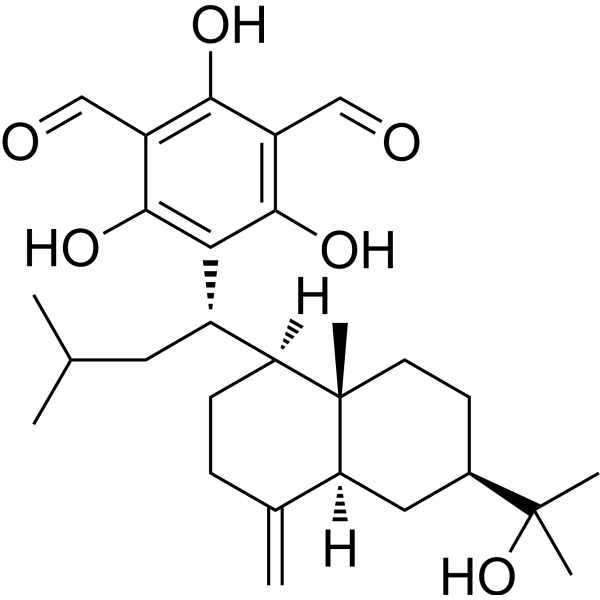
Macrocarpal H is a natural compound that can be isolated from the Leaves of Eucalyptus globulus. Macrocarpal H exhibits antibacterial activity against Gram-positive cariogenic bacteria and Gram-negative periodontopathic bacteria. Macrocarpal H inhibits adherent water-insoluble glucan synthesis via glucosyltransferase. Macrocarpal H can be used for the research of caries, periodontal disease, dental caries, periodontal disorders .
loading...
    loading...
Cat. No.: HY-E71366
Research Areas:  

Metabolic Disease

Endo-1,4-β-D-glucanase is a glycoside hydrolase that cleaves internal β-1,4-glycosidic bonds in cellulose and related β-D-glucans (β-D-Glucan) (HY-139413). Endo-1,4-β-D-glucanase randomly cuts long, insoluble cellulose polymer chains into shorter, soluble fragments such as oligosaccharides, thereby paving the way for further digestion into glucose .
loading...
    loading...
Cat. No.: HY-P2840A
Target:  

Glycosidase

Research Areas:  

Metabolic Disease

Dextranase, Penicillium sp. belongs to glycoside hydrolase family 49. It catalyzes the hydrolysis of α-1,6-glycosidic linkages in dextran via a single-displacement reaction, ultimately releasing shorter isomaltooligosaccharides. Dextranase, Penicillium sp. reduces the molecular size of dextran, inhibits the formation of insoluble dextran and dental plaque, and decreases the viscosity of dextran-contaminated sugar juice. Dextranase, Penicillium sp. can be used in relevant research in fields such as chemical production, including beer manufacturing, feed additives, and toothpaste formulations .
loading...
    loading...

