



Dextranase, Trichoderma reesei

Based on 1 Customer Validation
Dextranase, Trichoderma reesei belongs to glycoside hydrolase family 49. It catalyzes the hydrolysis of α-1,6-glycosidic linkages in dextran via a single-displacement reaction, ultimately releasing shorter isomaltooligosaccharides. Dextranase, Trichoderma reesei reduces the molecular size of dextran, inhibits the formation of insoluble dextran and dental plaque, and decreases the viscosity of dextran-contaminated sugar juice. Dextranase, Trichoderma reesei can be used in relevant research in fields such as chemical production, including beer manufacturing, feed additives, and toothpaste formulations.
Nur für Forschungszwecke. Wir verkaufen nicht an Patienten.
- CAS. Nr.: 9025-70-1
-
Speicherung:
Please store the product under the recommended conditions in the Certificate of Analysis.

To place orders, for customer services and technical support, please contact: MedChemExpress USA
Tel: 609-228-6898 E-mail: [email protected] [email protected]


-
 Biologische Aktivität
-
Chemical Information
-
Lösungsmittel & Löslichkeit
- Reinheit & Dokumentation
- Verweise
-
 Help & FAQs


-
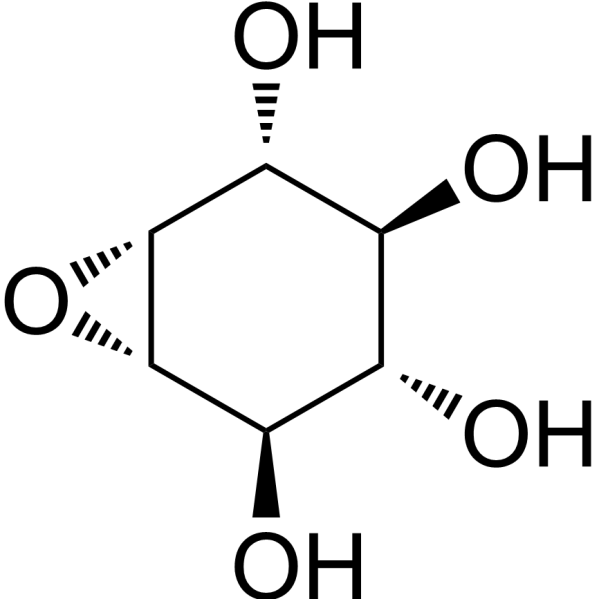
HY-100944
Conduritol B epoxideGcase Inhibitor -

HY-P2929
PNGase FGlycosidase -
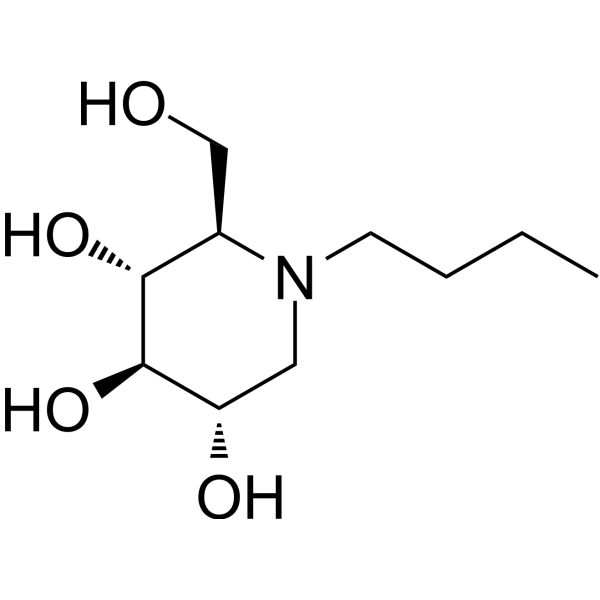
HY-17020
MiglustatCeramide Glucosyltransferase Inhibitor -

HY-P2929A
PNGase F-FastGlycosidase -

HY-P2929C
PNGase F (Lyophilized)Glycosidase -
HY-132177B
α1-2,4,6 Fucosidase O, Omnitrophica bacteriumExoglycosidase -
HY-132177
α-L-Fucosidase, MicroorganismLysosomal Enzyme -
HY-132177C
α1-3,4 Fucosidase, Bifidobacterium bifidumExoglycosidase -
HY-132177A
α-1-2 Fucosidase, bifidobacterium longumExoglycosidase -

HY-P2929D
PNGase F (MS grade)Glycosidase -

HY-P2929B
PNGase F (Immobilized, Microspin)N-glycosidic bond Cleaver -
HY-P2872
ThioglucosidaseS-glycosidic Bond Hydrolase


Biologische Aktivität
Beschreibung
In Vitro
Dextranase, Penicillium sp. forms product complexes containing isomaltose upon incubation with tetraisomaltose and pentaisomaltose; the spatial layout of core catalytic residues Asp395, Asp376 and Asp396 further validates its inverting hydrolysis mechanism in vitro[2].
Dextranase, Penicillium sp. preparations (DN 25 L and DN 50 L) hydrolyze dextran in sugar mill juices and syrups[3].
MedChemExpress (MCE) has not independently confirmed the accuracy of these methods. They are for reference only.
EC Number
3.2.1.11
Enzyme Activity
≥50 U/mg soild
Unit Definition
One unit is defined as the amount of enzyme that hydrolyze 1% barley β-glucan to 1 μmol glucose per min at 40°C, pH 6.0.


Chemical Information
-
CAS. Nr. 9025-70-1
-
Appearance Solid
-
Color Light yellow to light brown
-
SMILES
[Dextranase, Trichoderma reesei]
-
Versand
Room temperature in continental US; may vary elsewhere.
-
Speicherung
Please store the product under the recommended conditions in the Certificate of Analysis.


Lösungsmittel & Löslichkeit
In Vitro:
H2O : 50 mg/mL (Need ultrasonic)


Reinheit & Dokumentation
-
Data Sheet (264 KB)
-
SDS (251 KB)
- English - EN (251 KB)
- Français - FR (251 KB)
- Deutsch - DE (251 KB)
- Norwegian - NO (251 KB)
- Español - ES (251 KB)
- Swedish - SV (251 KB)
- Italian - IT (251 KB)
- Korean - KR (251 KB)
- Portuguese - PT (251 KB)
-
Handling Instructions (2659 KB)
Verweise

Calculators
Konzentration (Stammlösung) × Volumen (Stammlösung) = Konzentration (Ziellösung) × Volumen (Ziellösung)


Dextranase, Trichoderma reesei Related Classifications
HY-P2840 Related Classifications
 Powered by Bioz