9 Results for "

latent inhibition

" in MedChemExpress (MCE) Product Catalog:
Products (9)

9 Results for "latent inhibition" in MCE Product Catalog:

18
18 Publications Verification
Cat. No.: HY-P0299
CAS No.: 283609-79-0
Target:  

TGF-β Receptor

Research Areas:  

Cancer

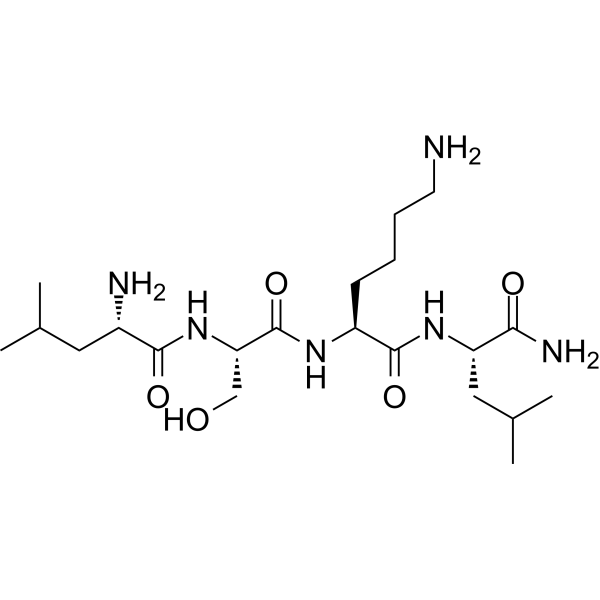
LSKL, Inhibitor of Thrombospondin (TSP-1) is a latency-associated protein (LAP)-TGFβ derived tetrapeptide and a competitive TGF-β1 antagonist. LSKL, Inhibitor of Thrombospondin (TSP-1) inhibits the binding of TSP-1 to LAP and alleviates renal interstitial fibrosis and hepatic fibrosis. LSKL, Inhibitor of Thrombospondin (TSP-1) suppresses subarachnoid fibrosis via inhibition of TSP-1-mediated TGF-β1 activity, prevents the development of chronic hydrocephalus and improves long-term neurocognitive defects following subarachnoid hemorrhage (SAH). LSKL, Inhibitor of Thrombospondin (TSP-1) can readily crosse the blood-brain barrier .
loading...
    loading...
18
18 Publications Verification
Cat. No.: HY-P0299A
CAS No.: 2828433-17-4
Target:  

TGF-β Receptor

Research Areas:  

Cancer

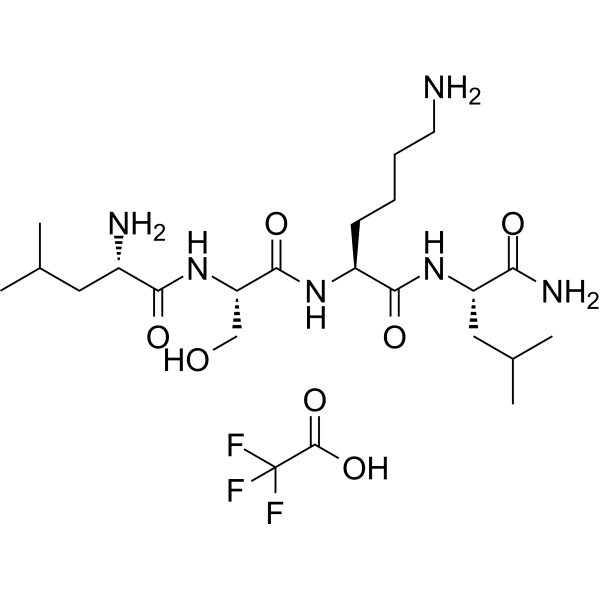
LSKL, Inhibitor of Thrombospondin (TSP-1) TFA is a latency-associated protein (LAP)-TGFβ derived tetrapeptide and a competitive TGF-β1 antagonist. LSKL, Inhibitor of Thrombospondin (TSP-1) TFA inhibits the binding of TSP-1 to LAP and alleviates renal interstitial fibrosis and hepatic fibrosis. LSKL, Inhibitor of Thrombospondin (TSP-1) TFA suppresses subarachnoid fibrosis via inhibition of TSP-1-mediated TGF-β1 activity, prevents the development of chronic hydrocephalus and improves long-term neurocognitive defects following subarachnoid hemorrhage (SAH). LSKL, Inhibitor of Thrombospondin (TSP-1) TFA can readily crosse the blood-brain barrier .
loading...
    loading...
1
1 Cited Publications
Cat. No.: HY-124767
CAS No.: 184162-21-8
Purity:  98.90%
Research Areas:  

Neurological Disease

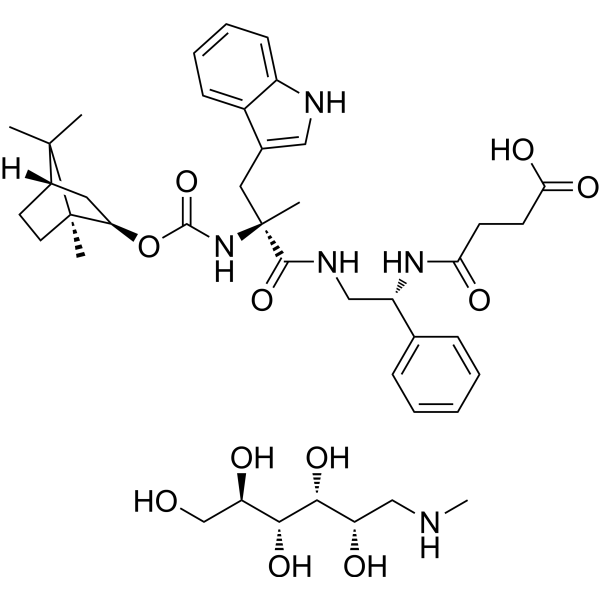
SR 142948A is a blood-brain barrier-permeable, orally active, selective, non-peptide Neurotensin Receptor antagonist. SR 142948A exhibits an IC50 of 4.0 nM at the NTS1 site. SR 142948A competitively antagonizes neurotensin-dependent neurotransmitter release and modulates neurotensin-related dopaminergic and serotonergic signaling, making it useful for research on neurobehavioral mechanisms associated with schizophrenia .
loading...
    loading...
Cat. No.: HY-103151
CAS No.: 845861-39-4
Purity:  98.84%
Target:  

5-HT Receptor

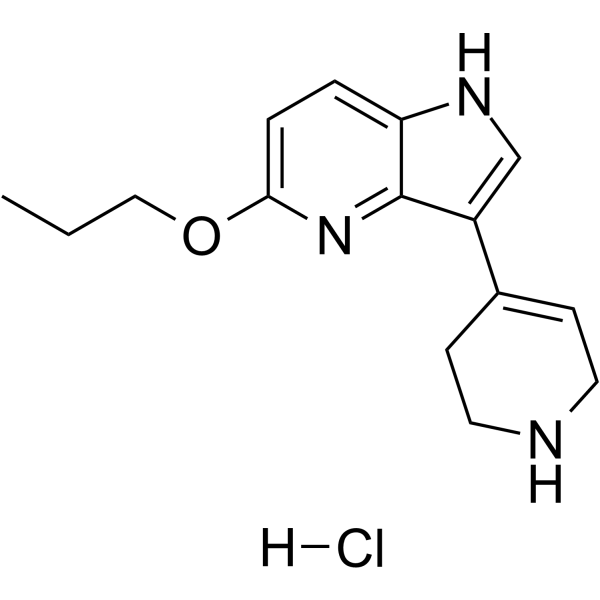
CP94253 hydrochloride is an orally active, brain-penetrant and selective 5-HT1B receptor agonist with an Ki of 2 nM. CP94253 hydrochloride induces antidepressant-like effects, waking enhancement, sleep inhibition, increased sleep latency, hyperlocomotion, and suppressed aggressive behavior. CP94253 hydrochloride can be used for the research of depression and heightened aggressive behavior .
loading...
    loading...
Cat. No.: HY-129810
CAS No.: 130325-35-8
Synonyms: CAM 1028
Research Areas:  

Neurological Disease

PD 135158 (CAM 1028) is a selective CCKB receptor antagonist with an IC50 of 2.8 nM against mouse cortex CCKB. PD 135158 shows anxiolytic activity .
loading...
    loading...
Cat. No.: HY-A0139
CAS No.: 5591-45-7
Synonyms: NSC 108165; Navan; Navane
Thiothixene is a typical antipsychotic. It selectively binds to dopamine D2 over D1, D3, and D4 receptors (Kis=0.417, 338, 186.2, and 363.1 nM, respectively). Thiothixene also binds to various serotonin (5-HT), histamine H1, α1- and α2-adrenergic, muscarinic acetylcholine, and sigma receptors (Kis=15-5,754 nM) as well as the dopamine, norepinephrine, and serotonin transporters (Kis=3.16-30 μM). In vivo, thiothixene reduces spontaneous and amphetamine-induced locomotor activity in rats. It enhances latent inhibition, as measured by a decreased lick latency in response to light and foot shock stimuli, which is a measure of selective attention in rats.3 Thiothixene also increases competitive behavior in submissive mice, indicating antidepressant-like behavior.
loading...
    loading...
Cat. No.: HY-103151A
CAS No.: 131084-35-0
Target:  

5-HT Receptor

CP94253 is an orally active, brain-penetrant and selective 5-HT1B receptor agonist with an Ki of 2 nM. CP94253 induces antidepressant-like effects, waking enhancement, sleep inhibition, increased sleep latency, hyperlocomotion, and suppressed aggressive behavior. CP94253 can be used for the research of depression and heightened aggressive behavior .
loading...
    loading...
Cat. No.: HY-W748758
Synonyms: NSC 108165-d8; Navan-d8; Navane-d8
(Z)-Thiothixene-d8 (NSC 108165-d8; Navan-d8; Navane-d8) is the deuterium labeled Thiothixene (HY-A0139). Thiothixene is a typical antipsychotic. It selectively binds to dopamine D2 over D1, D3, and D4 receptors (Kis=0.417, 338, 186.2, and 363.1 nM, respectively). Thiothixene also binds to various serotonin (5-HT), histamine H1, α1- and α2-adrenergic, muscarinic acetylcholine, and sigma receptors (Kis=15-5,754 nM) as well as the dopamine, norepinephrine, and serotonin transporters (Kis=3.16-30 μM). In vivo, thiothixene reduces spontaneous and amphetamine-induced locomotor activity in rats. It enhances latent inhibition, as measured by a decreased lick latency in response to light and foot shock stimuli, which is a measure of selective attention in rats.3 Thiothixene also increases competitive behavior in submissive mice, indicating antidepressant-like behavior.
loading...
    loading...
Cat. No.: HY-103151R
CAS No.: 845861-39-4
CP94253 hydrochloride (Standard) is the analytical standard of CP94253 hydrochloride (HY-103151). This product is intended for research and analytical applications. CP94253 hydrochloride is an orally active, brain-penetrant and selective 5-HT1B receptor agonist with an Ki of 2 nM. CP94253 hydrochloride induces antidepressant-like effects, waking enhancement, sleep inhibition, increased sleep latency, hyperlocomotion, and suppressed aggressive behavior. CP94253 hydrochloride can be used for the research of depression and heightened aggressive behavior .
loading...
    loading...

