15 Results for "

murine melanoma models

" in MedChemExpress (MCE) Product Catalog:
Products (15)

15 Results for "murine melanoma models" in MCE Product Catalog:

5
5 Cited Publications
Cat. No.: HY-117037
CAS No.: 107530-18-7
Purity:  99.90%
FR900359 is a depsipeptide selective inhibitor of q/11/14 in mammalia, can inhibits ERK pathway. FR900359 suppresses the proliferation of melanoma cells and decreases of blood pressure. FR900359 also protected against airway hyperreactivity in murine models of allergen sensitization in Ovalbumin, low endotoxin (HY-W250978A)-induced sensitization model of asthma. FR900359 can be used for cancer and cardiovascular disease research .
loading...
    loading...
1
1 Cited Publications
Cat. No.: HY-10615
CAS No.: 272769-49-0
Target:  

PARP

Research Areas:  

Cancer

A-620223 is a PARP-1 inhibitor with a Ki of 8 nM against PARP-1 and EC50 of 3 nM in a whole cell assay. A-620223 demonstrates good in vivo efficacy in a B16F10 subcutaneous murine melanoma model in combination with Temozolomide (TMZ) (HY-17364) and in an MX-1 breast xenograph model in combination with Cisplatin (HY-17394). A-620223 can be used for the studies of melanoma and breast cancer .
loading...
    loading...
Cat. No.: HY-124309
CAS No.: 1269802-97-2
Purity:  99.30%
Research Areas:  

Cancer

NHI-2 is a lactate dehydrogenase A (LDHA) inhibitor with an IC50 of 14.7 µM. NHI-2 shows selective for LDHA over LDHB (IC50 = 55.8 µM). NHI-2 is an efficient anti-glycolytic agent. NHI-2 enhances apoptosis, induces cell cycle arrest at S and G2 phases. NHI-2 has a broad spectrum anti-proliferative activity in cancer cells. NHI-2 affects extracellular acidification rate and ATP production. NHI-2 suppresses tumor growth in murine B78 melanoma tumor model .
loading...
    loading...
Cat. No.: HY-174830
CAS No.: 3099808-68-8
Target:  

PD-1/PD-L1

Research Areas:  

Cancer

GJ19 is a PD-L1 inhibitor with an IC50 of 32.06 nM. GJ19 can effectively bind to human/murine PD-L1 protein with Kd values of 171 and 290 nM, respectively. GJ19 concentration-dependently promotes HepG2 cell mortality in a co-culture model of HepG2/hPD-L1 and Jurkat T/hPD-1 cells. GJ19 effectively suppresses tumor growth in a B16-F10 melanoma mouse model. GJ19 can be used for the study of tumor immunotherapy .
loading...
    loading...
Cat. No.: HY-172200
CAS No.: 2834094-36-7
Target:  

PD-1/PD-L1 HDAC

Research Areas:  

Inflammation/Immunology Cancer

PD-L1/HDAC6-IN-1 is an orally active dual inhibitor of PD-L1 and HDAC6, with IC50 values of 26.8 nM and 78 nM, respectively. PD-L1/HDAC6-IN-1 binds to human and murine PD-L1 proteins with high affinity, while it reduces STAT3 phosphorylation and downregulates PD-L1 expression by inhibiting HDAC6, thus blocking the PD-1/PD-L1 interaction. PD-L1/HDAC6-IN-1 exhibits potent anti-tumor activity in a mouse melanoma model. PD-L1/HDAC6-IN-1 is suitable for research on tumor immune regulation related to melanoma .
loading...
    loading...
Cat. No.: HY-W654372
Target:  

Endogenous Metabolite

Research Areas:  

Cancer

Tigloyl-L-carnitine (chloride) is a short-chain acylacarnitine containing tiglic acid and L-carnitine. Tigloyl-L-carnitine (chloride) is increased in plasma in certain melanoma xenograft murine models. Tigloyl-L-carnitine (chloride) can be studied in research on melanoma .
loading...
    loading...
Cat. No.: HY-172533
Target:  

STING

Research Areas:  

Cancer

3’,5’-DiOA-dC is a hydrophobic nucleotide lipid and a ligand for the STING agonist c-di-GMP (CDG). 3’,5’-DiOA-dC can assemble with CDG and form stable cyclic dinucleotide nanoparticles via various supramolecular forces driven by molecular recognition. 3’,5’-DiOA-dC can decrease tumor weight and volume, increase CD8 T cell, neutrophils as well as NK cell counts in tumor microenvironment in combination with CDG. 3’,5’-DiOA-dC also increases the levels of TNF-α and IFN-γ in murine melanoma model .
loading...
    loading...
Cat. No.: HY-15616
CAS No.: 457893-92-4
Target:  

Melanocortin Receptor

Research Areas:  

Cancer

BMS-470539 is a synthetic MC-1R agonist with potent anti-inflammatory properties. BMS-470539 selectively activates human and murine MC-1R with EC50 values ??of 16.8 nM and 11.6 nM, respectively. In vitro studies have shown that BMS-470539 is able to dose-dependently inhibit TNF-alpha-induced NF-kB activation in human melanoma cells expressing MC-1R. In vivo, subcutaneous injection of BMS-470539 into BALB/c mice effectively inhibited LPS-induced TNF-alpha production with an ED50 of approximately 10 μmol/kg and a pharmacodynamic half-life of approximately 8 hours. It also significantly reduced leukocyte infiltration in a lung inflammation model and attenuated paw swelling in a delayed-type hypersensitivity model, highlighting its efficacy as an anti-inflammatory agent through MC-1R modulation .
loading...
    loading...
Cat. No.: HY-130116A
CAS No.: 2243079-27-6
Target:  

STING

Research Areas:  

Cancer

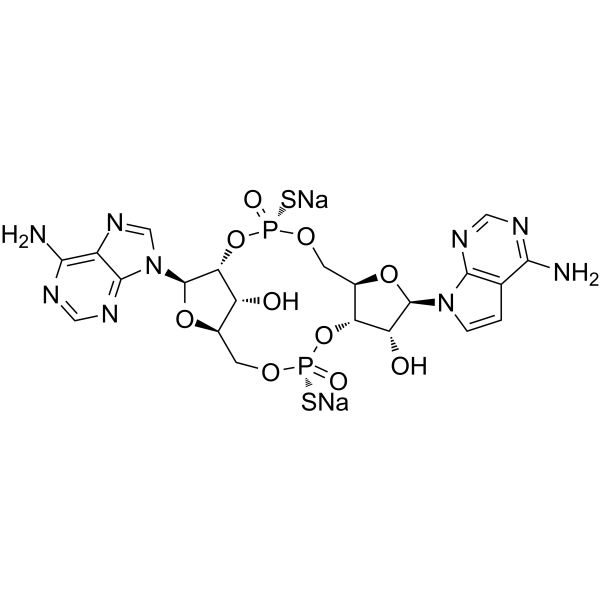
IACS-8779 disodium is a highly potent stimulator of interferon genes (STING) agonist with robust systemic antitumor efficacy. IACS-8779 disodium shows robust activation of the STING pathway in vitro and a superior systemic anti-tumor response in the B16 murine model of melanoma .
loading...
    loading...
Cat. No.: HY-180555
Target:  

PROTACs STING

Research Areas:  

Inflammation/Immunology Cancer

SN38-(PEG)2-Pom-α is a selective PROTAC RPL15 degrader. SN38-(PEG)2-Pom-α induces ubiquitin-mediated degradation of RPL15 without affecting TOP1. SN38-(PEG)2-Pom-α induces damage-associated molecular pattern (DAMP) secretion from cancer cells, which activated cGAS-STING signaling in dendritic cells. SN38-(PEG)2-Pom-α enhances anti-PD-1 immunotherapy in a murine melanoma tumor model expressing human CRBN. SN38-(PEG)2-Pom-α can be used for melanoma research .
loading...
    loading...
Cat. No.: HY-181967
Research Areas:  

Cancer

PROTAC PARP1 degrader-5 is a PARP1 PROTAC degrader with a DC50 of 0.12 μM. PROTAC PARP1 degrader-5 hijacks the ubiquitin-proteasome system via catalytic ternary complex formation to drive sustained PARP1 degradation. PROTAC PARP1 degrader-5 induces DNA damage, drives marginal cytosolic double-stranded DNA accumulation in tumor cells, and up-regulates PD-L1 surface expression in tumor cells. PROTAC PARP1 degrader-5 shows tumor growth inhibition activity in murine melanoma models when encapsulated in lipid nanoparticles. PROTAC PARP1 degrader-5 can be used for the research of cancer, such as melanoma .
loading...
    loading...
Cat. No.: HY-180419
CAS No.: 1883721-73-0
Target:  

ERK Apoptosis c-Myc

Research Areas:  

Inflammation/Immunology Cancer

SF-3-030 is a potent, selective and non-ATP competitive ERK1/2 inhibitor. SF-3-030 selectively induces apoptosis in melanoma cells containing mutated BRaf and constitutively active ERK1/2 signalling. SF-3-030 mitigates multiple features of asthma in a murine model of asthma. SF-3-030 can be used for the research of asthma and melanomasup .
loading...
    loading...
Cat. No.: HY-185150
CAS No.: 114088-58-3
Synonyms: 9-(2-Phosphonylmethoxy)ethylguanine
PMEG is a nuclear DNA polymerases α, δ, and ε inhibitor that causes DNA chain termination, inhibits DNA synthesis, induces cytotoxicity in dividing cells. PMEG is an acyclic nucleotide phosphonate that forms an active phosphorylated metabolite, PMEG diphosphate, within cells. PMEG has activity against leukemia and melanoma in rodent models. PMEG has poor cell permeability; its prodrug is Rabacfosadine (GS-9219) (HY-13640). PMEG shows antiviral activity against against various DNA virus infections including murine cytomegalovirus (MCMV) and human cytomegalovirus (HCMV). PMEG can be used for the research of non-hodgkin's lymphoma [1][2].
loading...
    loading...
Cat. No.: HY-172200A
Target:  

PD-1/PD-L1 HDAC

Research Areas:  

Inflammation/Immunology Cancer

PD-L1/HDAC6-IN-1 TFA is an orally active dual inhibitor of PD-L1 and HDAC6, with IC50 values of 26.8 nM and 78 nM, respectively. PD-L1/HDAC6-IN-1 TFA binds to human and murine PD-L1 proteins with high affinity, while it reduces STAT3 phosphorylation and downregulates PD-L1 expression by inhibiting HDAC6, thus blocking the PD-1/PD-L1 interaction. PD-L1/HDAC6-IN-1 TFA exhibits potent anti-tumor activity in a mouse melanoma model. PD-L1/HDAC6-IN-1 is suitable for research on tumor immune regulation related to melanoma .
loading...
    loading...
Cat. No.: HY-181916
BXY-14 is a TLR2 agonist and vaccine adjuvant. BXY-14 significantly downregulates the expression of intratumoral PD-L1 in mouse models. BXY-14 acts as a vaccine adjuvant to induce antibody responses. BXY-14 exhibits synergistic efficacy when combined with the anti-PD-L1 monoclonal antibody Atezolizumab (HY-P9904) in mouse models of melanoma, and prolongs overall survival. BXY-14 is applicable to research related to melanoma .
loading...
    loading...
  • 1

