

1. Search Result
Search Result
Results for "

murine sepsis

" in MedChemExpress (MCE) Product Catalog:

13

Inhibitors & Agonists

3

Peptides

1

Inhibitory Antibodies

Targets Recommended:
Cat. No. Product Name Target Research Areas Chemical Structure
  • HY-100574A
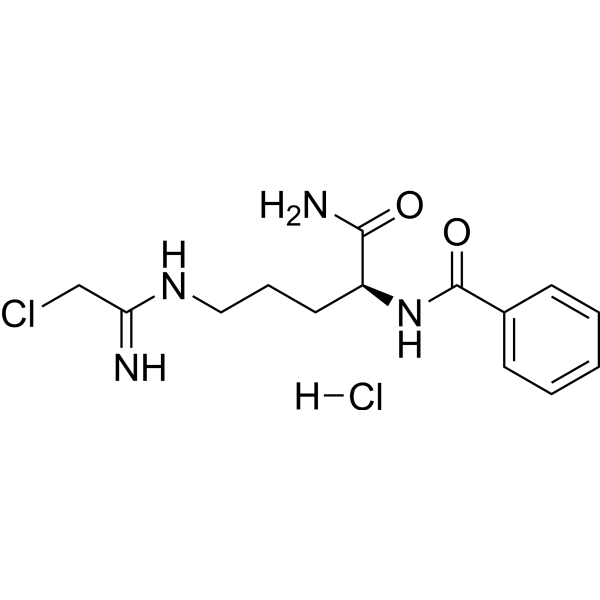
    Cl-amidine hydrochloride
    Maximum Cited Publications
    22 Publications Verification

    Protein Arginine Deiminase Apoptosis MicroRNA Inflammation/Immunology Cancer
    Cl-amidine hydrochloride is an orally active peptidylarginine deminase (PAD) inhibitor, with IC50 values of 0.8 μM, 6.2 μM and 5.9 μM for PAD1, PAD3, and PAD4, respectively. Cl-amidine hydrochloride induces apoptosis in cancer cells. Cl-amidine hydrochloride induces microRNA (miR)-16 (miRNA-16, microRNA-16) expression and causes cell cycle arrest. Cl-Amidine hydrochloride prevents histone 3 citrullination and neutrophil extracellular trap formation, and improves survival in a murine sepsis model .
    Cl-amidine hydrochloride
  • HY-P99008
    Atibuclimab
    2 Publications Verification

    IC14

    Toll-like Receptor (TLR) Infection Neurological Disease Inflammation/Immunology
    Atibuclimab (IC14), is a chimeric monoclonal antibody directed against CD14 and is composed of murine variable and human IgG4 Fc regions. Atibuclimab attenuates Lipopolysaccharides (HY-D1056) (LPS)-induced symptoms and strongly inhibits LPS-induced proinflammatory cytokine release, while only delaying the release of the anti-inflammatory cytokines soluble TNF receptor type I and IL-1 receptor antagonist. Atibuclimab can be used for the research of amyotrophic lateral sclerosis, sepsis, community-acquired pneumonia, or acute lung injury .
    Atibuclimab
  • HY-100574

    Protein Arginine Deiminase Apoptosis MicroRNA Inflammation/Immunology Cancer
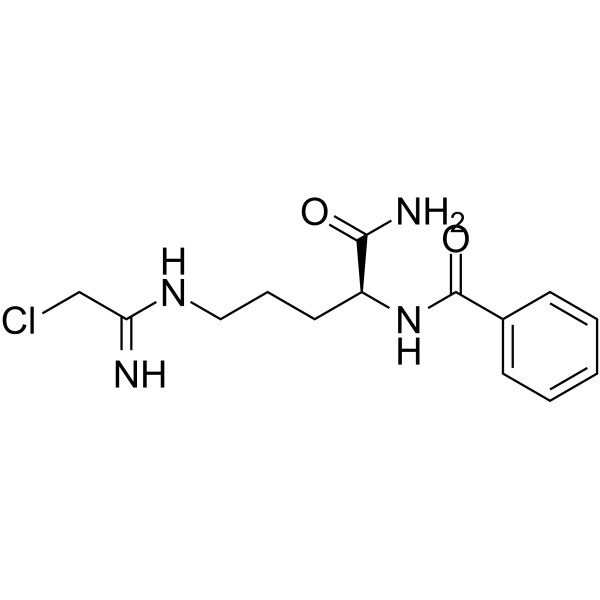
    Cl-amidine is an orally active peptidylarginine deminase (PAD) inhibitor, with IC50 values of 0.8 μM, 6.2 μM and 5.9 μM for PAD1, PAD3, and PAD4, respectively. Cl-amidine induces apoptosis in cancer cells. Cl-amidine induces microRNA (miR)-16 (miRNA-16, microRNA-16) expression and causes cell cycle arrest. Cl-Amidine prevents histone 3 citrullination and neutrophil extracellular trap formation, and improves survival in a murine sepsis model .
    Cl-amidine
  • HY-146066

    nAChR JAK STAT NO Synthase Interleukin Related Inflammation/Immunology
    α7 nAchR-JAK2-STAT3 agonist 1 is a potent α7 nAchR-JAK2-STAT3 agonist, with an IC50 value of 0.32 μM for nitric oxide (NO). α7 nAchR-JAK2-STAT3 agonist 1 effectively suppresses the expression of iNOS, IL-1β, and IL-6 in murine RAW264.7 macrophages. α7 nAchR-JAK2-STAT3 agonist 1 can inhibit LPS-induced NO release, NF-κB activation and cytokine production. α7 nAchR-JAK2-STAT3 can be used for researching sepsis .
    α7 nAchR-JAK2-STAT3 agonist 1
  • HY-100574B
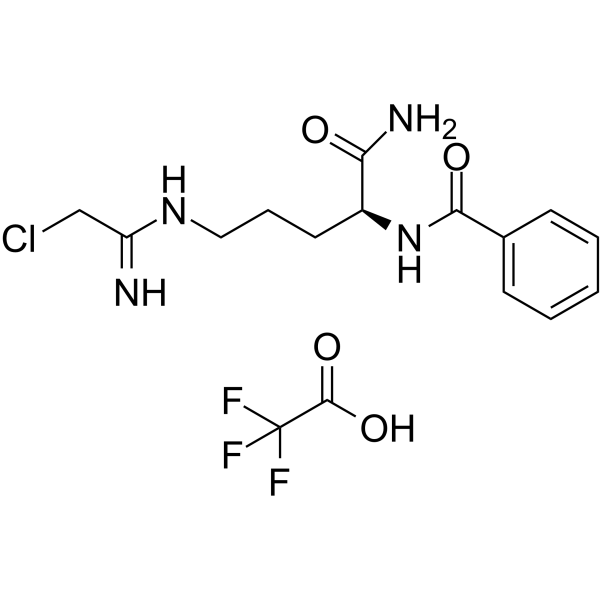
    Cl-amidine TFA
    Maximum Cited Publications
    22 Publications Verification

    Protein Arginine Deiminase Apoptosis MicroRNA Inflammation/Immunology Cancer
    Cl-amidine TFA is an orally active peptidylarginine deminase (PAD) inhibitor, with IC50 values of 0.8 μM, 6.2 μM and 5.9 μM for PAD1, PAD3, and PAD4, respectively. Cl-amidine TFA induces apoptosis in cancer cells. Cl-amidine TFA induces microRNA (miR)-16 (miRNA-16, microRNA-16) expression and causes cell cycle arrest. Cl-Amidine TFA prevents histone 3 citrullination and neutrophil extracellular trap formation, and improves survival in a murine sepsis model .
    Cl-amidine TFA
  • HY-146066A

    nAChR JAK STAT NO Synthase Others
    (R)-α7 nAchR-JAK2-STAT3 agonist 1 is the R-enantiomer of α7 nAchR-JAK2-STAT3 agonist 1 (HY-146066). α7 nAchR-JAK2-STAT3 agonist 1 is a potent α7 nAchR-JAK2-STAT3 agonist, with an IC50 value of 0.32 μM for nitric oxide (NO). α7 nAchR-JAK2-STAT3 agonist 1 effectively suppresses the expression of iNOS, IL-1β, and IL-6 in murine RAW264.7 macrophages. α7 nAchR-JAK2-STAT3 agonist 1 can inhibit LPS-induced NO release, NF-κB activation and cytokine production. α7 nAchR-JAK2-STAT3 can be used for researching sepsis .
    (R)-α7 nAchR-JAK2-STAT3 agonist 1
  • HY-178949

    Antibiotic Bacterial DNA/RNA Synthesis Infection
    MRSA antibiotic 3 (Compound C8) is a small-molecule antibiotic active against Methicillin (HY-121544)-resistant Staphylococcus aureus (MRSA), showing a MIC of 0.5 μg/mL against the standard S. aureus strain (ATCC 29213). MRSA antibiotic 3 potently inhibits the ATPase activity of S. aureus DNA gyrase with an IC50 of 0.32 μM. MRSA antibiotic 3 exhibits strong inhibitory activity against five clinical MRSA isolates, with MIC values ranging from 0.5 to 1 μg/mL. MRSA antibiotic 3 demonstrates negligible cytotoxicity at effective antibacterial concentrations and causes no hemolysis in erythrocytes even at extremely high concentrations. MRSA antibiotic 3 shows significant protective effects in both Galleria mellonella infection and murine sepsis models .
    MRSA antibiotic 3
  • HY-P5949

    Bacterial Infection
    AMPR-22 is an antimicrobial peptide. AMPR-22 can bind to the bacterial membrane and induces membrane permeabilization. AMPR-22 is effective against murine model of sepsis induced by MDR strains
    AMPR-22
  • HY-P11879

    SARS-CoV Infection Inflammation/Immunology Endocrinology
    LSALT peptide is a selective DPEP-1 inhibitor with selectivity over DPEP2/3. LSALT peptide inhibits neutrophil and monocyte/macrophage recruitment, inflammation, and tissue injury. LSALT peptide reduces kidney damage, improves survival in murine sepsis and endotoxemia models. LSALT peptide can be used for the research of COVID-19, sepsis, acute respiratory distress syndrome, and acute kidney injury .
    LSALT peptide
  • HY-183296

    NOD-like Receptor (NLR) Interleukin Related Caspase Inflammation/Immunology
    NLRP3-IN-91 is a potent NLRP3 inflammasome inhibitor with a Kd of 558.4 nM. NLRP3-IN-91 directly targets the NLRP3 NACHT domain, blocks inflammasome assembly and activation, and exerts anti-inflammatory effects. NLRP3-IN-91 increases survival time in a murine model of LPS (HY-D1056)-induced sepsis. NLRP3-IN-91 can be used for the research of sepsis .
    NLRP3-IN-91
  • HY-182417

    Bacterial Topoisomerase Infection
    PD 0305970 is an orally active bacterial gyrase and topoisomerase inhibitor. PD 0305970 shows exceptional activity against gram-positive and fastidious organisms and more modest activity against gram-negative species. PD 0305970 shows low spontaneous resistance frequencies. PD 0305970 shows antibacterial efficacy in murine streptococcal sepsis and pneumococcal pneumonia models. PD 0305970 can be used for the research of bacterial infection .
    PD 0305970
  • HY-181671

    Bacterial Infection
    Antibacterial agent 324 is an amphipathic antibacterial agent. Antibacterial agent 324 exhibits selective activity against Gram-positive bacteria, with limited activity against enterococci and weak activity against Gram-negative bacteria .
    Antibacterial agent 324
  • HY-P11791

    Endogenous Metabolite Infection
    nNIF peptide is an endogenous polypeptide detectable in human umbilical cords and neonatal blood. nNIF peptide specifically inhibits neutrophil extracellular trap (NETs) formation by neutrophils without interfering with other key immune functions of neutrophils. nNIF peptide can be used in studies related to COVID-19 acute respiratory distress syndrome, polymicrobial sepsis, and neonatal infectious peritonitis .
    nNIF peptide

Inquiry Online

Your information is safe with us. * Required Fields.

Salutation


Country or Region *

Applicant Name *


Organization Name *

Department *


Email Address *


Product Name *

Cat. No.


Requested quantity *

Phone Number *


Remarks

Inquiry Online

Inquiry Information

Product Name:
Cat. No.:
Quantity:
MCE Japan Authorized Agent:

