9 Results for "

myocardial oxygen consumption

" in MedChemExpress (MCE) Product Catalog:
Products (9)

9 Results for "myocardial oxygen consumption" in MCE Product Catalog:

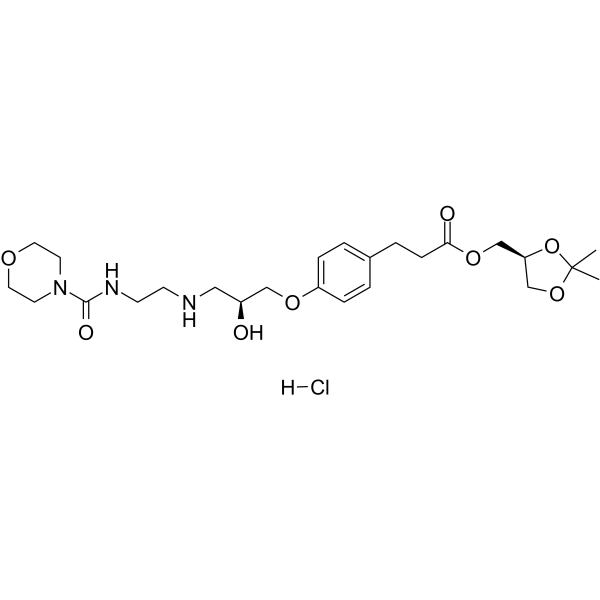
Cat. No.: HY-100607A
CAS No.: 144481-98-1
Purity:  99.65%
Synonyms: ONO1101 hydrochloride
Landiolol (ONO1101) hydrochloride is a highly selective, ultra-short-acting competitive inhibitor of β1 adrenergic receptors. Landiolol hydrochloride specifically blocks cardiac β1 receptors, reducing heart rate and myocardial oxygen consumption. Landiolol hydrochloride inhibits TNF-α-induced excessive mitochondrial oxygen consumption and reactive oxygen species production in a sepsis model, alleviating renal injury. Landiolol hydrochloride has little effect on cardiac ion channels (such as L-type calcium current and inward rectifier potassium current) and has a weak negative inotropic effect. Landiolol hydrochloride can be used for perioperative tachycardia control and protection studies of sepsis-related acute kidney injury .
loading...
    loading...
Cat. No.: HY-100607
CAS No.: 133242-30-5
Synonyms: ONO1101
Landiolol (ONO1101) is a highly selective, ultra-short-acting competitive inhibitor of β1 adrenergic receptors. Landiolol specifically blocks cardiac β1 receptors, reducing heart rate and myocardial oxygen consumption. Landiolol inhibits TNF-α-induced excessive mitochondrial oxygen consumption and reactive oxygen species production in a sepsis model, alleviating renal injury. Landiolol has little effect on cardiac ion channels (such as L-type calcium current and inward rectifier potassium current) and has a weak negative inotropic effect. Landiolol can be used for perioperative tachycardia control and protection studies of sepsis-related acute kidney injury .
loading...
    loading...
Cat. No.: HY-100607AR
CAS No.: 144481-98-1
Synonyms: ONO1101 hydrochloride (Standard)
Landiolol (ONO1101) hydrochloride (Standard) is the analytical standard of Landiolol hydrochloride (HY-100607A). This product is intended for research and analytical applications. Landiolol (ONO1101) hydrochloride is a highly selective, ultra-short-acting competitive inhibitor of β1 adrenergic receptors. Landiolol hydrochloride specifically blocks cardiac β1 receptors, reducing heart rate and myocardial oxygen consumption. Landiolol hydrochloride inhibits TNF-α-induced excessive mitochondrial oxygen consumption and reactive oxygen species production in a sepsis model, alleviating renal injury. Landiolol hydrochloride has little effect on cardiac ion channels (such as L-type calcium current and inward rectifier potassium current) and has a weak negative inotropic effect. Landiolol hydrochloride can be used for perioperative tachycardia control and protection studies of sepsis-related acute kidney injury .
loading...
    loading...
Cat. No.: HY-W748419
CAS No.: 60-38-8
Target:  

Others

Acetylstrophanthidin is a cardiac glycoside compound and a positive inotropic agent. Acetylstrophanthidin increases myocardial oxygen consumption in cat papillary muscles under constant load or tension, as well as under afterload (isotonic) and isometric contraction conditions .
loading...
    loading...
Cat. No.: HY-117181
CAS No.: 170684-14-7
UK-1745 is a cardiotonic agent with vasodilating and antiarrhythmic properties. It increases intracellular levels of cyclic adenosine monophosphate (cAMP) in cardiomyocytes by inhibiting phosphodiesterase III, thereby enhancing myocardial contractility. Additionally, UK-1745 exhibits β-adrenergic receptor blocking activity, which helps reduce the oxygen consumption of the heart and prevent calcium overload. These characteristics make UK-1745 a promising candidate for research in congestive heart failure .
loading...
    loading...
Cat. No.: HY-183473
CAS No.: 34535-83-6
Target:  

Drug Derivative

Research Areas:  

Cardiovascular Disease

Fenalcomine hydrochloride is an orally active phenethylamine derivative with antianginal activity. Fenalcomine hydrochloride reduces myocardial oxygen consumption, and increases cardiac output and coronary blood flow. Fenalcomine hydrochloride is suitable for angina models complicated by hypertension, diabetes, and old myocardial infarction. Fenalcomine hydrochloride can be used in studies related to angina pectoris .
loading...
    loading...
Cat. No.: HY-183473A
CAS No.: 34616-39-2
Target:  

Drug Derivative

Research Areas:  

Cardiovascular Disease

Fenalcomine is an orally active phenethylamine derivative with antianginal activity. Fenalcomine reduces myocardial oxygen consumption, and increases cardiac output and coronary blood flow. Fenalcomine is suitable for angina models complicated by hypertension, diabetes, and old myocardial infarction. Fenalcomine can be used in studies related to angina pectoris .
loading...
    loading...
Cat. No.: HY-100607S
Synonyms: ONO1101-d8
Landiolol-d8 (ONO1101-d8) is the deuterium labeled Landiolol (HY-100607). Landiolol (ONO1101) is a highly selective, ultra-short-acting competitive inhibitor of β1 adrenergic receptors. Landiolol specifically blocks cardiac β1 receptors, reducing heart rate and myocardial oxygen consumption. Landiolol inhibits TNF-α-induced excessive mitochondrial oxygen consumption and reactive oxygen species production in a sepsis model, alleviating renal injury. Landiolol has little effect on cardiac ion channels (such as L-type calcium current and inward rectifier potassium current) and has a weak negative inotropic effect. Landiolol can be used for perioperative tachycardia control and protection studies of sepsis-related acute kidney injury .
loading...
    loading...
Cat. No.: HY-129680
CAS No.: 90-54-0
Target:  

Adrenergic Receptor

Research Areas:  

Cardiovascular Disease

Etafenone is an antiarrhythmic agent and vasodilator. Etafenone exerts β-adrenergic agonistic effects. Etafenone inhibits the automaticity of sinoatrial nodes, atrioventricular junctions and Purkinje fibers, prolongs action potential duration and refractory period, slows the rising rate of action potentials, and prolongs conduction time. Etafenone enhances collateral circulation after coronary occlusion and suppresses ventricular premature beats. Etafenone delays ischemic myocardial energy imbalance, improves the recovery of high-energy phosphates after ischemia, and reduces myocardial oxygen consumption. Etafenone can be used in research related to ischemic heart disease, arrhythmia and angina pectoris .
loading...
    loading...

