



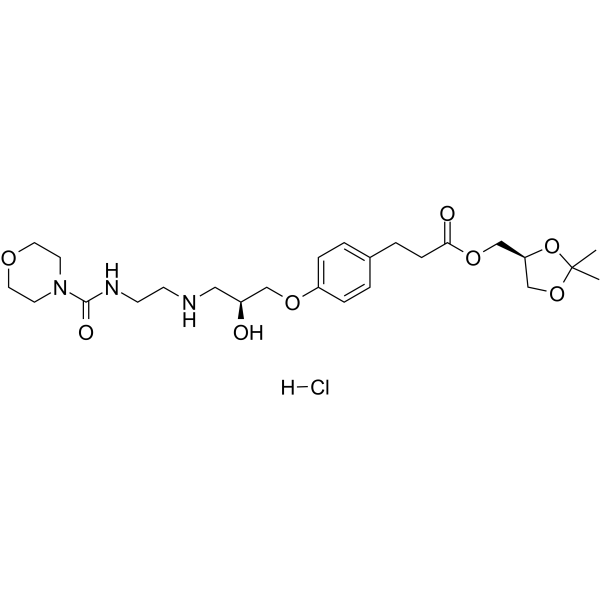
Landiolol hydrochloride

Based on 1 Customer Validation
Landiolol (ONO1101) hydrochloride is a highly selective, ultra-short-acting competitive inhibitor of β1 adrenergic receptors. Landiolol hydrochloride specifically blocks cardiac β1 receptors, reducing heart rate and myocardial oxygen consumption. Landiolol hydrochloride inhibits TNF-α-induced excessive mitochondrial oxygen consumption and reactive oxygen species production in a sepsis model, alleviating renal injury. Landiolol hydrochloride has little effect on cardiac ion channels (such as L-type calcium current and inward rectifier potassium current) and has a weak negative inotropic effect. Landiolol hydrochloride can be used for perioperative tachycardia control and protection studies of sepsis-related acute kidney injury.
For research use only. We do not sell to patients.
- Purity : 99.82%
- CAS No.: 144481-98-1
- Formula: C25H40ClN3O8
- Molecular Weight:546.05
-
Storage:
4°C, sealed storage, away from moisture
* In solvent : -80°C, 6 months; -20°C, 1 month (sealed storage, away from moisture)

To place orders, for customer services and technical support, please contact: MedChemExpress USA
Tel: 609-228-6898 E-mail: [email protected] [email protected]


-
 Biological Activity
-
Chemical Information
-
Solvent & Solubility
- Purity & Documentation
- References
-
 Help & FAQs




Biological Activity
Description
IC50 & Target
|
Beta-1 adrenergic receptor |
L-type calcium channel |
IrK |
In Vitro
Landiolol hydrochloride (10 μM; 24 h) significantly inhibits the increase in mitochondrial oxygen consumption rate (OCR) induced by TNF-α (0.5 nM) in HEK293 cells, reducing the basal OCR from 123% to 94.8%, and reduces the generation of reactive oxygen species (ROS)[1].
Landiolol hydrochloride (10 μM; 24 h) inhibits the excessive glycolytic capacity of HEK293 cells induced by TNF-α (0.5 nM), but does not significantly affect its basal glycolytic (ECAR) level[1].
MedChemExpress (MCE) has not independently confirmed the accuracy of these methods. They are for reference only.
-
Cell Line:HEK293 cells
-
Concentration:10 μM (Landiolol)
-
Incubation Time:24 h; with 0.5 nM TNF-α
-
Result:Resulted in a significant reduction in basal OCR compared to TNF-α alone. The OCR, normalized to control (100%), decreased from 123.9%±16.6% (TNF-α only) to 94.8%±13.3% (TNF-α + Landiolol).
Attenuated maximal OCR and ATP production, indicating inhibition of mitochondrial hyperactivity.
Significantly lowered intracellular ROS levels, measured via dichlorodihydrofluorescein (DCF) assay.
In Vivo
Landiolol hydrochloride has less effect on cardiac function than Esmolol (HY-B1392A) and does not directly shorten the action potential duration (APD)[3].
MedChemExpress (MCE) has not independently confirmed the accuracy of these methods. They are for reference only.
-
Animal Model:LPS-induced Acute Kidney Injury Rat Model (250-300 g,6-8 weeks old)[2]
-
Dosage:0.1 mg/kg/min
-
Administration:Continuous intravenous infusion starting at the time of LPS administration (7.5 mg/kg, iv), maintained for 6 h
-
Result:Significantly improved renal function compared to the LPS group.
Decreased serum creatinine levels to 0.7 ± 0.3 mg/mL versus 1.4 ± 0.7 mg/mL in the LPS group, and decreased lactate levels to 3.8 ± 0.7 mmol/L versus 6.5 ± 1.3 mmol/L, at 6 h.
Reduced tubular degeneration, dilation, and acute necrosis in the renal cortex and medulla in the landiolol group compared to the LPS group.
Urinary 8-OHdG, a marker of oxidative stress, was increased in both groups but not significantly different between them, indicating landiolol’s renoprotection was not mediated by systemic anti-inflammatory or antioxidant effects.


Chemical Information
-
CAS No. 144481-98-1
-
Appearance Solid
-
Molecular Weight 546.05
-
Formula C25H40ClN3O8
-
Color White to off-white
-
SMILES
O=C(OC[C@H]1OC(C)(C)OC1)CCC2=CC=C(OC[C@@H](O)CNCCNC(N3CCOCC3)=O)C=C2.[H]Cl
-
Synonyms
ONO1101 hydrochloride
-
Shipping
Room temperature in continental US; may vary elsewhere.
-
Storage
4°C, sealed storage, away from moisture
* In solvent : -80°C, 6 months; -20°C, 1 month (sealed storage, away from moisture)


Solvent & Solubility
In Vitro:
DMSO : 250 mg/mL (457.83 mM; Need ultrasonic; Hygroscopic DMSO has a significant impact on the solubility of product, please use newly opened DMSO)
H2O : ≥ 100 mg/mL (183.13 mM)
* "≥" means soluble, but saturation unknown.
Please refer to the solubility information to select the appropriate solvent. Once prepared, please aliquot and store the solution to prevent product inactivation from repeated freeze-thaw cycles.
Storage method and period of stock solution: -80°C, 6 months; -20°C, 1 month (sealed storage, away from moisture). When stored at -80°C, please use it within 6 months. When stored at -20°C, please use it within 1 month.
* Note: If you choose water as the stock solution, please dilute it to the working solution, then filter and sterilize it with a 0.22 μm filter before use.
Please refer to the solubility information to select the appropriate solvent. Once prepared, please aliquot and store the solution to prevent product inactivation from repeated freeze-thaw cycles.
Storage method and period of stock solution: -80°C, 6 months; -20°C, 1 month (sealed storage, away from moisture). When stored at -80°C, please use it within 6 months. When stored at -20°C, please use it within 1 month.
* Note: If you choose water as the stock solution, please dilute it to the working solution, then filter and sterilize it with a 0.22 μm filter before use.
Concentration (start) × Volume (start) = Concentration (final) × Volume (final)
In Vivo:
Select the appropriate dissolution method based on your experimental animal and administration route.
- For the following dissolution methods, please ensure to first prepare a clear stock solution using an In Vitro approach and then sequentially add co-solvents:
- To ensure reliable experimental results, the clarified stock solution can be appropriately stored based on storage conditions. As for the working solution for In Vivo experiments, it is recommended to prepare freshly and use it on the same day.
- The percentages shown for the solvents indicate their volumetric ratio in the final prepared solution. If precipitation or phase separation occurs during preparation, heat and/or sonication can be used to aid dissolution.
Add each solvent one by one: 10% DMSO 40% PEG300 5% Tween-80 45% Saline
Solubility: ≥ 2.08 mg/mL (3.81 mM); Clear solution
This protocol yields a clear solution of ≥ 2.08 mg/mL (saturation unknown).
Taking 1 mL working solution as an example, add 100 μL DMSO stock solution (20.8 mg/mL) to 400 μL PEG300, and mix evenly; then add 50 μL Tween-80 and mix evenly; then add 450 μL Saline to adjust the volume to 1 mL.
Preparation of Saline: Dissolve 0.9 g sodium chloride in ddH₂O and dilute to 100 mL to obtain a clear Saline solution.
Add each solvent one by one: 10% DMSO 90% (20% SBE-β-CD in Saline)
Solubility: ≥ 2.08 mg/mL (3.81 mM); Clear solution
This protocol yields a clear solution of ≥ 2.08 mg/mL (saturation unknown).
Taking 1 mL working solution as an example, add 100 μL DMSO stock solution (20.8 mg/mL) to 900 μL 20% SBE-β-CD in Saline, and mix evenly.
Preparation of 20% SBE-β-CD in Saline (4°C, storage for one week): 2 g SBE-β-CD powder is dissolved in 10 mL Saline, completely dissolve until clear.
In Vivo Dissolution Calculator
Please enter the basic information of animal experiments:
-
-
-
-
Recommended: Prepare an additional quantity of animals to account for potential losses during experiments.
Working solution concentration: 0.22 mg/mL
This product has good water solubility, please refer to the measured solubility data in water/PBS/Saline for details.


Purity & Documentation
-
Data Sheet (275 KB)
-
SDS (393 KB)
- English - EN (393 KB)
- Français - FR (393 KB)
- Deutsch - DE (393 KB)
- Norwegian - NO (393 KB)
- Español - ES (393 KB)
- Swedish - SV (393 KB)
- Italian - IT (393 KB)
- Korean - KR (393 KB)
- Portuguese - PT (393 KB)
-
Handling Instructions (2659 KB)
References
[1]. Atarashi H, et al. Pharmacokinetics of landiolol hydrochloride, a new ultra-short-acting beta-blocker, in patients with cardiac arrhythmias. Clin Pharmacol Ther. 2000 Aug;68(2):143-50. [Content Brief]
[2]. Okajima M, et al. Landiolol, an ultra-short-acting β1-blocker, is useful for managing supraventricular tachyarrhythmias in sepsis. World J Crit Care Med. 2015 Aug 4;4(3):251-7. [Content Brief]


Complete Stock Solution Preparation Table
Please refer to the solubility information to select the appropriate solvent. Once prepared, please aliquot and store the solution to prevent product inactivation from repeated freeze-thaw cycles.
Storage method and period of stock solution: -80°C, 6 months; -20°C, 1 month (sealed storage, away from moisture). When stored at -80°C, please use it within 6 months. When stored at -20°C, please use it within 1 month.
| Optional Solvent | Concentration Solvent Mass | 1 mg | 5 mg | 10 mg | 25 mg |
|---|---|---|---|---|---|
| H2O / DMSO | 1 mM | 1.8313 mL | 9.1567 mL | 18.3133 mL | 45.7834 mL |
| 5 mM | 0.3663 mL | 1.8313 mL | 3.6627 mL | 9.1567 mL | |
| 10 mM | 0.1831 mL | 0.9157 mL | 1.8313 mL | 4.5783 mL | |
| 15 mM | 0.1221 mL | 0.6104 mL | 1.2209 mL | 3.0522 mL | |
| 20 mM | 0.0916 mL | 0.4578 mL | 0.9157 mL | 2.2892 mL | |
| 25 mM | 0.0733 mL | 0.3663 mL | 0.7325 mL | 1.8313 mL | |
| 30 mM | 0.0610 mL | 0.3052 mL | 0.6104 mL | 1.5261 mL | |
| 40 mM | 0.0458 mL | 0.2289 mL | 0.4578 mL | 1.1446 mL | |
| 50 mM | 0.0366 mL | 0.1831 mL | 0.3663 mL | 0.9157 mL | |
| 60 mM | 0.0305 mL | 0.1526 mL | 0.3052 mL | 0.7631 mL | |
| 80 mM | 0.0229 mL | 0.1145 mL | 0.2289 mL | 0.5723 mL | |
| 100 mM | 0.0183 mL | 0.0916 mL | 0.1831 mL | 0.4578 mL |
* Note: If you choose water as the stock solution, please dilute it to the working solution, then filter and sterilize it with a 0.22 μm filter before use.


Landiolol hydrochloride Related Classifications
HY-100607A Related Classifications
 Powered by Bioz