16 Results for "

organochlorine

" in MedChemExpress (MCE) Product Catalog:
Products (16)

16 Results for "organochlorine" in MCE Product Catalog:

1
1 Cited Publications
Cat. No.: HY-B1984
CAS No.: 72-54-8
Synonyms: 4,4'-DDD; p,p'-Dichlorodiphenyl dichloroethane
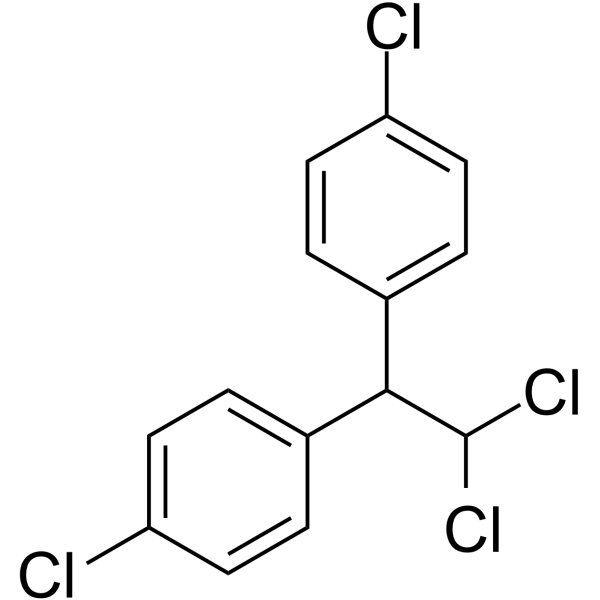
p,p'-DDD (4,4’-DDD) is an organochlorine insecticide, a major metabolite of p,p'-DDT. p,p'-DDD is an agonist at estrogen receptor α(ERα) and ERβ. p,p'-DDD increases DNA damage, apoptosis and necrosis in peripheral blood. p,p'-DDD stimulates cell proliferation in SKBR3 cells. p,p'-DDD activates the AP-1 transcription factor. p,p'-DDD decreases sleep times of barbiturates and steroids in rats .
loading...
    loading...
Cat. No.: HY-119725
CAS No.: 116-29-0
Purity:  99.71%
Research Areas:  

Infection

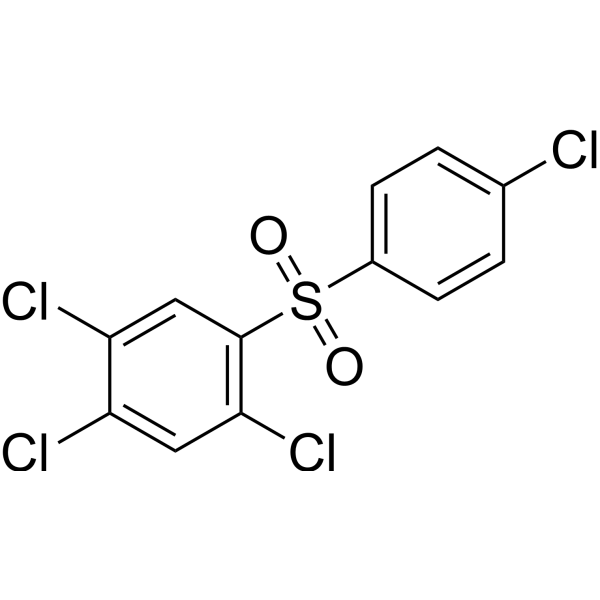
Tetradifon is a broad-spectrum organochlorine insecticide and an inhibitor of the mitochondrial oligomycin sensitivity conferring protein (OSCP), which can be used to control a variety of mites. Tetradifon inhibits energy-related activities such as ADP-stimulated respiration, DNP and Mg 2+-stimulated ATPase, with an IC50 of 4.5-27 nmoL/mg mitochondrial protein. Tetradifon exerts oligomycin-like activity by inhibiting the oxidative phosphorylation process, inducing oxidative stress and interfering with bone metabolism. Tetradifon is currently mainly used in the research of mitochondrial function regulation, bone remodeling mechanism and nephrotoxicity of environmental pollutants .
loading...
    loading...
Cat. No.: HY-116992
CAS No.: 2675-77-6
Purity:  ≥95.0%
Synonyms: Demosan; TERSAN SP(R)
Research Areas:  

Infection

Chloroneb (Demosan) is a pesticide with fungicidal and plant-protective activities. Chloroneb can be used to detect organochlorine pesticide residues, showing good selectivity, stability and reproducibility. Chloroneb has been applied to the detection of licorice, cucumber, river water and soil samples with satisfactory results .
loading...
    loading...
Cat. No.: HY-121779
CAS No.: 3424-82-6
Synonyms: 2,4'-DDE; 2,4-Dichlorodiphenyldichloroethylene; 2,4'-DDE; o,p'-Dichlorodiphenyldichloroethylene
Target:  

Insecticide

Research Areas:  

Endocrinology

o,p'-DDE (2,4-Dichlorodiphenyldichloroethylene) is a metabolite and degradation product of the organochlorine pesticide DDT. It accumulates in smallmouth buffalo, channel catfish, and largemouth bass, and in sediments from DDT manufacturing plants around the Huntsville Spring Branch-Indian Creek tributary system, where it is considered a persistent organic pollutant (POP). o,p'-DDE inhibits estrogen binding to the rainbow trout estrogen receptor (rtER) with an IC50 value of 3.2 μM. It induces concentration-dependent estradiol secretion in co-cultures of granulosa and theca cells isolated from porcine follicles. In ovo exposure to o,p'-DDE increases follicular degeneration and reduces testis size in Japanese medaka (O. latipes).
loading...
    loading...
Cat. No.: HY-B1873
CAS No.: 72-43-5
Target:  

Apoptosis

Research Areas:  

Infection

Methoxychlor is an organochlorine pesticide agent. Methoxychlor induces Ca 2 rise and apoptosis in HA59T cells .
loading...
    loading...
Cat. No.: HY-B1984S
CAS No.: 93952-20-6
Synonyms: 4,4'-DDD-d8; p,p'-Dichlorodiphenyl dichloroethane-d8
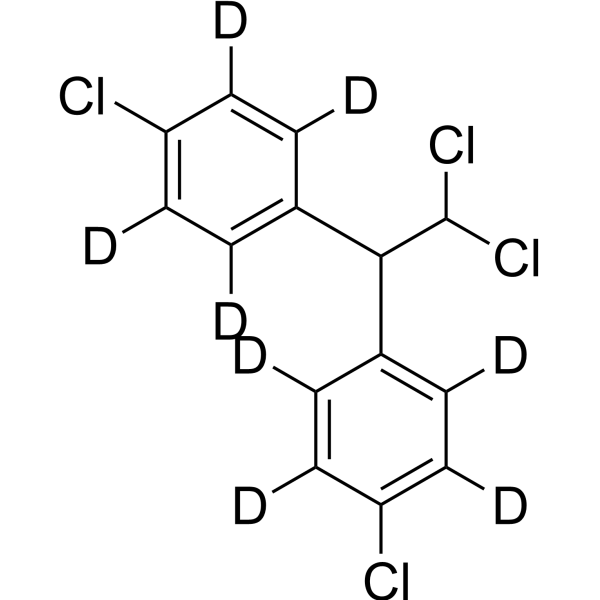
p,p'-DDD-d8 is the deuterium labeled p,p'-DDD[1]. p,p'-DDD (4,4’-DDD) is an organochlorine insecticide, a major metabolite of p,p'-DDT. p,p'-DDD is an agonist at estrogen receptor α(ERα) and ERβ. p,p'-DDD increases DNA damage, apoptosis and necrosis in peripheral blood. p,p'-DDD stimulates cell proliferation in SKBR3 cells. p,p'-DDD activates the AP-1 transcription factor. p,p'-DDD decreases sleep times of barbiturates and steroids in rats .
loading...
    loading...
Cat. No.: HY-119725R
CAS No.: 116-29-0
Research Areas:  

Infection

Tetradifon (Standard) is the analytical standard of Tetradifon (HY-119725). This product is intended for research and analytical applications. Tetradifon is a broad-spectrum organochlorine insecticide and an inhibitor of the mitochondrial oligomycin sensitivity conferring protein (OSCP), which can be used to control a variety of mites. Tetradifon inhibits energy-related activities such as ADP-stimulated respiration, DNP and Mg 2+-stimulated ATPase, with an IC50 of 4.5-27 nmoL/mg mitochondrial protein. Tetradifon exerts oligomycin-like activity by inhibiting the oxidative phosphorylation process, inducing oxidative stress and interfering with bone metabolism. Tetradifon is currently mainly used in the research of mitochondrial function regulation, bone remodeling mechanism and nephrotoxicity of environmental pollutants .
loading...
    loading...
Cat. No.: HY-114525
CAS No.: 103-17-3
Target:  

Insecticide

Research Areas:  

Others

Chlorbenside is an organochlorine pesticide. Chlorbenside targets organism such as mites and ticks and possesses efficient ovicidal and larvicidal activities .
loading...
    loading...
Cat. No.: HY-114525R
CAS No.: 103-17-3
Research Areas:  

Others

Chlorbenside (Standard) is the analytical standard of Chlorbenside. This product is intended for research and analytical applications. Chlorbenside is an organochlorine pesticide. Chlorbenside targets organism such as mites and ticks and possesses efficient ovicidal and larvicidal activities .
loading...
    loading...
Cat. No.: HY-116016R
CAS No.: 37178-37-3
Synonyms: L-DOPA ethyl ester (Standard); Levodopa ethyl ester (Standard)
Chlorbenside (Standard) is the analytical standard of Chlorbenside. This product is intended for research and analytical applications. Chlorbenside is an organochlorine pesticide. Chlorbenside targets organism such as mites and ticks and possesses efficient ovicidal and larvicidal activities .
loading...
    loading...
Cat. No.: HY-117179
CAS No.: 1031-07-8
Target:  

Parasite

Research Areas:  

Infection

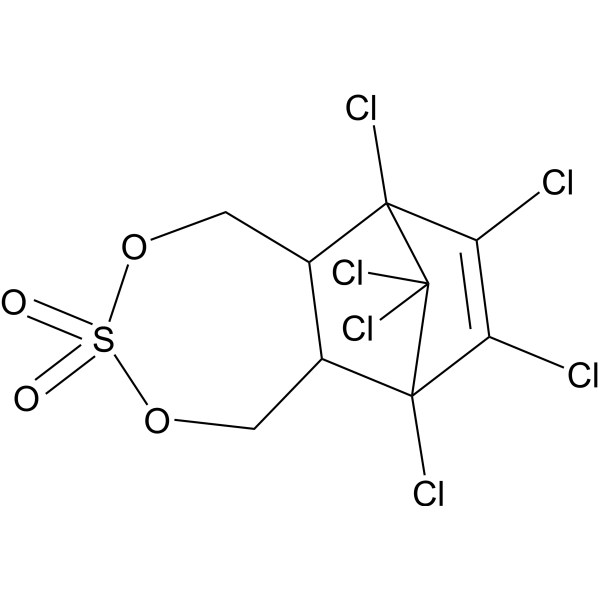
Endosulfan sulfate is the major metabolite of the insecticide Endosulfan, used for various crops. Endosulfan sulfate is more toxic and persistent than Endosulfan .
loading...
    loading...
Cat. No.: HY-117179R
CAS No.: 1031-07-8
Research Areas:  

Infection

Endosulfan sulfate (Standard) is the analytical standard of Endosulfan sulfate. This product is intended for research and analytical applications. Endosulfan sulfate is the major metabolite of the insecticide Endosulfan, used for various crops. Endosulfan sulfate is more toxic and persistent than Endosulfan .
loading...
    loading...
Cat. No.: HY-116992R
CAS No.: 2675-77-6
Synonyms: Demosan (Standard); TERSAN SP(R) (Standard)
Research Areas:  

Infection

Chloroneb (Standard) is the analytical standard of Chloroneb. This product is intended for research and analytical applications. Chloroneb (Demosan) is a pesticide with fungicidal and plant-protective activities. Chloroneb can be used to detect organochlorine pesticide residues, showing good selectivity, stability and reproducibility. Chloroneb has been applied to the detection of licorice, cucumber, river water and soil samples with satisfactory results .
loading...
    loading...
Cat. No.: HY-B1984R
CAS No.: 72-54-8
Synonyms: 4,4'-DDD (Standard); p,p'-Dichlorodiphenyl dichloroethane (Standard)
p,p'-DDD (Standard) is the analytical standard of p,p'-DDD (HY-B1984) . This product is intended for research and analytical applications. p,p'-DDD (4,4’-DDD) is an organochlorine insecticide, a major metabolite of p,p'-DDT. p,p'-DDD is an agonist at estrogen receptor α(ERα) and ERβ. p,p'-DDD increases DNA damage, apoptosis and necrosis in peripheral blood. p,p'-DDD stimulates cell proliferation in SKBR3 cells. p,p'-DDD activates the AP-1 transcription factor. p,p'-DDD decreases sleep times of barbiturates and steroids in rats.
loading...
    loading...
Cat. No.: HY-W090961
CAS No.: 1192027-04-5
Research Areas:  

Others

DDTT is a highly efficient sulfur transfer reagent for the synthesis of phosphorothioate oligonucleotides. DDTT serves as a collective detection indicator for total organochlorine pesticide residues consisting of DDT, DDE and DDD .
loading...
    loading...
Cat. No.: HY-B2180
CAS No.: 2893-78-9
Research Areas:  

Infection

Dichloroisocyanurate sodium is a synthetic organochlorine compound belonging to triazine derivatives, and is commonly used as a disinfectant and biocide. Dichloroisocyanurate sodium can release hypochlorous acid to inactivate waterborne bacteria, viruses, helminths and protozoa, and can act as a hypochlorous acid reservoir to provide sustained biocidal protection .
loading...
    loading...
  • 1

