



Etilevodopa (Standard)
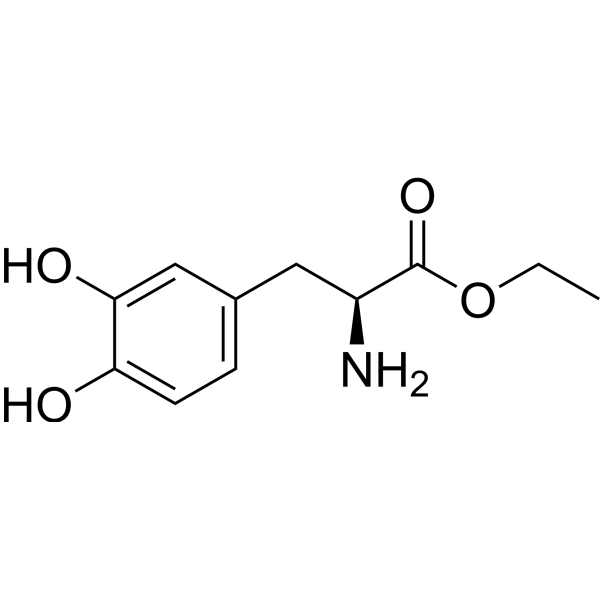
Etilevodopa (Standard) (L-DOPA ethyl ester (Standard)) is the analytical standard of Etilevodopa (HY-116016). This product is intended for research and analytical applications. Etilevodopa (L-Dopa ethyl ester), an ethyl-ester proagent of Levodopa, is rapidly hydrolyzed to Levodopa and ethanol by nonspecific esterases in the gastrointestinal tract. Etilevodopa is used for the treatment of Parkinson disease (PD). Levodopa is the direct precursor of dopamine and is a suitable proagent as it facilitates CNS penetration and delivers dopamine.
Nur für Forschungszwecke. Wir verkaufen nicht an Patienten.
- CAS. Nr.: 37178-37-3
- Formel: C11H15NO4
- Molecular Weight:225.24
-
Speicherung:
Please store the product under the recommended conditions in the Certificate of Analysis.


To place orders, for customer services and technical support, please contact: MedChemExpress USA
Tel: 609-228-6898 E-mail: [email protected] [email protected]


-
 Product Information
-
Chemical Information
- Reinheit & Dokumentation
-
 Help & FAQs




Product Information
Information
Anwendung
The compound is the grade of analytical standard, which is the reference standard supplied assay. It is commonly used in qualitative, quantitative and methodological research experiments in HPLC, GC and MS.


Chemical Information
-
CAS. Nr. 37178-37-3
-
Molecular Weight 225.24
-
Formel C11H15NO4
-
SMILES
N[C@H](C(OCC)=O)CC1=CC=C(C(O)=C1)O
-
Synonyms
L-DOPA ethyl ester (Standard); Levodopa ethyl ester (Standard)
-
Versand
Room temperature in continental US; may vary elsewhere.
-
Speicherung
Please store the product under the recommended conditions in the Certificate of Analysis.


Reinheit & Dokumentation
Verweise
[1]. Djaldetti R, et al. Pharmacokinetics of etilevodopa compared to levodopa in patients with Parkinson's disease: an open-label, randomized, crossover study. Clin Neuropharmacol. 2003 Nov-Dec;26(6):322-6. [Content Brief]
[2]. Blindauer K, et al. A randomized controlled trial of etilevodopa in patients with Parkinson disease who have motor fluctuations. Arch Neurol. 2006 Feb;63(2):210-6. [Content Brief]
[3]. Haddad F, et al. Dopamine and Levodopa Prodrugs for the Treatment of Parkinson's Disease. Molecules. 2017 Dec 25;23(1). pii: E40. [Content Brief]

Calculators
Konzentration (Stammlösung) × Volumen (Stammlösung) = Konzentration (Ziellösung) × Volumen (Ziellösung)


Etilevodopa (Standard) Related Classifications
HY-116016R Related Classifications
 Powered by Bioz