17 Results for "

orthosteric ligands

" in MedChemExpress (MCE) Product Catalog:
Products (17)

17 Results for "orthosteric ligands" in MCE Product Catalog:

Cat. No.: HY-W668775
CAS No.: 871100-12-8
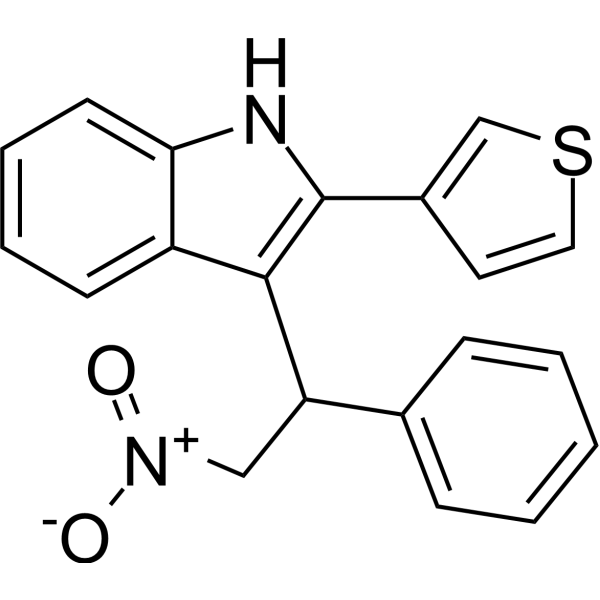
Quin-C7 is an orally active FPR2/ALX antagonist. Quin-C7 binds to the orthosteric ligand-binding pocket of FPR2/ALX, modulates receptor activation, and inhibits pro-inflammatory ERK signaling mediated by serum amyloid A (SAA). Quin-C7 reduces pro-inflammatory mediators TNF-α levels, increases anti-inflammatory IL-10, decreases inflammatory neutrophils and pro-inflammatory M1 macrophages, downregulates ERK1/2 phosphorylation, and upregulates JNK1/2/3 phosphorylation. Quin-C7 blocks FPR2/mFpr2 signaling, reduces brain lesion volume. Quin-C7 can be used for the research of inflammatory bowel disease and neuromyelitis optica spectrum disorder .
loading...
    loading...
Cat. No.: HY-158104
Target:  

ATF6

Research Areas:  

Others

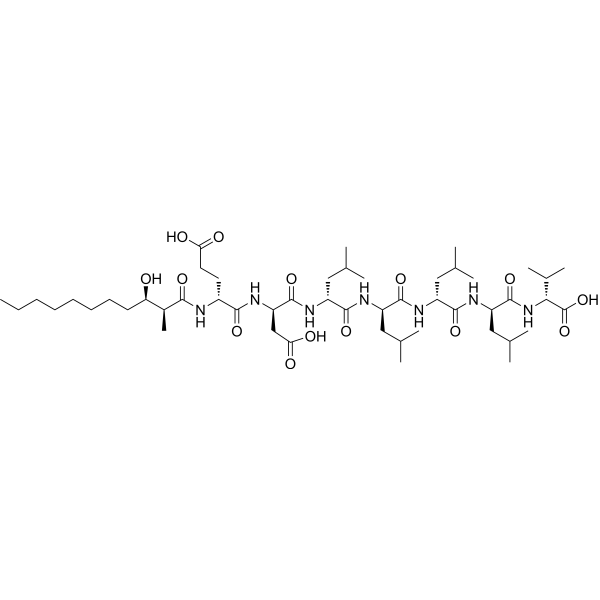
LPPM-8 is a ligand of Med25 and an inhibitor of Med25 protein-protein interactions (PPIs). LPPM-8 engages Med25 through interaction with the H2 face of its Activator Interaction Domain and stabilizes full-length protein in the cellular proteome. LPPM-8 is an orthosteric inhibitor of H2-binding transcriptional activators (such as ATF6a). LPPM-8 can be used for studying Med25 and Mediator complex biology .
loading...
    loading...
Cat. No.: HY-147558
CAS No.: 2513102-41-3
Target:  

Cannabinoid Receptor

Research Areas:  

Others

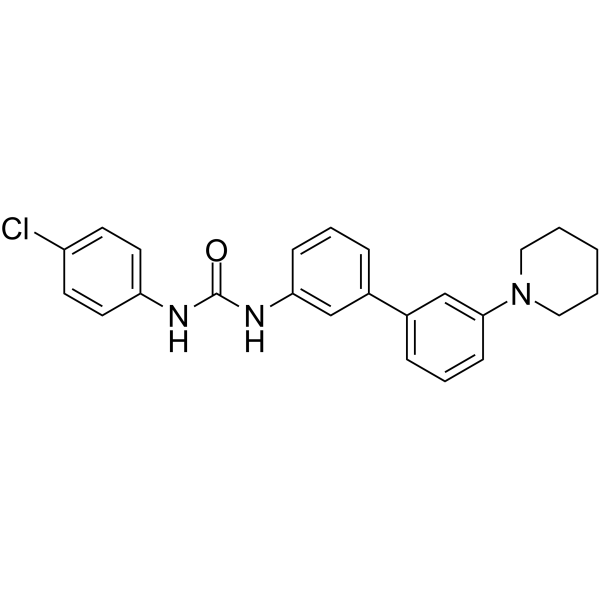
CB1R Allosteric modulator 1 (compound 11) is a potent CB1R allosteric modulator. CB1R Allosteric modulator 1 shows negatively affects the functional activity of orthosteric ligands (NAM) at CB1Rs .
loading...
    loading...
Cat. No.: HY-147559
CAS No.: 2513102-64-0
Target:  

Cannabinoid Receptor

Research Areas:  

Others

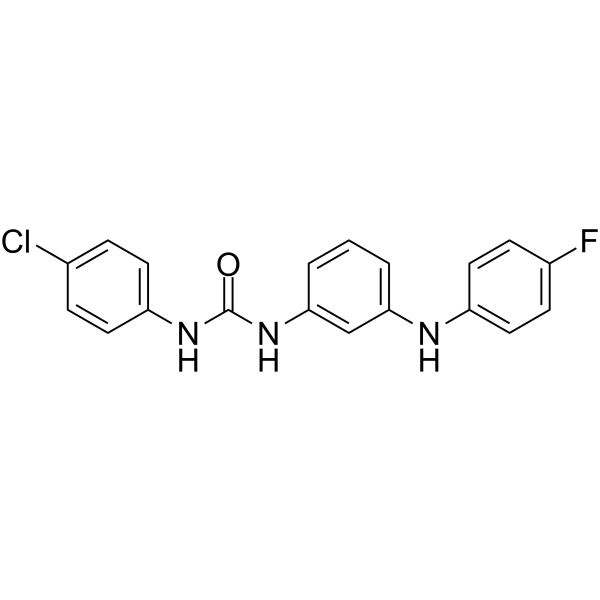
CB1R Allosteric modulator 2 (compound 18) is a potent CB1R allosteric modulator. CB1R Allosteric modulator 2 shows negatively affects the functional activity of orthosteric ligands (NAM) at CB1Rs .
loading...
    loading...
Cat. No.: HY-103513
CAS No.: 1236105-75-1
Target:  

GABA Receptor

Research Areas:  

Others

GABAA receptor agent 2 (compound 13) is a compound used to study the structure and orthosteric ligand binding of GABA(A) receptors. The relevant model of GABAA receptor agent 2 can be used to understand the details of orthosteric ligand binding, and a detailed binding mode hypothesis was created through structure-activity relationships with two homologous series of orthosteric GABA(A)R antagonists.
loading...
    loading...
Cat. No.: HY-162659
CAS No.: 3051498-44-0
Target:  

Adrenergic Receptor

Research Areas:  

Others

β2AR ligand 1 (Compound 4) is a homobivalent bitopic ligand for β2 adrenergic receptor (β2AR) on the orthosteric binding site (OBS) and the metastable binding sites (MBS) .
loading...
    loading...
Cat. No.: HY-122491
CAS No.: 402475-33-6
Target:  

mAChR

Research Areas:  

Neurological Disease

Dimethyl-W84 (dibromide) modulates M2 muscarinic acetylcholine receptors. Dimethyl-W84 (dibromide) can be used in nervous system related research .
loading...
    loading...
Cat. No.: HY-144705
CAS No.: 2851895-01-5
Target:  

Cannabinoid Receptor

Research Areas:  

Neurological Disease

GAT564 (Compound 15d) is a potent allosteric modulator of cannabinoid 1 receptor (CB1R) with EC50s of 87 and 320 nM respectively for cAMP and β-arrestin2. GAT564 markedly promotes orthosteric ligand binding to hCB1R. GAT564 is efficacious as a topical agent that significantly reduces intraocular pressure (IOP) in the ocular normotensive murine model of glaucoma .
loading...
    loading...
Cat. No.: HY-124912
CAS No.: 3455-10-5
Target:  

Histamine Receptor

Research Areas:  

Others

VUF-6884 (Compound 7j) is a histamine receptor (Histamine Receptor) ligand with activity toward human H4R and H1R. Its pEC50 and pKi values against human H4R are 7.70 and 7.55, respectively, while those against human H1R are 8.17 and 8.11, respectively. VUF-6884 competitively binds to the orthosteric binding site of human H4R to displace histamine, and exhibits inverse agonist activity at human H1R .
loading...
    loading...
Cat. No.: HY-180554
CAS No.: 300587-89-7
Research Areas:  

Neurological Disease

UCB1244283 is a synaptic vesicle glycoprotein 2A (SV2A) allosteric modulator. UCB1244283 binds to a secondary ligand-binding site in SV2A and enhances orthosteric ligand engagement when the orthosteric site is occupied, by stabilizing the occluded state and slowing ligand dissociation. UCB1244283 shows a clear protective effect against both tonic and clonic convulsions in sound-sensitive mice. UCB1244283 can be used for epilepsy research .
loading...
    loading...
Cat. No.: HY-187537
5-HT2AR ligand-2 is a serotonin 2A receptor (5-HT2AR) ligand with a Ki value of 11.4 nM. 5-HT2AR ligand-2 stabilizes the inactive conformation of receptors by interacting with specific amino acid residues in the orthosteric binding pockets of D2R and 5-HT2AR, thereby blocking downstream signal transduction. 5-HT2AR ligand-2 can be used in studies related to schizophrenia .
loading...
    loading...
Cat. No.: HY-L170
258 compounds

An emerging drug design method is based on the secondary binding site effect, where small molecule drugs are designed to bind to secondary binding sites on target biomolecules rather than primary orthomorphic sites. Successful potential drugs (known as allosteric modulators) will be able to bind to allosteric sites and remotely alter (or modify) the conformation of the main orthosteric binding sites of biological targets. Allosteric modulators (AMs) are ligands of proteins that act through binding sites different from natural (orthosteric) ligand sites. AMs are relatively small, more lipophilic, and more rigid compounds. The binding efficacy of AMs with their targets is often slightly lower. AMs are divided into positive AMs (PAMs) and negative AMs (NAMs). AMs are ideal drug targets because they can fine-tune receptor activity while preserving the spatial and temporal signal transduction characteristics of endogenous ligands, resulting in fewer targeted side effects, improved subtype selectivity, and better promotion of biased signal transduction than normal ligands.

MCE designs a unique collection of 258 small allosteric modulators. It is a good tool to be used for research on metabolize, cancer and other diseases.

Cat. No.: HY-W1135319
Research Areas:  

Cancer

SB-405483 is a CRBN orthosteric ligand bindign enhancer. SB-405483 potentiates degradation of CRBN substrates including CK1α, Wee1, IKZF1/3. SB-405483 stabilizes CRBN and reduces CRBN autoubiquitination. SB-405483 can be used for the research of cancer, such as multiple myeloma and acute myeloid leukemia .
loading...
    loading...
Cat. No.: HY-187536
CAS No.: 129281-28-3
Research Areas:  

Neurological Disease

SYA16263 is a dopamine D2 receptor (D2R) and serotonin 1A receptor (5-HT1AR) ligand, with Ki values of 1.24 nM and 0.67 nM for D2R and 5-HT1AR, respectively. SYA16263 stabilizes the inactive conformation of D2R and 5-HT1AR via interactions with specific amino acid residues in their orthosteric binding pockets, thereby blocking downstream signal transduction. SYA16263 can be used in research related to schizophrenia and psychosis .
loading...
    loading...
Cat. No.: HY-L928
7,106 compounds

G protein-coupled receptors (GPCRs) are membrane proteins in humans and one of the most important targets in drug discovery. Approximately 35% of launched drugs are targeted GPCRs, making them a crucial class of targets in drug discovery.

The orthosteric site of a GPCR is its endogenous ligand’s (such as neurotransmitters or hormones) binding site. This site plays a central role in signal transduction. Small molecules binding to this site typically contain a protonatable amino group, enabling the formation of salt bridges or hydrogen bonds with acidic residues in the binding pocket. In contrast, the allosteric site does not directly initiate signaling but modulates the signal intensity of the GPCR by altering or stabilizing the conformation of the orthosteric site. Small molecules binding to the allosteric site often contain multiple aromatic rings to occupy hydrophobic pockets and achieve their functional effects.

MCE has collected over 7,106 reported bioactive molecules targeting GPCRs, covering Class A, B, and C GPCRs. These small molecules were subjected to AI representation to extract 2D and 3D features. Subsequently, we do screening by AI score based on similarity to identify molecules in diversity library highly similar to the reported bioactive molecules in both 2D and 3D, with a threshold greater than 0.7. Further screening based on cLogP was applied to select molecules with good lipophilicity, which facilitates the binding of small molecules to GPCRs. This diversity library can be widely applied to the discovery of compounds targeting GPCR proteins.

Cat. No.: HY-189243
P2Y2R antagonist-2 is an antagonist of the P2Y2 receptor (P2Y2R), with a pKi value of 6.53 for human P2Y2R. P2Y2R antagonist-2 blocks UTPγS (HY-137603)-induced calcium mobilization, binds to the orthosteric site of P2Y2R to displace fluorescent antagonist ligands, and forms unique binding interactions. P2Y2R antagonist-2 has no structural alerts, exhibiting low lipophilicity and high lipophilic efficiency. P2Y2R antagonist-2 can be used in studies related to astrocytoma and inflammation .
loading...
    loading...
Cat. No.: HY-189040
Target:  

mAChR

Research Areas:  

Neurological Disease

M4R ligand-1 is a M4R ligand. M4R ligand-1 binds to the extracellular vestibular allosteric site of M4R. M4R ligand-1 can be used for the research of schizophrenia .
loading...
    loading...
  • 1

