8 Results for "

pan+cdk+inhibitor

" in MedChemExpress (MCE) Product Catalog:
Products (8)

8 Results for "pan+cdk+inhibitor" in MCE Product Catalog:

Cat. No.: HY-15491
CAS No.: 837364-57-5
Purity:  98.53%
Target:  

COX Apoptosis

Research Areas:  

Cancer

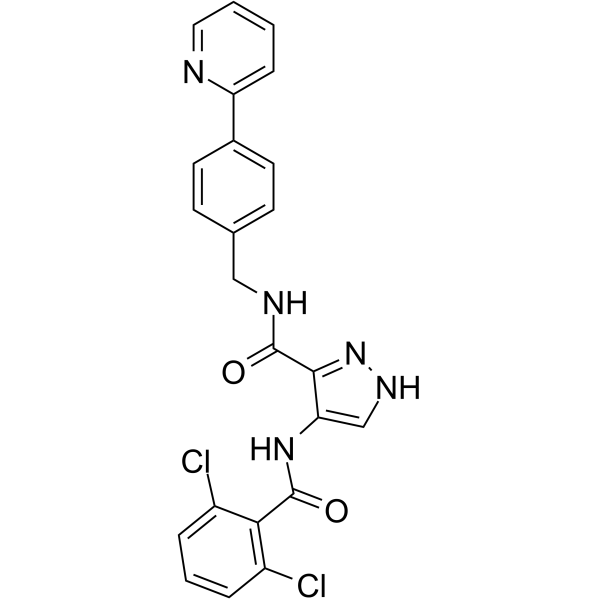
AG-024322 is a potent ATP-competitive pan-CDK inhibitor against cell cycle kinases CDK1, CDK2, and CDK4 with Ki values in the 1-3 nM range . AG-024322 displays broad-spectrum anti-tumor activity and clear target modulation in vivo. AG-024322 induces cell apoptosis .
loading...
    loading...
Cat. No.: HY-155805
Purity:  99.85%
Target:  

CDK

Research Areas:  

Cancer

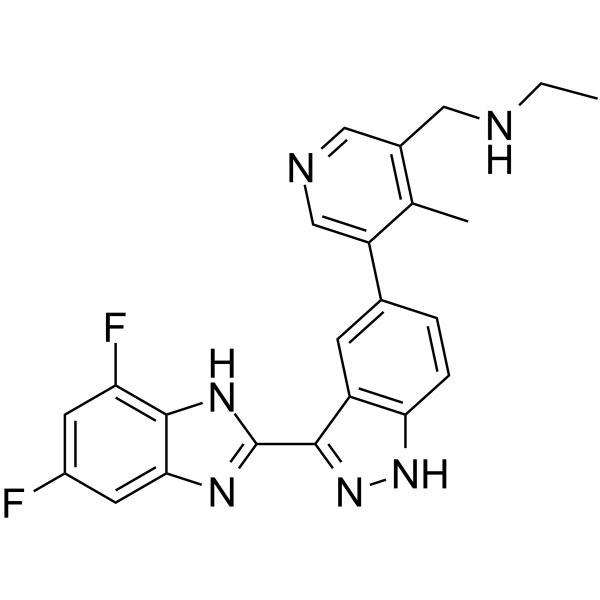
CAF-382 (compound B1) is an analog of SNS-032 and a CDKL5 and pan-CDK inhibitor with a weak GSK3α/β affinity (>1.8 μM) and inhibitory activity. CAF-382 inhibits CDKL5 and blocks the phosphorylation of the CDKL5 E2 domain .
loading...
    loading...
Cat. No.: HY-161168
CAS No.: 3055008-98-2
Target:  

Molecular Glues CDK

Research Areas:  

Cancer

Cyclin K degrader 1 is a molecular glue degrader derived from the pan-CDK inhibitor AT-7519 (HY-50940), with potent Cyclin K degrading activity and a DC50 of 21 nM. Cyclin K degrader 1 binds to CDK12, mediates the formation of a CDK12-DDB1 ternary protein complex, recruits the E3 ubiquitin ligase complex, and induces ubiquitination and proteasomal degradation of Cyclin K. Cyclin K degrader 1 can be used in the research of various Cyclin K-related diseases such as cancer .
loading...
    loading...
Cat. No.: HY-119715
CAS No.: 486414-35-1
Target:  

CDK Apoptosis

Research Areas:  

Inflammation/Immunology Cancer

AG-012986 is a pan-CDK inhibitor with Ki values of 44 nM (CDK1), 9.2 nM (CDK4), 94 nM (CDK2), and IC50 values of 22 nM (CDK5), 4 nM (CDK9). AG-012986 causes apoptosis of T-cells by targeting upstream kinases in the p38 Mitogen-activated protein kinase (MAPK) pathway and impairing cellular survival. AG-012986 induces cell cycle arrest, retinoblastoma protein hypophosphorylation, and reduces Ki-67 expression. AG-012986 exerts antiproliferative activity in tumor cells, demonstrates antitumor efficacy in human xenograft models, and causes retinal and peripheral neurotoxicity, plus immune cell toxicity. AG-012986 can be used for the research of colon carcinoma, non-small cell lung carcinoma, lung carcinoma, breast carcinoma, ovarian tumor, pancreatic carcinoma, osteosarcoma, lymphoma, leukemia, retinotoxicity .
loading...
    loading...
Cat. No.: HY-151069
CAS No.: 2488892-01-7
Purity:  99.42%
Research Areas:  

Cancer

TMX-2039 is a pan-CDK inhibitor for both cell cycle CDKs (CDK1, CDK2, CDK4, CDK5 and CDK6) and transcriptional CDKs (CDK7 and CDK9), with IC50s of 2.6, 1.0, 52.1, 0.5, 35.0, 32.5 and 25 nM, respectively. TMX-2039 acts as a Ligands for Target Protein for PROTACs .
loading...
    loading...
Cat. No.: HY-182734
CAS No.: 350509-99-8
Target:  

CDK

Research Areas:  

Cancer

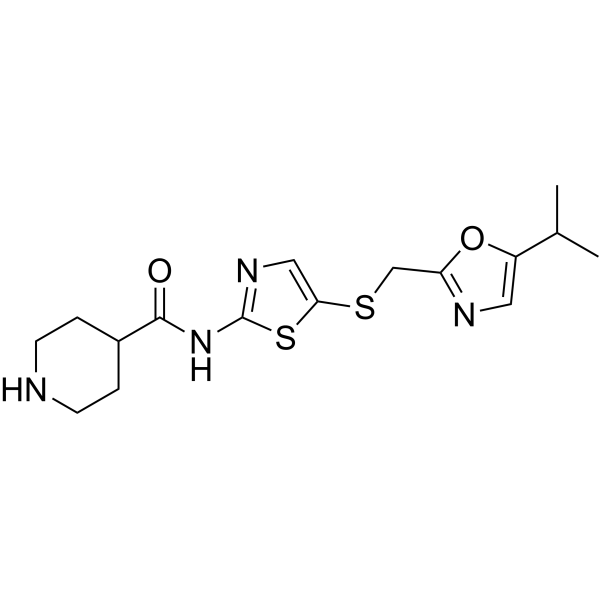
BMS-357075 is a pan-CDK inhibitor with CDK1 IC50 18 nM, CDK2 IC50 3 nM, CDK4 IC50 26 nM. BMS-357075 induces cytotoxicity in human ovarian cancer A2780 cells. BMS-357075 exhibits anticancer activity in mice against P388 murine leukemia. BMS-357075 can be used for the research of leukemia .
loading...
    loading...
Cat. No.: HY-183854
CAS No.: 223784-75-6
Target:  

CDK

Research Areas:  

Cancer

AG-12286 is a pan-CDK inhibitor with an IC50 value of 2 nM against cdk1/cyclin B, 6 nM against cdk2/cyclin E, and 12 nM against cdk4/cyclin D. AG-12286 is 1000-fold more selective for the CDK family than for PKC. AG-12286 can be used in cancer research .
loading...
    loading...
Cat. No.: HY-182470
CAS No.: 486414-32-8
Target:  

CDK

AG-012986 (dihydrochloride) is a pan-CDK inhibitor with Ki values of 44 nM (CDK1), 9.2 nM (CDK4), 94 nM (CDK2), and IC50 values of 22 nM (CDK5), 4 nM (CDK9). AG-012986 (dihydrochloride) causes apoptosis of T-cells by targeting upstream kinases in the p38 Mitogen-activated protein kinase (MAPK) pathway and impairing cellular survival. AG-012986 (dihydrochloride) induces cell cycle arrest, retinoblastoma protein hypophosphorylation, and reduces Ki-67 expression. AG-012986 (dihydrochloride) exerts antiproliferative activity in tumor cells, demonstrates antitumor efficacy in human xenograft models, and causes retinal and peripheral neurotoxicity, plus immune cell toxicity. AG-012986 (dihydrochloride) can be used for the research of colon carcinoma, non-small cell lung carcinoma, lung carcinoma, breast carcinoma, ovarian tumor, pancreatic carcinoma, osteosarcoma, lymphoma, leukemia, retinotoxicity .
loading...
    loading...

