
1. Search Result
Search Result
Results for "

phospholipid biomarker

" in MedChemExpress (MCE) Product Catalog:

6

Inhibitors & Agonists

1

Isotope-Labeled Compounds

3

Oligonucleotides

Cat. No. Product Name Target Research Areas Chemical Structure
  • HY-154918

    Drug Metabolite Metabolic Disease
    LysoPE (18:2/0:0) is a lysophosphatidylethanolamine implicated in phospholipid metabolism. LysoPE (18:2/0:0) shows significantly altered serum levels in mice exposed to a combination of DEHP (HY-B1945) and Aroclor 1254, which is associated with disturbed phospholipid metabolism. LysoPE (18:2/0:0) can be used for the research of endocrine-disrupting compound-induced metabolic disorders and lipid metabolism disturbance. LysoPE (18:2/0:0) is identified as a potential biomarker for the combined toxicity of DEHP and Aroclor 1254 .
    LysoPE(18:2/0:0)
  • HY-W355700

    Drug Metabolite Infection
    1-oleoyl-sn-glycero-3-phosphoethanolamine (LysoPE 18:1) is a lysophosphatidylethanolamine molecule involved in phospholipid metabolism, targeting cell membrane receptors (such as G protein-coupled receptors) to regulate cell signaling pathways. 1-oleoyl-sn-glycero-3-phosphoethanolamine may activate mitogen-activated protein kinase (MAPK) signaling, promote cell migration, regulate inflammatory responses and lipid metabolism, and has both pro-inflammatory and anti-inflammatory activities. 1-oleoyl-sn-glycero-3-phosphoethanolamine is mainly used in the screening of biomarkers for metabolic diseases (such as non-alcoholic fatty liver disease and obesity), as well as the study of the mechanism of lysophospholipids in cell membrane homeostasis and signal transduction .
    1-Oleoyl-2-hydroxy-sn-glycero-3-phosphoethanolamine
  • HY-145486

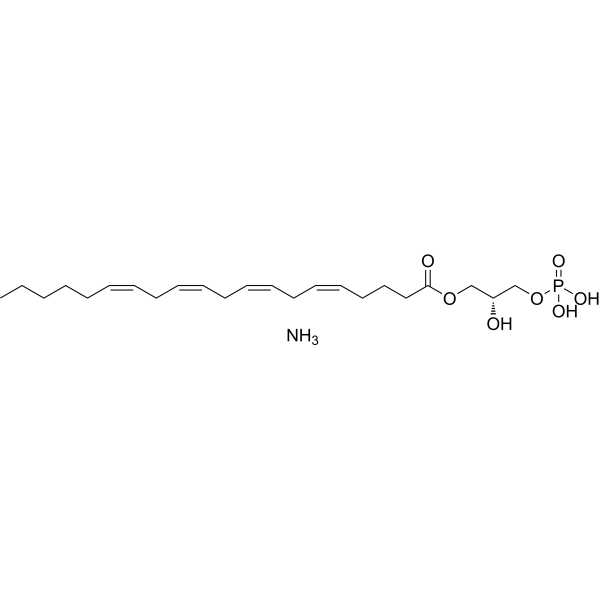
    20:4 Lyso PA

    Liposome Neurological Disease
    1-Arachidonoyl-sn-glycerol 3-phosphate ammonium (20:4 Lyso PA) is a phospholipid and an LPA derived from arachidonic acid. The concentration of 1-Arachidonoyl-sn-glycerol 3-phosphate ammonium in plasma is significantly correlated with the age of onset of cocaine use and the duration of abstinence. 1-Arachidonoyl-sn-glycerol 3-phosphate ammonium can be used in the research of biomarkers for cocaine use disorder (CUD) .
    1-Arachidonoyl-sn-glycerol 3-phosphate ammonium
  • HY-W783254

    PA(18:0e/0:0)

    G Protein-coupled Receptor Kinase (GRK) Calcium Channel Cardiovascular Disease Cancer
    C18 LPA (PA(18:0e/0:0)) is a water-soluble phospholipid that functions as a signaling molecule, influencing various cellular responses through G protein-coupled receptors (GPCRs). It is known to promote smooth muscle contraction, cytoskeletal rearrangement, and chemotaxis, while also playing a role in neurotransmitter release, cell proliferation, platelet aggregation, and Ca2+ mobilization. Elevated levels of C18 LPA in human plasma are associated with ovarian cancer and atherosclerosis, suggesting its potential as a biomarker for ovarian cancer.
    C18 LPA
  • HY-167967

    Biochemical Assay Reagents Others
    PEth-16:0/18:1 ammonium is the ammonium salt of a phosphatidylethanol homolog, and it is a phospholipid biomarker reflecting past alcohol consumption. PEth-16:0/18:1 ammonium can be used to determine an individual's past ethanol intake .
    PEth-16:0/18:1 ammonium
  • HY-W355700S

    Isotope-Labeled Compounds Infection
    1-Oleoyl-2-hydroxy-sn-glycero-3-phosphoethanolamine-d31 is the deuterium labeled 1-Oleoyl-2-hydroxy-sn-glycero-3-phosphoethanolamine (HY-W355700). 1-oleoyl-sn-glycero-3-phosphoethanolamine (LysoPE 18:1) is a lysophosphatidylethanolamine molecule involved in phospholipid metabolism, targeting cell membrane receptors (such as G protein-coupled receptors) to regulate cell signaling pathways. 1-oleoyl-sn-glycero-3-phosphoethanolamine may activate mitogen-activated protein kinase (MAPK) signaling, promote cell migration, regulate inflammatory responses and lipid metabolism, and has both pro-inflammatory and anti-inflammatory activities. 1-oleoyl-sn-glycero-3-phosphoethanolamine is mainly used in the screening of biomarkers for metabolic diseases (such as non-alcoholic fatty liver disease and obesity), as well as the study of the mechanism of lysophospholipids in cell membrane homeostasis and signal transduction .
    1-Oleoyl-2-hydroxy-sn-glycero-3-phosphoethanolamine-d31

Inquiry Online

Your information is safe with us. * Required Fields.

Salutation


Country or Region *

Applicant Name *


Organization Name *

Department *


Email Address *


Product Name *

Cat. No.


Requested quantity *

Phone Number *


Remarks

Inquiry Online

Inquiry Information

Product Name:
Cat. No.:
Quantity:
MCE Japan Authorized Agent:

