1. Search Result
Search Result
Results for "

phosphorylated EGFR

" in MedChemExpress (MCE) Product Catalog:

11

Inhibitors & Agonists

2

Screening Libraries

1

Peptides

4

Natural
Products

1

Isotope-Labeled Compounds

1

Click Chemistry

Targets Recommended:
Cat. No. Product Name Target Research Areas Chemical Structure
  • HY-N4309

    Amylases Glycosidase Neurological Disease Metabolic Disease Cancer
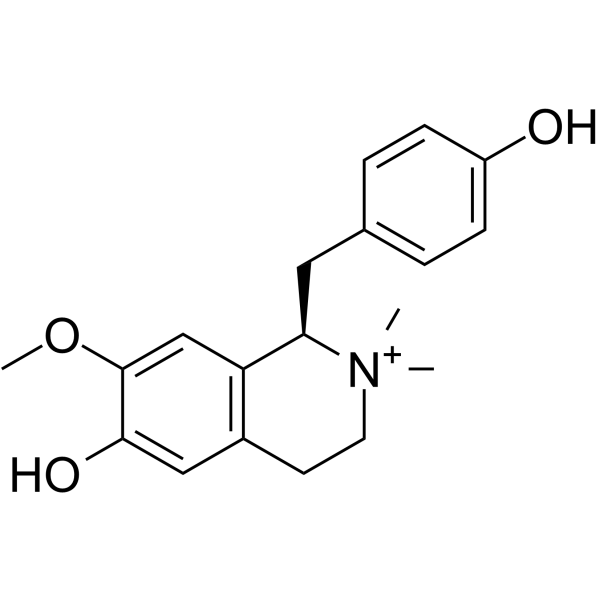
    Lotusine is an orally active signaling pathway modulator and enzyme inhibitor, with an IC50 of 30.60 μg/mL against α-amylase and an IC50 of 36.15 μg/mL against α-glucosidase. Lotusine inhibits the EGFR-Akt-ERK signaling pathway by reducing the levels of phosphorylated EGFR, Akt and ERK. Lotusine induces apoptosis, triggers G0/G1 cell cycle arrest and inhibits cancer cell proliferation. Lotusine reduces lipid peroxidation and increases the activities of SOD, CAT and GPx. Lotusine is applicable to researches related to non-small cell lung cancer, type 2 diabetes and autism spectrum disorder .
    Lotusine
  • HY-160187A

    Cadherin MMP Akt FAK ERK NF-κB Cancer
    (Rac)-AAA is a regulator and inhibitor targeting GPR75. By blocking the 20-HETE-induced downregulation of GPR75 expression, (Rac)-AAA effectively inhibits the activation of key downstream signaling pathways including EGFR, AKT, NF-κB and FAK. (Rac)-AAA reverses 20-HETE-mediated epithelial-mesenchymal transition, which is specifically characterized by downregulating vimentin (vimentin), upregulating E-Cadherin, as well as reducing MMP-2 activity and cancer cell migration ability. (Rac)-AAA also abolishes the 20-HETE-induced upregulation of HIC-5 expression and anchorage-independent growth, and modulates the subcellular localization of PKC-α and phosphorylated AKT. (Rac)-AAA is investigated in androgen-independent prostate cancer (castration-resistant prostate cancer) .
    (Rac)-AAA
  • HY-P2548

    EGFR Others
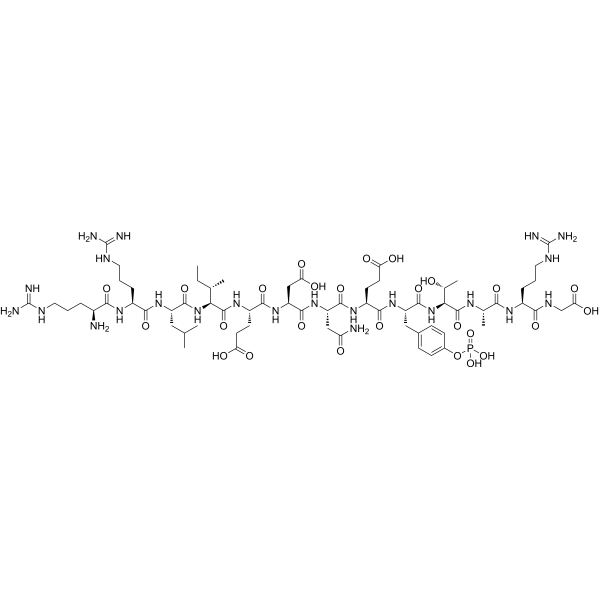
    pp60 (v-SRC) Autophosphorylation Site, Phosphorylated is the phosphorylated peptide of an EGFR substrate. pp60 (v-SRC) Autophosphorylation Site, Phosphorylated can be used for the screening of EGFR Kinase inhibitors via phosphorylated-substrate quantification .
    pp60 (v-SRC) Autophosphorylation Site, Phosphorylated
  • HY-164476

    EGFR GSK-3 PD-1/PD-L1 Cancer
    ES-072 is an orally effective selective EGFR mutant (EGFR-T790M) inhibitor. ES-072 activates GSK3α by inhibiting EGFR-T790M activity, which promotes phosphorylation of PD-L1 at Ser279 and Ser283. The phosphorylated PD-L1 recruits the E3 ubiquitin ligase ARIH1, leading to ubiquitination and proteasomal degradation of PD-L1. This mechanism not only reduces cancer cell growth but also enhances anti-tumor immune response by lowering PD-L1 levels. ES-072 can be used to inhibit proliferation in non-small cell lung cancer (NSCLC) cells .
    ES-072
  • HY-155227S

    Isotope-Labeled Compounds EGFR Anaplastic lymphoma kinase (ALK) BRK Apoptosis Mitochondrial Metabolism Cancer
    ALK/EGFR-IN-1-d5 (Compound (-)-9a) is a deuterated dual-target inhibitor of EGFR and ALK, with an IC50 of 1.08 nM for EGFR and an IC50 of 2.395 nM for ALK. ALK/EGFR-IN-1-d5 inhibits the phosphorylated proteins in the EGFR, ALK, and BRK signaling pathways, blocking the cell cycle, leading to a reduction in mitochondrial membrane potential and cell apoptosis (Apoptosis). ALK/EGFR-IN-1-d5 also significantly inhibits tumor growth in animal models and demonstrates good safety. ALK/EGFR-IN-1-d5 holds promise for research in the field of cancer treatment
    ALK/EGFR-IN-1-d5
  • HY-N14349

    ARQ; Asterriquinone SU5504

    EGFR HIV Reverse Transcriptase Infection Cancer
    Asterriquinone (ARQ), a Asterriquinone analog, is a Grb-2 binding inhibitor. Asterriquinone inhibits the Grb-2 binding activity to tyrosine phosphorylated EGFR, with an IC50 of 8.37 μM. Asterriquinone is a HIV1 reverse transcriptase inhibitor with a Ki of 2.3 μM. Asterriquinone also inhibits Grb-7 and PLC-γ binding activities. .
    Asterriquinone
  • HY-N16557

    Apoptosis EGFR STAT PERK Cancer
    (Rac)-8-Gingerol is a non-volatile component. (Rac)-8-Gingerol can be extracted from ginger. (Rac)-8-Gingerol enhances Apoptosis. (Rac)-8-Gingerol decreases the level of phosphorylated EGFR and, accordingly, the phosphorylation levels of its downstream effectors, STAT3 and ERK. (Rac)-8-Gingerol exhibits anticancer activity against colorectal cancer .
    (Rac)-8-Gingerol
  • HY-N4309A

    Amylases Glycosidase Cardiovascular Disease
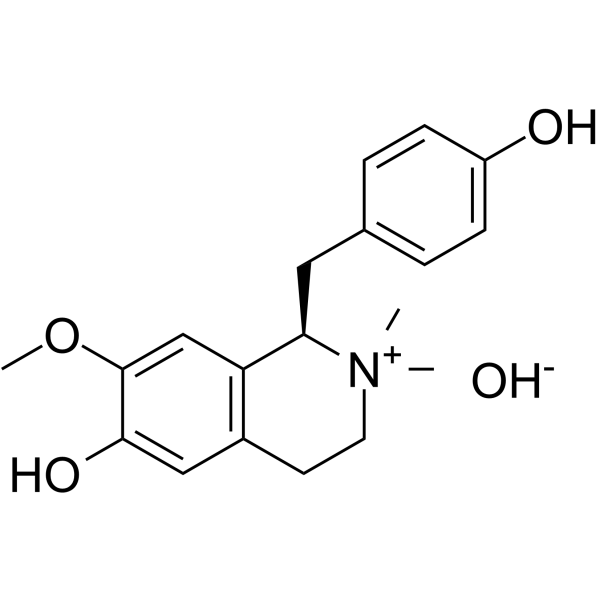
    Lotusine hydroxide is an orally active signaling pathway modulator and enzyme inhibitor, with an IC50 of 30.60 μg/mL against α-amylase and an IC50 of 36.15 μg/mL against α-glucosidase. Lotusine hydroxide inhibits the EGFR-Akt-ERK signaling pathway by reducing the levels of phosphorylated EGFR, Akt and ERK. Lotusine hydroxide induces apoptosis, triggers G0/G1 cell cycle arrest and inhibits cancer cell proliferation. Lotusine hydroxide reduces lipid peroxidation and increases the activities of SOD, CAT and GPx. Lotusine hydroxide is applicable to researches related to non-small cell lung cancer, type 2 diabetes and autism spectrum disorder .
    Lotusine hydroxide
  • HY-181479

    EGFR PI3K Akt Apoptosis Reactive Oxygen Species (ROS) Mitochondrial Metabolism Cancer
    EGFR-IN-196 is an EGFR inhibitor with an IC50 of 105.96 nM. EGFR-IN-196 inhibits EGFR enzymatic activity, reduces phosphorylated PI3K levels, and suppresses downstream EGFR-AKT signaling. EGFR-IN-196 increases intracellular ROS generation, induces mitochondrial depolarisation, and induces apoptosis in cancer cells. EGFR-IN-196 can be used for the research of lung cancer .
    EGFR-IN-196
  • HY-116091

    EGFR Akt ERK Cancer
    EGFR-IN-451 is an EGFR inhibitor with an IC50 value of 0.02 nM. EGFR-IN-451 also inhibits mutant EGFR L858R, EGFR T790M, and EGFR L858R/T790M with IC50 values of 0.26-34 nM. EGFR-IN-451 inhibits AKT and ERK activation and inhibits proliferation of EGFR-mutant cancer cells. EGFR-IN-451 can be used for the research of EGFR-driven cancer .
    EGFR-IN-451
  • HY-181701

    EGFR Cancer
    EGFR-IN-202 is an epidermal growth factor receptor (EGFR) inhibitor that selectively targets EGFR exon 20 insertion mutations. EGFR-IN-202 can be used in research related to non-small cell lung cancer .
    EGFR-IN-202

Inquiry Online

Your information is safe with us. * Required Fields.

Salutation


Country or Region *

Applicant Name *


Organization Name *

Department *


Email Address *


Product Name *

Cat. No.


Requested quantity *

Phone Number *


Remarks

Inquiry Online

Inquiry Information

Product Name:
Cat. No.:
Quantity:
MCE Japan Authorized Agent:

