
15 Results for "

phosphorylated Tau

" in MedChemExpress (MCE) Product Catalog:
Products (15)

15 Results for "phosphorylated Tau" in MCE Product Catalog:

Cat. No.: HY-N0859
CAS No.: 69363-14-0
Synonyms: Schizanhenol; Gomisin-K3
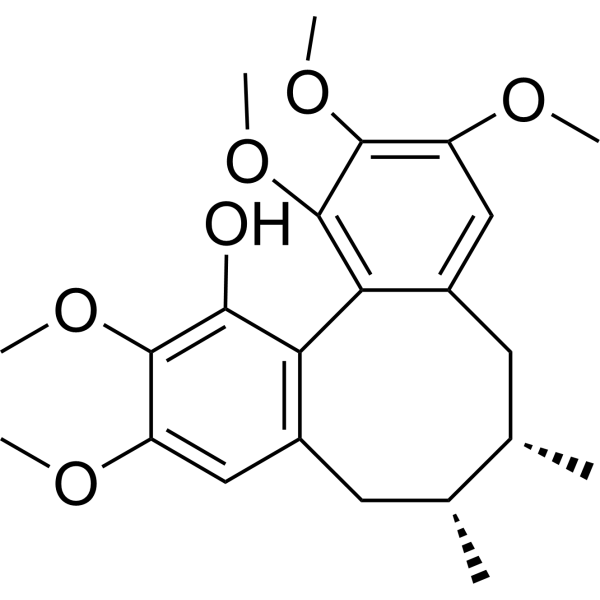
Schisanhenol (Schizanhenol), a lignan, is an orally active antioxidant. Schisanhenol reduces AChE activity, increases SIRT1 and PGC-1α expression, and decreases phosphorylated Tau (Ser 396) levels. Schisanhenol increases SOD and glutathione peroxidase activity, decreases malondialdehyde (MDA) content, and inhibits UGT2B7 activitY. Schisanhenol attenuates ox-LDL-induced apoptosis, intracellular reactive oxygen species generation, and cytotoxicity in endothelial cells. Schisanhenol inhibits LDL oxidation, brain mitochondrial and membrane peroxidative damage, and brain mitochondrial swelling and disintegration. Schisanhenol can be used for the research of Alzheimer’s disease, atherosclerosis, brain ischemia, and age-related brain deterioration .
loading...
    loading...
Cat. No.: HY-138820
CAS No.: 1010820-68-4
Purity:  98.3%
Target:  

HSP

Research Areas:  

Neurological Disease

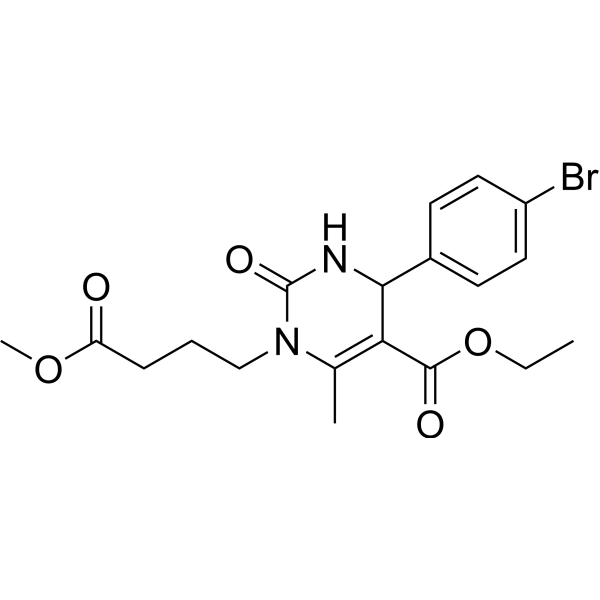
SW02 is a potent activator of ATPase activity of Hsp70, with an EC50 of 150 μM. SW02 leads to accumulation of both total tau and phosphorylated tau (pTau) .
loading...
    loading...
Cat. No.: HY-P9995
CAS No.: 2517973-04-3
Synonyms: JNJ-63733657

Target:  

Tau Protein

Research Areas:  

Neurological Disease

Posdinemab (JNJ-63733657) is a humanized IgG1/κ monoclonal antibody that selectively targets phosphorylated tau (pT217). Posdinemab specifically binds to the pT217+tau epitope rich in the proline domain, blocks tau protein aggregation and seed propagation, and promotes the clearance of extracellular tau species. Posdinemab reduces the levels of free and total p217+tau in cerebrospinal fluid, thereby inhibiting the pathological propagation of tau protein and the formation of neurofibrillary tangles. Posdinemab can be used for the study of progressive supranuclear palsy syndrome and Alzheimer's disease (AD), especially for prodromal or mild AD disease .
loading...
    loading...
Cat. No.: HY-116586
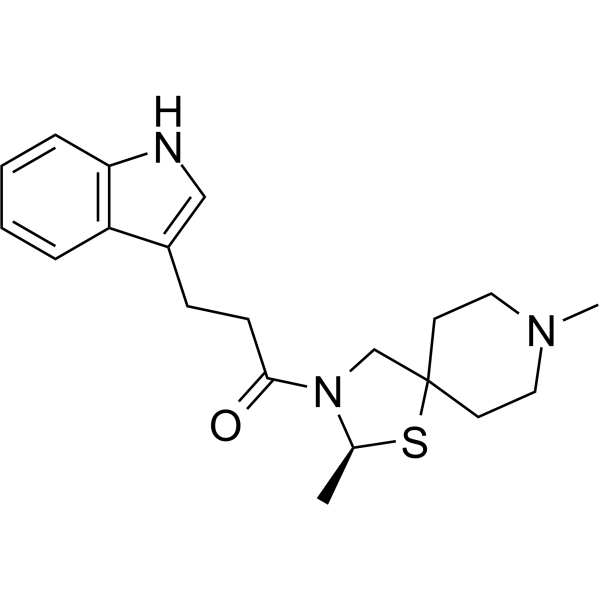
AF710B is an orally effective allosteric agonist for the M1 muscarinic receptor and σ1 receptor. AF710B activates the downstream phosphorylated ERK1/2 and phosphorylated CREB signaling pathways. AF710B simultaneously improves cognitive function and alleviates the core pathological features of Alzheimer's disease, including deposition, excessive Tau phosphorylation and neuroinflammation. AF710B is applicable to the research of Alzheimer's disease .
loading...
    loading...
Cat. No.: HY-162750
CAS No.: 3096805-18-1
Target:  

DYRK Tau Protein

Research Areas:  

Neurological Disease

ZJCK-6-46 (32) is a potential and orally activeDYRK1A inhibitor (IC50 = 0.68 nM) with high BBB permeability (CNS+). ZJCK-6-46 (32) reduces tau phosphorylation. ZJCK-6-46 (32) ameliorates cognitive dysfunction by obviously reducing the expression of phosphorylated tau and neuronal loss in vivo .
loading...
    loading...
Cat. No.: HY-176130
CAS No.: 3115333-82-6
Research Areas:  

Neurological Disease

MRL828 is a heterobifunctional molecule that targets aggregated tau protein. As an autophagy-targeting chimera (ATTEC), MRL828 selectively labels aggregated tau protein for clearance via the autophagy (autophagy)-lysosome pathway. The activity of MRL828 depends on autophagosomes rather than lysosomes, and it induces autophagosome-dependent secretion. MRL828 acts as an intracellular aggregate inhibitor and a secretory autophagy inducer, reducing intracellular levels of aggregated tau protein through autophagosome-dependent secretory autophagy instead of lysosomal degradation. MRL828 can be used in the research of neurodegenerative diseases such as Alzheimer's disease .
loading...
    loading...
Cat. No.: HY-E70667
Target:  

CDK

Research Areas:  

Neurological Disease

CDK18 is a neuronal kinase that phosphorylates TAU protein when overexpressed in human brain. CDK18 shares a conserved PCTAIRE amino acid sequence in the helical α-C region of the kinase N-lobe. CDK18/CycY Recombinant Human Active Protein Kinase is an ortholog of CDK18 .
loading...
    loading...
Cat. No.: HY-N0859R
CAS No.: 69363-14-0
Synonyms: Schizanhenol (Standard); Gomisin-K3 (Standard)
Schisanhenol (Standard) (Schizanhenol (Standard)) is the analytical standard of Schisanhenol (HY-N0859). This product is intended for research and analytical applications. Schisanhenol, a lignan, is an orally active antioxidant. Schisanhenol reduces AChE activity, increases SIRT1 and PGC-1α expression, and decreases phosphorylated Tau (Ser 396) levels. Schisanhenol increases SOD and glutathione peroxidase activity, decreases malondialdehyde (MDA) content, and inhibits UGT2B7 activitY. Schisanhenol attenuates ox-LDL-induced apoptosis, intracellular reactive oxygen species generation, and cytotoxicity in endothelial cells. Schisanhenol inhibits LDL oxidation, brain mitochondrial and membrane peroxidative damage, and brain mitochondrial swelling and disintegration. Schisanhenol can be used for the research of Alzheimer’s disease, atherosclerosis, brain ischemia, and age-related brain deterioration.
loading...
    loading...
Cat. No.: HY-184742
AJ-4 is an orally active, blood-brain barrier-permeable GSK-3β/AChE inhibitor, with an IC50 of 4.7 nM against GSK-3β and 2.97 μM against AChE. AJ-4 increases the level of phosphorylated GSK-3β and reduces the expression of Amyloid-β and phosphorylated Tau. AJ-4 improves scopolamine-induced learning and memory impairment and alleviates hippocampal neuron damage in AD mice. AJ-4 can be used for the research of Alzheimer's disease .
loading...
    loading...
Cat. No.: HY-P60760S
Research Areas:  

Others

TPSLP{pT}PPTR- 13C6, 15N4 is the 13C- and 15N-labeled TPSLP{pT}PPTR. TPSLP{pT}PPTR is a tau protein fragment phosphorylated in the central region.
loading...
    loading...
Cat. No.: HY-P60760S1
Research Areas:  

Others

TPSLP{pT}PPTR- 13C6, 15N4 TFA is the 13C- and 15N-labeled TPSLP{pT}PPTR TFA. TPSLP{pT}PPTR TFA is a tau protein fragment phosphorylated in the central region.
loading...
    loading...
Cat. No.: HY-P704910
Purity:  ≥ 90%, as determined by reducing SDS-PAGE.
Synonyms: MAPT; Tau-Derived Paired Helical Filament Hexapeptide; Prev. MAPTL; Microtubule-Associated Protein Tau; Prev. DDPAC; Neurofibrillary Tangle Protein; MTBT1; Paired Helical Filament-Tau; PPP1R103; MGC138549; Tau-PHF6; FLJ31424; FTDP-17; PHF-Tau; Tau-40; Microtubule-Associated Protein Tau, Isoform 4; MTBT2; Mutant Microtubule-Associated Protein Tau; PPND; Microtubule-Associated Protein; MSTD; FTD1; Tau; Tau; G Protein Beta1/Gamma2 Subunit-Interacting Factor 1; Microtubule Associated Protein Tau; Protein Phosphatase 1, Regulatory Subunit 103
Species:  
Human
Source:  
E. coli
loading...
    loading...
Cat. No.: HY-P99648A
CAS No.: 1788032-39-2
Synonyms: BMS-986168 (powder); IPN007 (powder); BIIB092 (powder)

Target:  

Tau Protein

Research Areas:  

Neurological Disease

Gosuranemab (BMS-986168; IPN007; BIIB092) (powder) is a humanised IgG4 anti-tau monoclonal antibody. Gosuranemab (powder) neutralizes the extracellular tau protein, inhibiting the spread and aggregation of pathological tau protein. Gosuranemab (powder) can be used for the research of progressive supranuclear palsy and early Alzheimer’s disease .
loading...
    loading...
Cat. No.: HY-183057
CAS No.: 2234900-83-3
GRK2 modulator 1 is an orally active, brain-penetrant and selective GRK2 modulator. GRK2 modulator 1 enhances the active, non-phosphorylated GRK2 and prevents mitochondrial GRK2 and TOMM6 aggregation. GRK2 modulator 1 enhances the non-amyloidogenic processing of APP and prevent PHF-tau, neurodegeneration, and neuronal loss. GRK2 modulator 1 decreases the senescence marker, UPAR, reduces the Alzheimer disease (AD)-related mortality, and prolongs survival. GRK2 modulator 1 exerts neuroprotection by inhibiting HDAC6, and counteracts age-related cardiac dysfunction. GRK2 modulator 1 can be used for research on AD .
loading...
    loading...
Cat. No.: HY-P12141
CAS No.: 2227651-65-0
Synonyms: KP405
DA5-CH (KP405) is a blood-brain barrier-permeable GLP-1/GIP receptor agonist. DA5-CH activates GLP-1 and GIP receptors, inhibits the NF-κB inflammatory pathway, reduces α-synuclein (α-synuclein) levels, restores the expression of tyrosine hydroxylase and neurotrophic factors, improves motor function, decreases amyloid plaques and phosphorylated tau protein levels in the hippocampus, restores synaptic plasticity, regulates the PI3K/AKT/GSK3β and CREB signaling pathways, and alleviates mitochondrial stress. DA5-CH can be used for research on Parkinson's disease and Alzheimer's disease .
loading...
    loading...
  • 1

