
1. Search Result
Search Result
Results for "

photocatalysts

" in MedChemExpress (MCE) Product Catalog:

15

Inhibitors & Agonists

1

Fluorescent Dyes

3

Biochemical Assay Reagents

Cat. No. Product Name Target Research Areas Chemical Structure
  • HY-W051271

    Titanium dioxide

    Environmental Pollutants Reactive Oxygen Species (ROS) Photosensitizer Others
    Titanium(IV) oxide is a photosensitizer and photocatalyst. Titanium(IV) oxide can be used as a pharmaceutical excipient such as a flow aid, coating agent, sunscreen, colorant, etc. Pharmaceutical excipients or pharmaceutical excipients refer to other chemical substances used in the pharmaceutical process other than the drug ingredients. Pharmaceutical excipients generally refer to inactive ingredients in pharmaceutical preparations that can improve the stability, solubility and processability of pharmaceutical preparations. Pharmaceutical excipients also affect the absorption, distribution, metabolism and elimination (ADME) process of co-administered drugs. Titanium(IV) oxide can use light energy to generate electron-hole pairs to degrade pollutants. Photons excite electrons in TiO2 to generate active oxygen species (such as ·OH and ·O2 -), thereby oxidizing and mineralizing pollutants such as organic compounds and heavy metals. TiO2 can be used in the research of environmental remediation fields such as water treatment, air purification and self-cleaning materials .
    Titanium(IV) oxide
  • HY-W540000

    Biochemical Assay Reagents Others
    Graphitic carbon nitride is a metal-free photocatalyst with a semiconductor absorption wavelength of 460 nm. Graphitic carbon nitride can be applied to photocatalytic water splitting, degradation of organic pollutants, and carbon dioxide reduction .
    Graphitic carbon nitride
  • HY-W110910

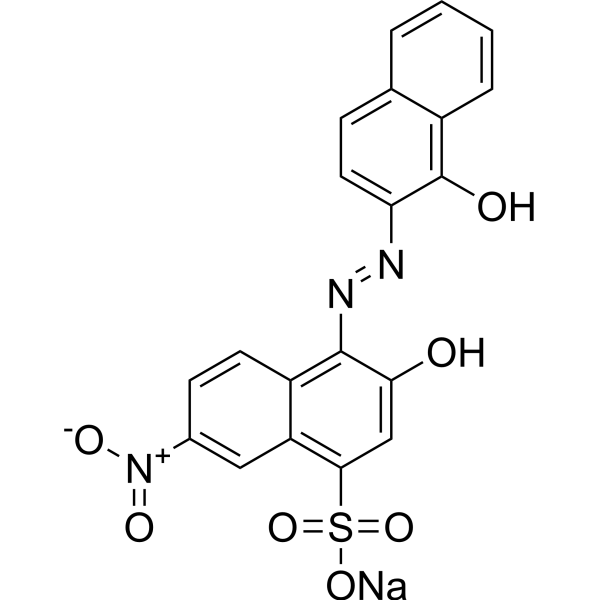
    Biochemical Assay Reagents Infection
    Eriochrome black T, Indicator is a complexing agent for metal ions (e.g., Ca 2+, Mg 2+) and is used as an indicator in complexometric titrations. Eriochrome black T, Indicator forms colored complexes with metal ions through covalent coordination bonds, and indicates the endpoint of the titration by color change. Eriochrome black T, Indicator can be used as an anionic azo dye in photocatalytic degradation studies to evaluate the performance of photocatalysts. The reaction solution of Eriochrome black T, Indicator combined with Mg 2+ is initially purple. During loop-mediated isothermal amplification (LAMP), the color changes from purple to sky blue due to the consumption of Mg 2+ by the formation of magnesium pyrophosphate, indicating a positive reaction. The optimal concentration of Eriochrome black T, Indicator in LAMP is 60 μM, and the detection limit for Mycobacterium tuberculosis is 1 pg DNA/reaction .
    Eriochrome black T, Indicator
  • HY-W039724

    Biochemical Assay Reagents Others
    Thioxanthone is a powerful photocatalyst for organic reactions. Thioxanthone is a heterocyclic compound with the ability to participate successfully in merger reactions with metal complexes .
    Thioxanthone
  • HY-W116336B

    Biochemical Assay Reagents Fungal Bacterial Infection Cancer
    Zinc oxide, 99.99% metals basis is a versatile wide-bandgap semiconductor with superior comprehensive properties. Zinc oxide, 99.99% metals basis serves as raw material for Schottky diodes, functional nanostructures, sensors, energy harvesters and photocatalysts for hydrogen production. Zinc oxide, 99.99% metals basis acts as a non-toxic antibacterial agent and selective cytotoxin against multiple bacteria, fungi and spores. Zinc oxide, 99.99% metals basis induces cancer cell death. Zinc oxide, 99.99% metals basis is applicable to drug delivery, biosensing, bioimaging and researches on cancer, microbial infections and skin diseases .
    Zinc oxide, 99.99% metals basis
  • HY-W145116

    Biochemical Assay Reagents
    [Ru(phen)3]Cl2 is an important photocatalyst with photosensitivity and has the activity of promoting reactions in the fields of organic synthesis and photoelectrochemistry. [Ru(phen)3]Cl2 can drive chemical reactions under light conditions and shows good catalytic performance. [Ru(phen)3]Cl2's applications include photocatalytic water decomposition and synthesis of complex organic molecules.
    [Ru(phen)3]Cl2
  • HY-W412215

    Biochemical Assay Reagents Endogenous Metabolite
    TTMAPP is a photocatalyst with the activity of promoting organic reactions. TTMAPP is widely used in chemical synthesis, especially in oxidation and reduction reactions. TTMAPP can also be used as a synthetic intermediate for bioactive molecules, which is of great significance for compound development.
    TTMAPP
  • HY-W035599

    Tris(2-(3-tert-butylphenyl)-4-tert-butylpyridine)iridium

    Biochemical Assay Reagents Endogenous Metabolite
    Ir[pF(t-Bu)-ppy]3 (Tris(2-(3-tert-butylphenyl)-4-tert-butylpyridine)iridium) is an effective photocatalyst with excellent catalytic activity. Ir[pF(t-Bu)-ppy]3 can promote organic reactions, especially showing significant potential in the synthesis of new organic compounds. Ir[pF(t-Bu)-ppy]3 can be used to develop green chemical processes and reduce the impact of traditional catalysts on the environment. Ir[pF(t-Bu)-ppy]3 also has broad prospects in photoelectrochemical applications.
    Ir[p-F(t-Bu)-ppy]3
  • HY-183088

    Biochemical Assay Reagents Others
    Cl-C6-PEG8-NH2 (Compound Int-8) hydrochloride is a self-labeling protein reagent that can be used to synthesize photocatalysts .
    Cl-C6-PEG8-NH2 hydrochloride
  • HY-179670

    Bacterial Infection
    Antibacterial agent 304 (Compound 3a) is an antibacterial agent with a minimum inhibitory concentration (MIC) of 8 μg/mL against S. aureus and P. aeruginosa. This antibacterial agent has a bactericidal effect and can disrupt the integrity of the cell wall. Antibacterial agent 304 has the potential to be a sustainable organic photocatalyst .
    Antibacterial agent 304
  • HY-W174480

    Drug Derivative Others
    5-deazaflavin is a flavin analogue with redox activity. 5-deazaflavin is a photocatalyst in biological redox systems .
    5-Deazaflavin
  • HY-W075708

    Cu(II) Meso-Tetra(4-carboxyphenyl)porphyrin

    MOFs Others
    Cu (II) MTCPP (Cu (II) Meso-Tetra (4-carboxyphenyl) porphyrin) is a copper coordination complex. Cu (II) MTCPP-sensitized TiO2 nanotubes are a type of visible-light photocatalyst. Cu (II) MTCPP-sensitized TiO2 nanotubes can expand the wavelength response range, transfer excited electrons more efficiently, and separate photogenerated electron-hole pairs .
    Cu(II) MTCPP
  • HY-W072496

    Photosensitizer Endogenous Metabolite
    10-(3,5-Di-OMe-Ph)-9-mesityl-(1,3,6,8-tetra-OMe-acridinium) tetrafluoroborate is a photocatalyst with the activity of enhancing the efficiency of organic reactions. 10-(3,5-Di-OMe-Ph)-9-mesityl-(1,3,6,8-tetra-OMe-acridinium) tetrafluoroborate is widely used in the synthesis of complex molecules and compounds. 10-(3,5-Di-OMe-Ph)-9-mesityl-(1,3,6,8-tetra-OMe-acridinium) tetrafluoroborate also exhibits excellent performance in photosensitization reactions.
    10-(3,5-Di-OMe-Ph)-9-mesityl-(1,3,6,8-tetra-OMe-acridinium) tetrafluoroborate
  • HY-W075731

    Biochemical Assay Reagents Others
    (Ir[dF (F) ppy]2 (dCF3)) PF6 is a cyclometalated iridium (III) complex that is used in visible light-mediated photocatalytic organic transformations .
    (Ir[dF(F)ppy]2(dCF3))PF6
  • HY-W585442

    Biochemical Assay Reagents Endogenous Metabolite
    5,9,14,18,23,27,32,36-Octabutoxy-2,3-naphthalocyanine is a photosensitive material with excellent light absorption and electron conduction activity. 5,9,14,18,23,27,32,36-Octabutoxy-2,3-naphthalocyanine is widely used in optoelectronic devices and is considered to be an effective photocatalyst. 5,9,14,18,23,27,32,36-Octabutoxy-2,3-naphthalocyanine can be used to improve the performance of solar cells and increase the photoelectric conversion efficiency. 5,9,14,18,23,27,32,36-Octabutoxy-2,3-naphthalocyanine also has potential anti-tumor activity and can inhibit the proliferation of certain cancer cells. 5,9,14,18,23,27,32,36-Octabutoxy-2,3-naphthalocyanine exhibits excellent fluorescence properties in medical imaging, which helps to improve the clarity and accuracy of imaging. 5,9,14,18,23,27,32,36-Octabutoxy-2,3-naphthalocyanine is studied as a component of a novel compound delivery system to improve the targeting and release effect of the compound.
    5,9,14,18,23,27,32,36-Octabutoxy-2,3-naphthalocyanine

Inquiry Online

Your information is safe with us. * Required Fields.

Salutation


Country or Region *

Applicant Name *


Organization Name *

Department *


Email Address *


Product Name *

Cat. No.


Requested quantity *

Phone Number *


Remarks

Inquiry Online

Inquiry Information

Product Name:
Cat. No.:
Quantity:
MCE Japan Authorized Agent:

