



Eriochrome black T, Indicator

Based on 1 Customer Validation
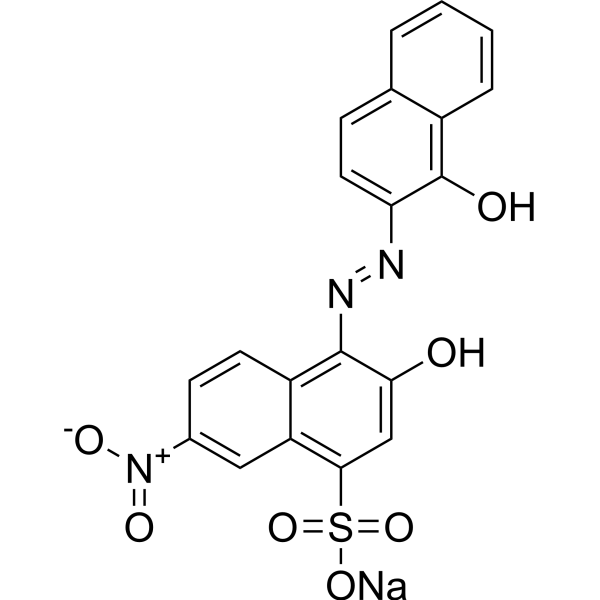
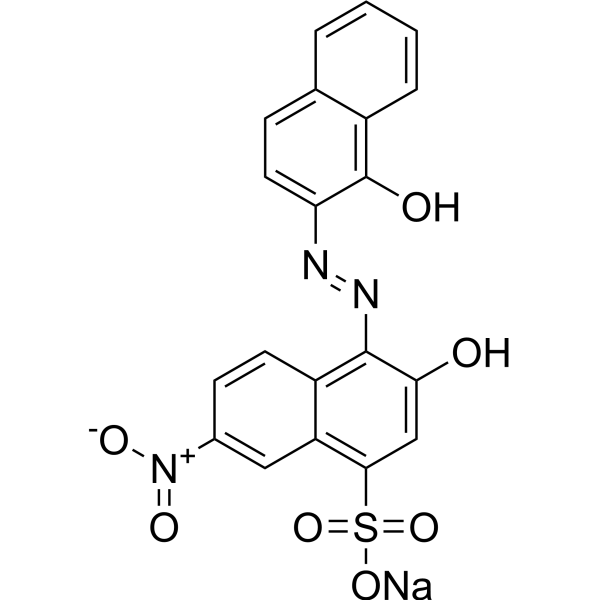
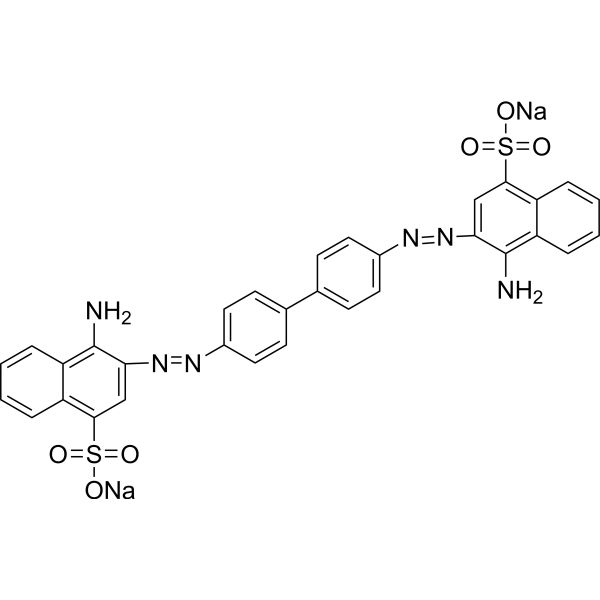
Eriochrome black T, Indicator is a complexing agent for metal ions (e.g., Ca2+, Mg2+) and is used as an indicator in complexometric titrations. Eriochrome black T, Indicator forms colored complexes with metal ions through covalent coordination bonds, and indicates the endpoint of the titration by color change. Eriochrome black T, Indicator can be used as an anionic azo dye in photocatalytic degradation studies to evaluate the performance of photocatalysts. The reaction solution of Eriochrome black T, Indicator combined with Mg2+ is initially purple. During loop-mediated isothermal amplification (LAMP), the color changes from purple to sky blue due to the consumption of Mg2+ by the formation of magnesium pyrophosphate, indicating a positive reaction. The optimal concentration of Eriochrome black T, Indicator in LAMP is 60 μM, and the detection limit for Mycobacterium tuberculosis is 1 pg DNA/reaction.
For research use only. We do not sell to patients.
- CAS No.: 1787-61-7
- Formula: C20H12N3NaO7S
- Molecular Weight:461.38
-
Storage:
4°C, stored under nitrogen, away from moisture
* In solvent : -80°C, 6 months; -20°C, 1 month (stored under nitrogen, away from moisture)

To place orders, for customer services and technical support, please contact: MedChemExpress USA
Tel: 609-228-6898 E-mail: [email protected] [email protected]


-
 Biological Activity
-
Chemical Information
-
Solvent & Solubility
- Purity & Documentation
- References
-
 Help & FAQs




Biological Activity
Description
In Vitro
Eriochrome black T, Indicator can be used to detect Mycobacterium tuberculosis by loop-mediated isothermal amplification (LAMP) reaction. It indirectly indicates the presence of bacterial DNA through the consumption of magnesium ions in the LAMP reaction. Eriochrome black T, Indicator can bind to Mg2+ to form a purple complex. In the initial stage of the LAMP reaction, the concentration of Mg2+ in the solution is sufficient; and Eriochrome black T, Indicator appears purple. When the byproduct magnesium pyrophosphate (Mg2P2O7) precipitates, Eriochrome black T, Indicator turns sky blue[2].
1.?DNA extraction
(1) Biological specimen processing:
Sputum or bronchoalveolar lavage fluid was treated by the Petroff method and DNA was extracted by boiling.
The biological specimen was washed twice with TE buffer, the precipitate was boiled for 5-10 minutes, and the supernatant was taken as template DNA after centrifugation.
(2) Preparation of purified DNA:
Genomic DNA was extracted from Mycobacterium tuberculosis H37Rv strain for reaction optimization and detection limit determination: the bacterial liquid was suspended in TE buffer, inactivated at 80°C for 1 hour, lysed with lysozyme and proteinase K at 37°C, and purified DNA was obtained by chloroform-isoamyl alcohol extraction and isopropanol precipitation.
2. LAMP reaction system (taking 25 μL system as an example)
Reaction components:
Inner primers (FIP, BIP) 1.6 μM each, outer primers (F3, B3) 0.2 μM each, loop primers (FLP, BLP) 0.8 μM each;
0.8 M betaine, 1X ThermoPol buffer, 8 U Bst DNA polymerase, 1 ng template DNA;
3.5 mM MgSO4, 1.4 mM dNTPs, 60 μM EBT indicator.
Incubation conditions: 64°C constant temperature incubation for 30 minutes, no denaturation or annealing steps required.
3. Result observation
Positive judgment: The color of the reaction solution changes from purple to sky blue, indicating the presence of target DNA.
Negative control: The reaction solution without template DNA should remain purple.
MedChemExpress (MCE) has not independently confirmed the accuracy of these methods. They are for reference only.


Chemical Information
-
CAS No. 1787-61-7
-
Appearance Solid
-
Molecular Weight 461.38
-
Formula C20H12N3NaO7S
-
Color Brown to black
-
SMILES
O=S(C1=C2C=C([N+]([O-])=O)C=CC2=C(/N=N/C3=CC=C4C=CC=CC4=C3O)C(O)=C1)(O[Na])=O
-
Shipping
Room temperature in continental US; may vary elsewhere.
-
Storage
4°C, stored under nitrogen, away from moisture
* In solvent : -80°C, 6 months; -20°C, 1 month (stored under nitrogen, away from moisture)


Solvent & Solubility
In Vitro:
DMSO : 50 mg/mL (108.37 mM; Need ultrasonic; Hygroscopic DMSO has a significant impact on the solubility of product, please use newly opened DMSO)
Please refer to the solubility information to select the appropriate solvent. Once prepared, please aliquot and store the solution to prevent product inactivation from repeated freeze-thaw cycles.
Storage method and period of stock solution: -80°C, 6 months; -20°C, 1 month (stored under nitrogen, away from moisture). When stored at -80°C, please use it within 6 months. When stored at -20°C, please use it within 1 month.
Please refer to the solubility information to select the appropriate solvent. Once prepared, please aliquot and store the solution to prevent product inactivation from repeated freeze-thaw cycles.
Storage method and period of stock solution: -80°C, 6 months; -20°C, 1 month (stored under nitrogen, away from moisture). When stored at -80°C, please use it within 6 months. When stored at -20°C, please use it within 1 month.
Concentration (start) × Volume (start) = Concentration (final) × Volume (final)
In Vivo:
Select the appropriate dissolution method based on your experimental animal and administration route.
- For the following dissolution methods, please ensure to first prepare a clear stock solution using an In Vitro approach and then sequentially add co-solvents:
- To ensure reliable experimental results, the clarified stock solution can be appropriately stored based on storage conditions. As for the working solution for In Vivo experiments, it is recommended to prepare freshly and use it on the same day.
- The percentages shown for the solvents indicate their volumetric ratio in the final prepared solution. If precipitation or phase separation occurs during preparation, heat and/or sonication can be used to aid dissolution.
Add each solvent one by one: 10% DMSO 40% PEG300 5% Tween-80 45% Saline
Solubility: ≥ 2 mg/mL (4.33 mM); Clear solution
This protocol yields a clear solution of ≥ 2 mg/mL (saturation unknown).
Taking 1 mL working solution as an example, add 100 μL DMSO stock solution (20.0 mg/mL) to 400 μL PEG300, and mix evenly; then add 50 μL Tween-80 and mix evenly; then add 450 μL Saline to adjust the volume to 1 mL.
Preparation of Saline: Dissolve 0.9 g sodium chloride in ddH₂O and dilute to 100 mL to obtain a clear Saline solution.
In Vivo Dissolution Calculator
Please enter the basic information of animal experiments:
-
-
-
-
Recommended: Prepare an additional quantity of animals to account for potential losses during experiments.
Please enter your animal formula composition:
-
%DMSO +
Recommended: Keep the proportion of DMSO in working solution below 2% if your animal is weak.
-
%+
-
+%Tween-80 + +
-
%Saline +
The co-solvents required include: DMSO, . All of co-solvents are available by MedChemExpress (MCE). , Tween 80. All of co-solvents are available by MedChemExpress (MCE).
Working solution concentration: 0.22 mg/mL
Method for preparing stock solution: mg drug dissolved in μL DMSO. Stock solution concentration: mg/mL. * In solvent : -80°C, 6 months; -20°C, 1 month (stored under nitrogen, away from moisture)
1. Take μL DMSO stock solution;
2. Add μL .
μL , mix evenly;
3. Then add μL Tween 80, mix evenly;
4. Then add μL
Please ensure that the stock solution in the first step is dissolved to a clear state, and add co-solvents in sequence. You can use ultrasonic heating (ultrasonic cleaner, recommended frequency 20-40 kHz), vortexing, etc. to assist dissolution.


Purity & Documentation
-
Data Sheet (279 KB)
-
SDS (597 KB)
- English - EN (597 KB)
- Français - FR (597 KB)
- Deutsch - DE (597 KB)
- Norwegian - NO (597 KB)
- Español - ES (597 KB)
- Swedish - SV (597 KB)
- Italian - IT (597 KB)
- Korean - KR (597 KB)
- Portuguese - PT (597 KB)
-
Handling Instructions (2659 KB)
References


Complete Stock Solution Preparation Table
Please refer to the solubility information to select the appropriate solvent. Once prepared, please aliquot and store the solution to prevent product inactivation from repeated freeze-thaw cycles.
Storage method and period of stock solution: -80°C, 6 months; -20°C, 1 month (stored under nitrogen, away from moisture). When stored at -80°C, please use it within 6 months. When stored at -20°C, please use it within 1 month.
| Optional Solvent | Concentration Solvent Mass | 1 mg | 5 mg | 10 mg | 25 mg |
|---|---|---|---|---|---|
| DMSO | 1 mM | 2.1674 mL | 10.8371 mL | 21.6741 mL | 54.1853 mL |
| 5 mM | 0.4335 mL | 2.1674 mL | 4.3348 mL | 10.8371 mL | |
| 10 mM | 0.2167 mL | 1.0837 mL | 2.1674 mL | 5.4185 mL | |
| 15 mM | 0.1445 mL | 0.7225 mL | 1.4449 mL | 3.6124 mL | |
| 20 mM | 0.1084 mL | 0.5419 mL | 1.0837 mL | 2.7093 mL | |
| 25 mM | 0.0867 mL | 0.4335 mL | 0.8670 mL | 2.1674 mL | |
| 30 mM | 0.0722 mL | 0.3612 mL | 0.7225 mL | 1.8062 mL | |
| 40 mM | 0.0542 mL | 0.2709 mL | 0.5419 mL | 1.3546 mL | |
| 50 mM | 0.0433 mL | 0.2167 mL | 0.4335 mL | 1.0837 mL | |
| 60 mM | 0.0361 mL | 0.1806 mL | 0.3612 mL | 0.9031 mL | |
| 80 mM | 0.0271 mL | 0.1355 mL | 0.2709 mL | 0.6773 mL | |
| 100 mM | 0.0217 mL | 0.1084 mL | 0.2167 mL | 0.5419 mL |


Eriochrome black T, Indicator Related Classifications
HY-W110910 Related Classifications
 Powered by Bioz