9 Results for "

rat skeletal myoblasts

" in MedChemExpress (MCE) Product Catalog:
Products (9)

9 Results for "rat skeletal myoblasts" in MCE Product Catalog:

1
1 Cited Publications
Cat. No.: HY-N2230
CAS No.: 36417-86-4
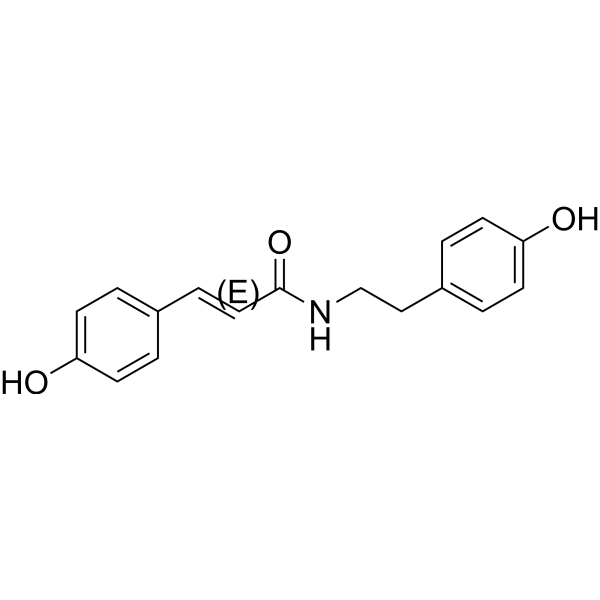
N-p-trans-Coumaroyltyramine is a natural phenolic amide compound and an inhibitor of AChE (IC50: 122 μM) and α-glucosidase (IC50: 2.7 μM). N-p-trans-Coumaroyltyramine also has anti-trypanosomal activity, with an IC50 of 13.3 µM against T. brucei rhodesiense. N-p-trans-Coumaroyltyramine can be used in the research of diseases such as Alzheimer's disease .
loading...
    loading...
Cat. No.: HY-N2380
CAS No.: 132201-33-3
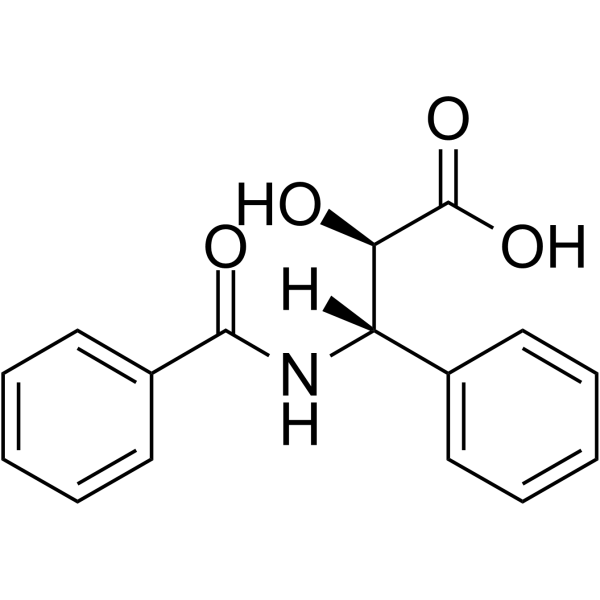
N-Benzoyl-(2R,3S)-3-phenylisoserine is the C-13 chiral side chain of paclitaxel and serves as a synthetic scaffold for constructing paclitaxel and related hybrid molecules. N-Benzoyl-(2R,3S)-3-phenylisoserine is used in studies on paclitaxel side chain synthesis and the design of anti-Plasmodium hybrid molecules .
loading...
    loading...
Cat. No.: HY-Q40175
CAS No.: 438474-67-0
Target:  

Parasite

Research Areas:  

Infection

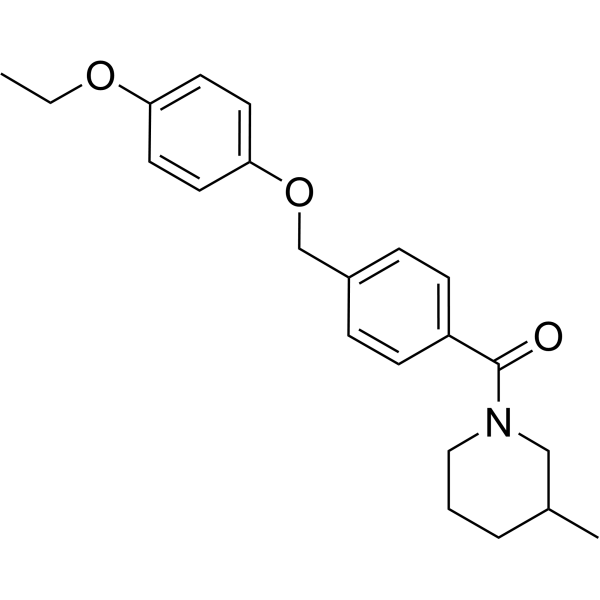
Antitrypanosomal agent 9 (compound 1) is a potent antitrypanosomal agent. Antitrypanosomal agent 9 shows inhibitory activity against T. b. brucei, with an IC50 of 1.15 μM. Antitrypanosomal agent 9 can be used for human African trypanosomiasis (HAT) research .
loading...
    loading...
Cat. No.: HY-P10870
Research Areas:  

Cancer

Pep1-DNP conjugate 9 is a functionalized peptide which is composed of the DNP-Hapten and the FGFR1 binding peptide. Pep1-DNP conjugate 9 exhibits good affinity to FGFR1 with KD of 5.01 μM. Pep1-DNP conjugate 9 recruits anti-DNP antibodies to the surface of FGFR1-positive cells, inhibits the FGF2-induced proliferation in rat skeletal myoblast cells, and induces apoptosis. Pep1-DNP conjugate 9 exhibits antitumor efficacy in mouse models .
loading...
    loading...
Cat. No.: HY-134310
CAS No.: 1353586-18-1
Target:  

Heme Oxygenase (HO)

Research Areas:  

Inflammation/Immunology

QC-308 hydrochloride is a HO-1/HO-2 inhibitor, with an IC50 of 0.27 μM against rat HO-1 and an IC50 of 0.46 μM against rat HO-2. QC-308 hydrochloride inhibits the activities of rat HO-1 and HO-2 in carbon monoxide generation assays using spleen and brain microsomes, respectively. QC-308 hydrochloride also exhibits senolytic activity, reducing the survival rate of adipogenic progenitor cells in skeletal muscle fibers of senescent mice and human skeletal muscle myoblasts. QC-308 hydrochloride is applicable for senescence-related research .
loading...
    loading...
Cat. No.: HY-182604
CAS No.: 1353712-58-9
Target:  

Heme Oxygenase (HO)

Research Areas:  

Inflammation/Immunology

QC-308 is a HO-1/HO-2 inhibitor, with an IC50 of 0.27 μM against rat HO-1 and an IC50 of 0.46 μM against rat HO-2. QC-308 inhibits the activities of rat HO-1 and HO-2 in carbon monoxide generation assays using spleen and brain microsomes, respectively. QC-308 also exhibits senolytic activity, reducing the survival rate of adipogenic progenitor cells in skeletal muscle fibers of senescent mice and human skeletal muscle myoblasts. QC-308 is applicable for senescence-related research .
loading...
    loading...
Cat. No.: HY-N20724
CAS No.: 93124-90-4
Ageconyflavone C is a natural pentamethoxyflavonoid found in the aerial parts of Ageratum conyzoides L. Ageconyflavone C inhibits Trypanosoma brucei rhodesiense, Leishmania donovani, and Chloroquine (HY-17589A)- and Pyrimethamine (HY-18062)-resistant Plasmodium falciparum K1, with IC50 values of 7.8, 9.2, and 9.25 μM, respectively. Ageconyflavone C can be used in studies related to anti-protozoal and parasitic infection research .
loading...
    loading...
Cat. No.: HY-W054427
CAS No.: 70842-04-5
Target:  

Parasite

Research Areas:  

Infection Metabolic Disease

Ro 13-3978 is an orally active antischistosomal agent. Ro 13-3978 exhibits excellent in vivo antischistosomal activity against juvenile and adult Schistosoma mansoni infections. Ro 13-3978 shows no in vivo activity against E. caproni and F. hepatica. Ro 13-3978 blocks dihydrotestosterone-induced proliferation of androgen-dependent cells. Ro 13-3978 can be used in research related to schistosomiasis .
loading...
    loading...
Cat. No.: HY-N21521
CAS No.: 24696-05-7
Dihydromelilotoside is an insecticide present in the stems of Dendrobium aurantiacum var. denneanum, sugarcane juice, and the aerial parts of Ajuga lupulina. Dihydromelilotoside can be used in studies related to Chagas disease (American trypanosomiasis) .
loading...
    loading...

