



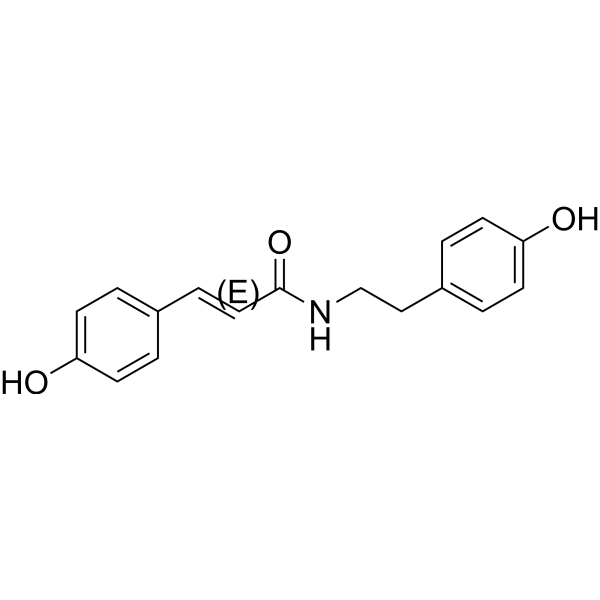
N-p-trans-Coumaroyltyramine
Based on 1 publication(s) in Google Scholar
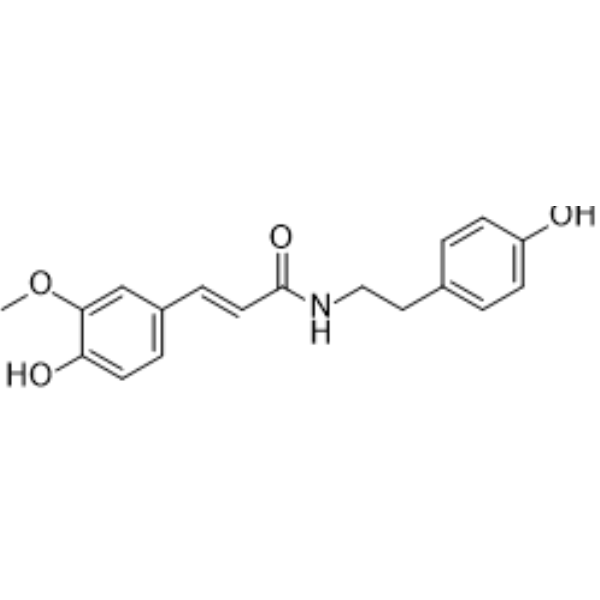
N-p-trans-Coumaroyltyramine is a natural phenolic amide compound and an inhibitor of AChE (IC50: 122 μM) and α-glucosidase (IC50: 2.7 μM). N-p-trans-Coumaroyltyramine also has anti-trypanosomal activity, with an IC50 of 13.3 µM against T. brucei rhodesiense. N-p-trans-Coumaroyltyramine can be used in the research of diseases such as Alzheimer's disease.
For research use only. We do not sell to patients.
- Purity : 99.28%
- CAS No.: 36417-86-4
- Formula: C17H17NO3
- Molecular Weight:283.33
-
Storage:
4°C, protect from light
* In solvent : -80°C, 6 months; -20°C, 1 month (protect from light)

To place orders, for customer services and technical support, please contact: MedChemExpress USA
Tel: 609-228-6898 E-mail: [email protected] [email protected]


-
 Biological Activity
-
Chemical Information
-
Solvent & Solubility
- Protocols
- Purity & Documentation
- References
-
 Help & FAQs


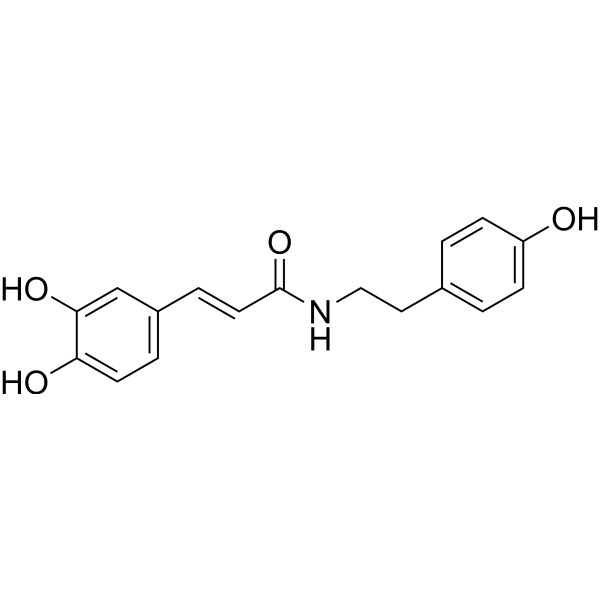

Publications Citing Use of MedChemExpress (MCE) N-p-trans-Coumaroyltyramine
MoreAll Parasite Isoforms
More

Biological Activity
Description
|
AChE |
Trypanosoma |
Cellular Effect
|
Cell Line

|
Type | Value | Description | References |
|---|---|---|---|---|
| A549 | ED50 |
3.24 μg/mL
Compound: 5
|
Cytotoxicity against human A549 cells after 7 days
Cytotoxicity against human A549 cells after 7 days
|
[PMID: 1593281] |
| A549 | IC50 |
15.21 μg/mL
Compound: 12
|
Cytotoxicity against human A549 cells by MTT assay
Cytotoxicity against human A549 cells by MTT assay
|
[PMID: 22413887] |
| BV-2 | IC50 |
2.2 μM
Compound: 22
|
Antineuroinflammatory activity against mouse BV2 cells assessed as inhibition of LPS-induced NO production incubated for 20 hrs by Griess assay
Antineuroinflammatory activity against mouse BV2 cells assessed as inhibition of LPS-induced NO production incubated for 20 hrs by Griess assay
|
[PMID: 33822610] |
| Ca9-22 | IC50 |
12.28 μg/mL
Compound: 12
|
Cytotoxicity against human Ca9-22 cells by MTT assay
Cytotoxicity against human Ca9-22 cells by MTT assay
|
[PMID: 22413887] |
| Hep 3B2 | IC50 |
11.23 μg/mL
Compound: 12
|
Cytotoxicity against human Hep3B cells by MTT assay
Cytotoxicity against human Hep3B cells by MTT assay
|
[PMID: 22413887] |
| HepG2 | IC50 |
9.57 μg/mL
Compound: 12
|
Cytotoxicity against human HepG2 cells by MTT assay
Cytotoxicity against human HepG2 cells by MTT assay
|
[PMID: 22413887] |
| KB | IC50 |
>47.8 μM
Compound: 14
|
Cytotoxicity against human KB cells by sulforhodamine B assay
Cytotoxicity against human KB cells by sulforhodamine B assay
|
[PMID: 26928423] |
| MCF7 | IC50 |
>20 μg/mL
Compound: 12
|
Cytotoxicity against human MCF7 cells by MTT assay
Cytotoxicity against human MCF7 cells by MTT assay
|
[PMID: 22413887] |
| MDA-MB-231 | IC50 |
>20 μg/mL
Compound: 12
|
Cytotoxicity against human MDA-MB-231 cells by MTT assay
Cytotoxicity against human MDA-MB-231 cells by MTT assay
|
[PMID: 22413887] |
| Vero | IC50 |
>47.8 μM
Compound: 14
|
Cytotoxicity against African green monkey Vero cells by sulforhodamine B assay
Cytotoxicity against African green monkey Vero cells by sulforhodamine B assay
|
[PMID: 26928423] |
In Vitro
N-p-trans-Coumaroyltyramine is cytotoxic to rat skeletal muscle myoblasts (L6 cells), with an IC50 of 105.3 μM[1].
N-p-trans-Coumaroyltyramine (0-120 μg/mL; 0-60 min) inhibits AChE activity in a dose-dependent manner, and the inhibition mode is reversible and mixed (competitive/non-competitive)[2].
MedChemExpress (MCE) has not independently confirmed the accuracy of these methods. They are for reference only. Further protocols information, click here.


Chemical Information
-
CAS No. 36417-86-4
-
Appearance Solid
-
Molecular Weight 283.33
-
Formula C17H17NO3
-
Color White to light yellow
-
SMILES
O=C(NCCC1=CC=C(O)C=C1)/C=C/C2=CC=C(O)C=C2
-
Structure Classification
-
Initial Source
-
Shipping
Room temperature in continental US; may vary elsewhere.
-
Storage
4°C, protect from light
* In solvent : -80°C, 6 months; -20°C, 1 month (protect from light)


Publications (1)
-
Journal Impact Factor
-
Most Recent


Solvent & Solubility
In Vitro:
DMSO : 50 mg/mL (176.47 mM; Need ultrasonic; Hygroscopic DMSO has a significant impact on the solubility of product, please use newly opened DMSO)
Please refer to the solubility information to select the appropriate solvent. Once prepared, please aliquot and store the solution to prevent product inactivation from repeated freeze-thaw cycles.
Storage method and period of stock solution: -80°C, 6 months; -20°C, 1 month (protect from light). When stored at -80°C, please use it within 6 months. When stored at -20°C, please use it within 1 month.
Please refer to the solubility information to select the appropriate solvent. Once prepared, please aliquot and store the solution to prevent product inactivation from repeated freeze-thaw cycles.
Storage method and period of stock solution: -80°C, 6 months; -20°C, 1 month (protect from light). When stored at -80°C, please use it within 6 months. When stored at -20°C, please use it within 1 month.
Concentration (start) × Volume (start) = Concentration (final) × Volume (final)
In Vivo:
Select the appropriate dissolution method based on your experimental animal and administration route.
- For the following dissolution methods, please ensure to first prepare a clear stock solution using an In Vitro approach and then sequentially add co-solvents:
- To ensure reliable experimental results, the clarified stock solution can be appropriately stored based on storage conditions. As for the working solution for In Vivo experiments, it is recommended to prepare freshly and use it on the same day.
- The percentages shown for the solvents indicate their volumetric ratio in the final prepared solution. If precipitation or phase separation occurs during preparation, heat and/or sonication can be used to aid dissolution.
Add each solvent one by one: 10% DMSO 40% PEG300 5% Tween-80 45% Saline
Solubility: ≥ 2.5 mg/mL (8.82 mM); Clear solution
This protocol yields a clear solution of ≥ 2.5 mg/mL (saturation unknown).
Taking 1 mL working solution as an example, add 100 μL DMSO stock solution (25.0 mg/mL) to 400 μL PEG300, and mix evenly; then add 50 μL Tween-80 and mix evenly; then add 450 μL Saline to adjust the volume to 1 mL.
Preparation of Saline: Dissolve 0.9 g sodium chloride in ddH₂O and dilute to 100 mL to obtain a clear Saline solution.
In Vivo Dissolution Calculator
Please enter the basic information of animal experiments:
-
-
-
-
Recommended: Prepare an additional quantity of animals to account for potential losses during experiments.
Please enter your animal formula composition:
-
%DMSO +
Recommended: Keep the proportion of DMSO in working solution below 2% if your animal is weak.
-
%+
-
+%Tween-80 + +
-
%Saline +
The co-solvents required include: DMSO, . All of co-solvents are available by MedChemExpress (MCE). , Tween 80. All of co-solvents are available by MedChemExpress (MCE).
Working solution concentration: 0.22 mg/mL
Method for preparing stock solution: mg drug dissolved in μL DMSO. Stock solution concentration: mg/mL. * In solvent : -80°C, 6 months; -20°C, 1 month (protect from light)
1. Take μL DMSO stock solution;
2. Add μL .
μL , mix evenly;
3. Then add μL Tween 80, mix evenly;
4. Then add μL
Please ensure that the stock solution in the first step is dissolved to a clear state, and add co-solvents in sequence. You can use ultrasonic heating (ultrasonic cleaner, recommended frequency 20-40 kHz), vortexing, etc. to assist dissolution.

Protocols
-
Cell Cytotoxicity Assay
Cytotoxicity assays are usually based on the assessment of cell membrane damage, which can also be indirectly detected by measuring cell viability. Detection methods include MTT assay, CKK-8 assay, LDH assay and ATP assay, etc.
-
Alzheimer’s Disease Modeling
Alzheimer’s Disease (AD) is a neurodegenerative disorder characterized by a progressive decline in cognitive functions and loss of specific types of neurons and synapses. Alzheimer's symptoms can be simulated in mice by injecting drugs (such as Aβ) or genetically modified.


Purity & Documentation
-
Data Sheet (271 KB)
-
SDS (252 KB)
- English - EN (252 KB)
- Français - FR (252 KB)
- Deutsch - DE (252 KB)
- Norwegian - NO (252 KB)
- Español - ES (252 KB)
- Swedish - SV (252 KB)
- Italian - IT (252 KB)
- Korean - KR (252 KB)
- Portuguese - PT (252 KB)
-
Handling Instructions (2659 KB)
References
[1]. Moradi-Afrapoli F, et al. Cinnamoylphenethyl amides from Polygonum hyrcanicum possess anti-trypanosomal activity. Nat Prod Commun. 2012 Jun;7(6):753-5. [Content Brief]
[2]. Kim DK, et al. Inhibitory effect of trans-N-p-coumaroyl tryamine from the twigs of Celtis chinensis on the acetylcholinesterase. Arch Pharm Res. 2003 Sep;26(9):735-8. [Content Brief]
[3]. Zhou X, et al. Separation and purification of α-glucosidase inhibitors from Polygonatum odoratum by stepwise high-speed counter-current chromatography combined with Sephadex LH-20 chromatography target-guided by ultrafiltration-HPLC screening. J Chromatogr B Analyt Technol Biomed Life Sci. 2015 Mar 15;985:149-54. [Content Brief]


Complete Stock Solution Preparation Table
Please refer to the solubility information to select the appropriate solvent. Once prepared, please aliquot and store the solution to prevent product inactivation from repeated freeze-thaw cycles.
Storage method and period of stock solution: -80°C, 6 months; -20°C, 1 month (protect from light). When stored at -80°C, please use it within 6 months. When stored at -20°C, please use it within 1 month.
| Optional Solvent | Concentration Solvent Mass | 1 mg | 5 mg | 10 mg | 25 mg |
|---|---|---|---|---|---|
| DMSO | 1 mM | 3.5295 mL | 17.6473 mL | 35.2945 mL | 88.2363 mL |
| 5 mM | 0.7059 mL | 3.5295 mL | 7.0589 mL | 17.6473 mL | |
| 10 mM | 0.3529 mL | 1.7647 mL | 3.5295 mL | 8.8236 mL | |
| 15 mM | 0.2353 mL | 1.1765 mL | 2.3530 mL | 5.8824 mL | |
| 20 mM | 0.1765 mL | 0.8824 mL | 1.7647 mL | 4.4118 mL | |
| 25 mM | 0.1412 mL | 0.7059 mL | 1.4118 mL | 3.5295 mL | |
| 30 mM | 0.1176 mL | 0.5882 mL | 1.1765 mL | 2.9412 mL | |
| 40 mM | 0.0882 mL | 0.4412 mL | 0.8824 mL | 2.2059 mL | |
| 50 mM | 0.0706 mL | 0.3529 mL | 0.7059 mL | 1.7647 mL | |
| 60 mM | 0.0588 mL | 0.2941 mL | 0.5882 mL | 1.4706 mL | |
| 80 mM | 0.0441 mL | 0.2206 mL | 0.4412 mL | 1.1030 mL | |
| 100 mM | 0.0353 mL | 0.1765 mL | 0.3529 mL | 0.8824 mL |


N-p-trans-Coumaroyltyramine Related Classifications
HY-N2230 Related Classifications
 Powered by Bioz