1. Search Result
Search Result
Results for "

reactive hydroxyl radicals

" in MedChemExpress (MCE) Product Catalog:

10

Inhibitors & Agonists

1

Fluorescent Dyes

1

Biochemical Assay Reagents

2

Natural
Products

Targets Recommended:
Cat. No. Product Name Target Research Areas Chemical Structure
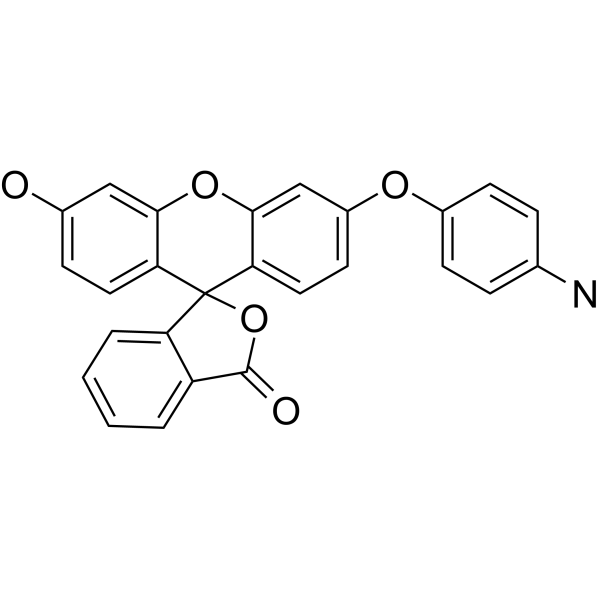
  • HY-119977
    APF
    1 Publications Verification

    Fluorescent Dye Reactive Oxygen Species (ROS) Others
    APF is a cell-permeable fluorogenic probe to measure hydroxyly radical of ROS. APF is nonfluorescent and produces bright green fluorescence upon reaction with hydroxyl radical. APF can be used to detect intracellular reactive oxygen species (ROS) (Ex/Em=490/525 nm) .
    APF
  • HY-N13022
    Humic acid
    1 Publications Verification

    Environmental Pollutants Bacterial SOD Inflammation/Immunology Cancer
    Humic acid is an important component of organic matter in soil and water, and serves as a plant regulator. Humic acid has multiple reactive activities such as surface adsorption, ion exchange, and complexation. Humic acid can enhance pyrene degradation by Mycobacterium NJS-1. Humic acid can inhibit the activity of superoxide dismutase and scavenge hydroxyl radicals. Humic acid is also toxic to CEM cells .
    Humic acid
  • HY-W115721

    Sodium rhodizonate dibasic

    Reactive Oxygen Species (ROS) DNA/RNA Synthesis Others
    Rhodizonic acid disodium (Sodium rhodizonate dibasic) is a transition metal-dependent pro-oxidant and lead detection agent that induces reactive oxygen species generation, DNA damage, and inhibits Aconitase activity. Rhodizonic acid disodium generates superoxide anion radicals in an iron (II)-dependent manner, leading to aconitase inactivation. Rhodizonic acid disodium also triggers hydroxyl radical-mediated DNA strand breaks and 8-OHdG formation via copper ion reduction. Rhodizonic acid disodium reacts with lead to form a scarlet precipitate, with the color intensity proportional to lead content, enabling qualitative or quantitative analysis of lead. Rhodizonic acid disodium can also be used for real-time visualization of the dynamic process of lead sequestration in the plant rhizosphere and evaluation of the effects of environmental factors such as soil type on the stability of lead-sequestering structures .
    Rhodizonic acid disodium
  • HY-W015229R

    Indole-3-propionic acid (Standard); 3-IPA (Standard)

    Reference Standards Endogenous Metabolite Reactive Oxygen Species (ROS) Neurological Disease Metabolic Disease
    3-Indolepropionic acid (Standard) is the analytical standard of 3-Indolepropionic acid. This product is intended for research and analytical applications. 3-Indolepropionic acid is shown to be a powerful antioxidant and has potential in the treatment for Alzheimer’s disease. In Vitro: 3-Indolepropionic acid is shown to be a powerful antioxidant and has potential in the treatment for Alzheimer’s disease . 3-Indolepropionic acid is a more potent scavenger of hydroxyl radicals than melatonin. Similar to melatonin but unlike other antioxidants, 3-Indolepropionic acid scavenges radicals without subsequently generating reactive and pro-oxidant intermediate compounds . It is also suggested that indolepropionic acid, a gut microbiota-produced metabolite, is a potential biomarker for the development of type 2 diabetes (T2D) that may mediate its protective effect by preservation of β-cell function .
    3-Indolepropionic acid (Standard)
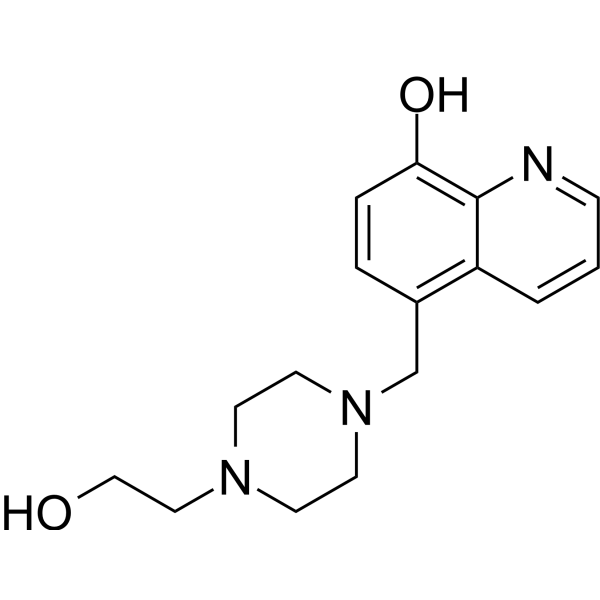
  • HY-W686216

    Dopamine Receptor Neurological Disease
    VK-28 is a blood-brain barrier-permeable iron chelator. VK-28 inhibits mitochondrial membrane lipid peroxidation and the iron-dependent generation of reactive hydroxyl radicals. VK-28 exhibits neuroprotective activity and protects rats against 6-OHDA-induced striatal dopaminergic damage. VK-28 can be used in studies related to Parkinson's disease .
    VK-28
  • HY-173473

    Reactive Oxygen Species (ROS) Apoptosis Ferroptosis Cancer
    Anticancer agent 272 (Compound 2) is an anticancer agent. Anticancer agent 272 has significant anti-bladder cancer cell (T-24) activity (IC50: 2.81 μM). Anticancer agent 272 consumes glutathione (GSH) through Fenton-like reaction, produces reactive oxygen species (ROS) and hydroxyl radicals (?OH), and induces apoptosis and ferroptosis. Anticancer agent 272 can enhance chemodynamic therapy (CDT) and promote tumor cell death through mitochondrial dysfunction and autophagy. Anticancer agent 272 has potential in the study of bladder cancer .
    Anticancer agent 272
  • HY-130743

    Bis-eugenol; Dehydrodieugenol

    Parasite Infection
    Dieugenol is a neolignan that has been found in N. leucantha and has antioxidative and antiprotozoal activities. It inhibits the formation of thiobarbituric acid reactive substances (TBARS) and scavenges superoxide anions, but not hydroxyl radicals, in cell-free assays. It has anti-trypanosomal activity against T. cruzi amastigotes and trypomastigotes (IC50s=15.1 and 11.5 μM, respectively) but is cytotoxic to NCTC L-929 fibroblasts with a 50% cytotoxic concentration (CC50) value of 58.2 μM.2 Dieugenol (15 μM) disrupts the integrity of the T. cruzi trypomastigote plasma membrane but does not induce the production of reactive oxygen species (ROS) in trypomastigotes or LPS-stimulated and unstimulated isolated mouse peritoneal macrophages.
    Dieugenol
  • HY-D3449

    Fluorescent Dye Reactive Oxygen Species (ROS) Others
    8-(9-Bromoanthracene)-BODIPY 505/515 is a fluorescence turn-on probe with selective fluorescence turn-on response towards hydroxyl radical. 8-(9-Bromoanthracene)-BODIPY 505/515 can be used to detect reactive oxygen/nitrogen species (ROS/RNS) . (Ex/Em = 505/515 nm)
    8-(9-Bromoanthracene)-BODIPY 505/515
  • HY-182333

    Cholinesterase (ChE) Neurological Disease
    AChE-IN-112 is an acetylcholinesterase (AChE) inhibitor with an IC50 of 0.41 μM. AChE-IN-112 scavenges various reactive oxygen and reactive nitrogen species, including DPPH, ABTS, NO, hydroxyl and hydrogen peroxide free radicals. AChE-IN-112 can be used for the research of Alzheimer's disease .
    AChE-IN-112
  • HY-183570

    Photosensitizer Reactive Oxygen Species (ROS) Cancer
    Antitumor photosensitizer-11 is a type-I carbazole/benzindolium photosensitizer with antitumor activity. Antitumor photosensitizer-11 induces ROS generation via a type-I pathway, forming superoxide anions and hydroxyl radicals. Antitumor photosensitizer-11 triggers immunogenic cell death in cancer cells via enhanced oxidative stress. Antitumor photosensitizer-11 exhibits antiproliferative activity in normoxic and hypoxic environments, inhibits breast cancer tumor growth in vivo, and promotes dendritic cell maturation and T cell infiltration. Antitumor photosensitizer-11 can be used for the research of cancer, such as breast cancer .
    Antitumor photosensitizer-11

Inquiry Online

Your information is safe with us. * Required Fields.

Salutation


Country or Region *

Applicant Name *


Organization Name *

Department *


Email Address *


Product Name *

Cat. No.


Requested quantity *

Phone Number *


Remarks

Inquiry Online

Inquiry Information

Product Name:
Cat. No.:
Quantity:
MCE Japan Authorized Agent:

