1. Search Result
Search Result
Results for "

stress urinary incontinence

" in MedChemExpress (MCE) Product Catalog:
Cat. No. Product Name Target Research Areas Chemical Structure
  • HY-171048

    Androgen Receptor Endocrinology Cancer
    GTx-027 is an orally active and non-steroidal selective androgen receptor modulator (SARM). GTx-027 shows androgen receptor (AR) transactivation effects with the EC50 of 1.8 nM. GTx-027 acts selectively increase muscle weight (anabolic) without affecting secondary sexual organs (androgenic). GTx-027 has the protential for the study of breast cancer and stress urinary incontinence (SUI) .
    GTx-027
  • HY-14790

    (S,S)-(+)-Reboxetine

    Adrenergic Receptor Neurological Disease
    Esreboxetine ((S,S)-Reboxetine) is a selective norepinephrine reuptake inhibitor with activity in increasing urethral resistance. Esreboxetine has been reported to be effective in patients with stress urinary incontinence in a Phase IIa clinical study, achieving this effect by increasing urethral closure. The mechanism of action of esreboxetine involves inhibition of norepinephrine transporters in the central and peripheral nervous systems. The peripheral selectivity of esreboxetine helps it significantly increase urethral resistance without penetrating the brain .
    Esreboxetine
  • HY-W039283

    MCHR1 (GPR24) Neurological Disease Cancer
    MCH-1 antagonist 2 (l-BROMO-2,4-DIFLUORO-5-NITROBEN-ZENE) is a melanin concentrating hormone-1 (MCH1) receptor-selective 4-aryl piperidine. MCH-1 antagonist 2 can be used for the research of depression, anxiety, obesity, urge incontinence, urinary incontinence, major depression, bipolar disorder, agoraphobia, specific phobia, social phobia, obsessive-compulsive disorder, post-traumatic stress disorder, acute stress disorder, urinary frequency, urinary urgency, nocturia, enuresis, bulimia, bulimia nervosa, anorexia nervosa, major depressive disorder, dysthymic disorder, bipolar 1 and 2 disorders, schizoaffective disorder, cognitive disorders with depressed mood, personality disorders, insomnia, hypersomnia, narcolepsy, circadian rhythm sleep disorder, nightmare disorder, sleep terror disorder, sleepwalking disorder, panic disorder, social anxiety disorder, generalized anxiety disorder, overactive bladder .
    MCH-1 antagonist 2
  • HY-119103

    5-HT Receptor Neurological Disease
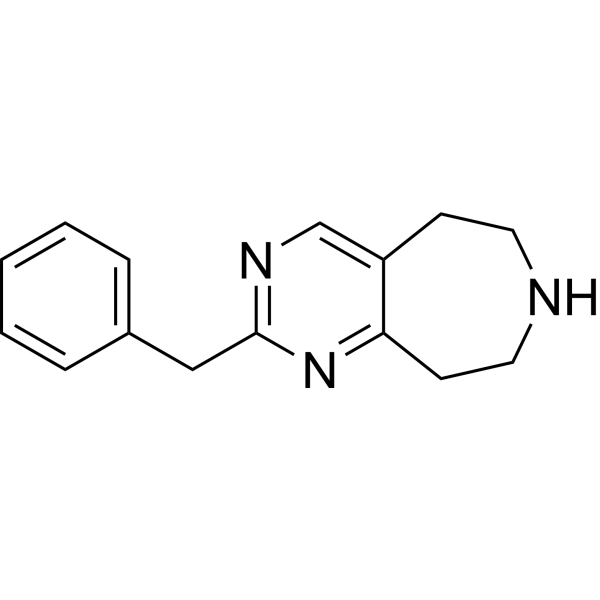
    PF-03246799 is a potent and selective 5-HT2C receptor agonist with an EC50 of 190 nM and a Ki of 160 nM. PF-03246799 shows selectivity for 5-HT2C over 5-HT2A and 5-HT2B receptors. PF-03246799 has the potential for stress urinary incontinence (SUI) research .
    PF-03246799
  • HY-124947

    5-HT Receptor Neurological Disease
    PF-4522654 is a potent, selective and brain-permeable 5-HT2C receptor agonist with an EC50 of 16 nM and a Ki of 8 nM. PF-4522654 shows no measurable functional agonism at no 5-HT2A and 5-HT2B receptors. PF-4522654 can be used for the study of stress urinary incontinence (SUI) .
    PF-4522654
  • HY-119262

    Adrenergic Receptor Cardiovascular Disease Endocrinology
    ABT-866 is an α1A-adrenoceptor agonist and an antagonist at the α1B- and α1D-adrenoceptor subtypes. ABT-866 has an EC50 of 0.60 μM for the α1A in the rabbit urethra. ABT-866 has a pA2 value of 5.4 for the α1B in the rat spleen. ABT-866 has a pA2 value of 6.2 for the α1D in the rat aorta. ABT-866 exhibits good urethral selectivity and lower cardiovascular side effects in stress urinary incontinence models. ABT-866 can be used for the research of diseases such as stress urinary incontinence .
    ABT-866
  • HY-137055

    Others Others
    PF-3774076 is a highly central nervous system (CNS) penetrant, potent, and selective human α1A-adrenoceptor partial agonist. It exhibits good potency and selectivity in multiple binding and functional assays. PF-3774076 increases peak urethral pressure in anesthetized female dogs in a dose-dependent manner via a central mechanism. PF-3774076 affects both the proximal and distal portions of the urethra in vivo. These properties suggest that PF-3774076 may have significant benefit in the treatment of stress urinary incontinence (SUI) as a CNS-penetrant α1A receptor partial agonist. However, despite its partial agonism and selectivity for α1A receptors, PF-3774076 failed to provide adequate safety differences in in vivo models of cardiovascular function. This may be due to the simultaneous activation of both peripheral and central α1A receptors. These data suggest that while central α1A partial agonists may have significant benefit in the treatment of SUI, this class of agents may have difficulty achieving the desired urethral selectivity without affecting cardiovascular function.
    PF-3774076
  • HY-119103B

    5-HT Receptor Neurological Disease
    PF-03246799 monohydrochloride is a potent and selective 5-HT2C receptor agonist with an EC50 of 190 nM and a Ki of 160 nM. PF-03246799 monohydrochloride shows selectivity for 5-HT2C over 5-HT2A and 5-HT2B receptors. PF-03246799 monohydrochloride has the potential for stress urinary incontinence (SUI) research .
    PF-03246799 monohydrochloride

Inquiry Online

Your information is safe with us. * Required Fields.

Salutation


Country or Region *

Applicant Name *


Organization Name *

Department *


Email Address *


Product Name *

Cat. No.


Requested quantity *

Phone Number *


Remarks

Inquiry Online

Inquiry Information

Product Name:
Cat. No.:
Quantity:
MCE Japan Authorized Agent:

