7 Results for "

thiocarbonyl

" in MedChemExpress (MCE) Product Catalog:
Products (7)

7 Results for "thiocarbonyl" in MCE Product Catalog:

Cat. No.: HY-78216
CAS No.: 16982-21-1
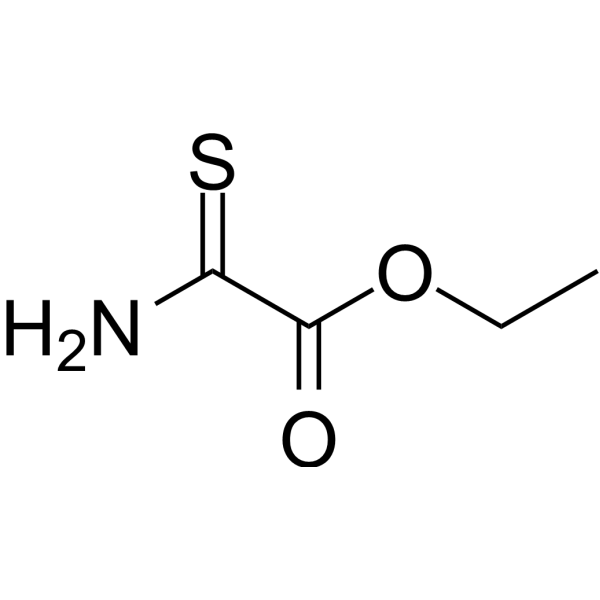
2-Thiooxamic acid ethyl ester is an organic compound containing thiocarbonyl and ethyl ester groups. 2-Thiooxamic acid ethyl ester can be used in the study of cancer (such as chronic myeloid leukemia, breast cancer, etc.) .
loading...
    loading...
Cat. No.: HY-Y0689
CAS No.: 6160-65-2
Target:  

MOFs

Research Areas:  

Others

Thiocarbonyldiimidazole is a synthetic chemical reagent that serves as a nitrogen-containing MOF ligand for synthetic applications. Thiocarbonyldiimidazole enables the preparation of thiocarbonyl imidazolides from alcohols, and is used in the Barton-McCombie deoxygenation reaction and natural product synthesis .
loading...
    loading...
Cat. No.: HY-P4901
CAS No.: 1926163-69-0
Research Areas:  

Others

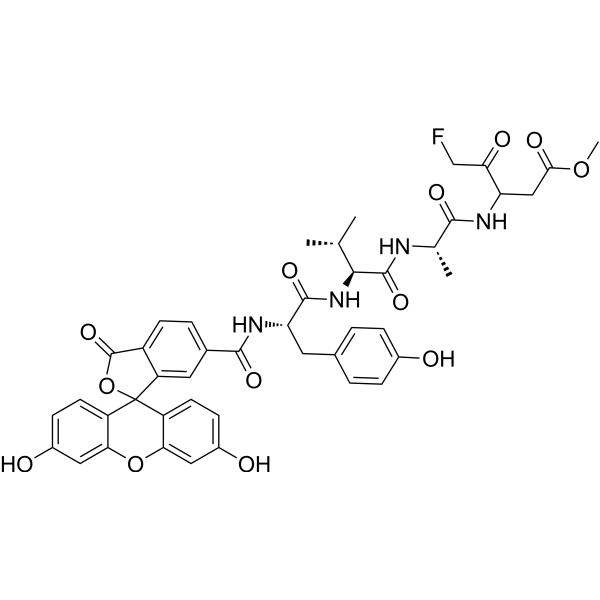
Fluorescein-6-carbonyl-Tyr-Val-Ala-DL-Asp(OMe)-fluoromethylketone is a polypeptide.
loading...
    loading...
Cat. No.: HY-P12260
CAS No.: 3027489-02-4
Research Areas:  

Cancer

AJICAP reagent 1b is a thiophenyl ester-based site-specific conjugation reagent for antibody modification applications. AJICAP reagent 1b is used in HER2-positive gastric cancer-related research .
loading...
    loading...
Cat. No.: HY-P12261
Research Areas:  

Cancer

AJICAP reagent 6b is an Fc-affinity peptide reagent that site-specifically modifies Lys288 of native antibodies via thiophenyl ester chemistry. AJICAP reagent 6b enables site-specific conjugation of native antibodies at Lys288 with high conversion yield and reduced aggregation. AJICAP reagent 6b can be used for the research of cancer .
loading...
    loading...
Cat. No.: HY-D3206
CAS No.: 1860808-05-4
CuFS is a reaction-based fluorescent sensor for detecting Cu 2+ with zero background fluorescence. CuFS acts as a fluorescence quencher in the absence of Cu 2+ and as a fluorescence enhancer in the presence of Cu 2+. CuFS can be fabricated into test strips and applied to the detection of Cu 2+ in human cancer cells .
loading...
    loading...
Cat. No.: HY-D3084
Target:  

Fluorescent Dye

Research Areas:  

Cancer

C-TPA is a fluorescent probe used for hypochlorite detection and bioimaging of lipid droplet polarity in cancer cells. For hypochlorite detection, when its derivative C-TPA-S is exposed to hypochlorite, an oxidative desulfurization reaction converts the thiocarbonyl group of C-TPA-S to the carbonyl group of C-TPA, thus restoring bright fluorescence from the almost non-fluorescent C-TPA-S. For bioimaging of lipid droplet polarity, the intramolecular charge transfer process between its Triphenylamine (HY-W011998) donor group and Coumarin (HY-N0709) acceptor group endows C-TPA with solvatochromism-it exhibits stronger fluorescence in less polar environments (such as lipid droplets in cancer cells) and weaker fluorescence in more polar environments (such as lipid droplets in normal cells), enabling the differentiation of cancer cells and cancer tissues from normal cells and normal tissues. The excitation wavelength of C-TPA is 405 nm, and the emission wavelengths used for cell and tissue imaging cover 425-475 nm and 500-550 nm; in solvents, its emission peak shifts from 494 nm in non-polar toluene to 528 nm in polar water .
loading...
    loading...

