



Tyrosinase (192-200), human mouse
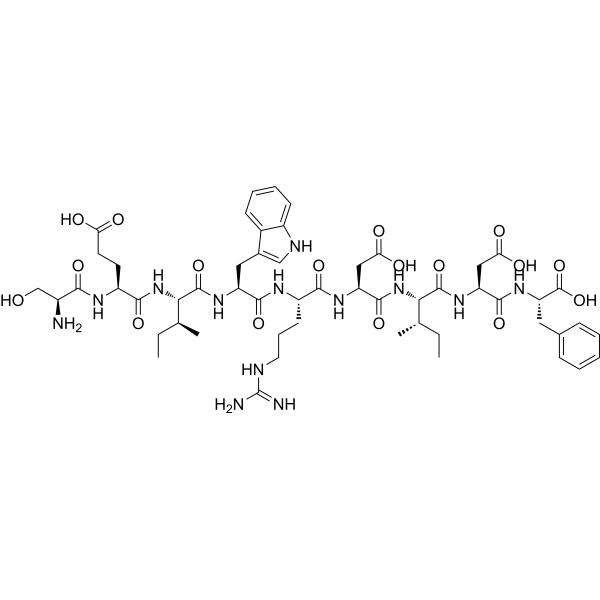
Tyrosinase (192-200), human mouse is a HLA-B*4403-restricted tyrosinase epitope with affinity for HLA-B4403 and HLA-B4402. Tyrosinase (192-200), human mouse binds to HLA-B*4403 to form a complex, which is recognized by the autologous cytotoxic T lymphocyte clone 22/31 derived from melanoma. Tyrosinase (192-200), human mouse binds to HLA-B4402 to form a complex, which is recognized by the CTL clone 329B/5 derived from healthy HLA-B4402 donors. Tyrosinase (192-200), human mouse is applicable to melanoma-related research.
For research use only. We do not sell to patients.
- CAS No.: 170294-35-6
- Formula: C54H77N13O17
- Molecular Weight:1180.27
-
Storage:
Please store the product under the recommended conditions in the Certificate of Analysis.

To place orders, for customer services and technical support, please contact: MedChemExpress USA
Tel: 609-228-6898 E-mail: [email protected] [email protected]


-
 Biological Activity
-
Chemical Information
- Purity & Documentation
- References
-
 Help & FAQs




Biological Activity
Description
In Vitro
Tyrosinase (192-200), human mouse (0.1-1000 nM; 30 min pre-incubation with target cells, 4 h CTL incubation) potently sensitizes HLA-B*4403-positive LG2-EBV lymphoblastoid cells to lysis by autologous CTL clone 22/31, with maximal lysis observed at concentrations of 100 nM and above[1].
Tyrosinase (192-200), human mouse (10-1000 nM; 30 min pre-incubation with target cells, 4 h CTL incubation) is recognized by CTL clone 22/31 in the context of HLA-B4403 and by CTL clone 329B/5 in the context of HLA-B4402, inducing dose-dependent lysis of the respective HLA subtype-positive lymphoblastoid cell lines[1].
Tyrosinase (192-200), human mouse (1-50 μM; 4 h pre-incubation with adherent cells, re-stimulation on days 7, 14, and weekly thereafter) effectively stimulates CD8+ T lymphocytes from a healthy HLA-B4402 donor to generate CTL clone 329B/5, which recognizes the peptide presented by HLA-B4402[1].
Tyrosinase (192-200), human mouse-specific HLA-B4403-restricted CTL clone efficiently lyses tyrosinase-expressing HLA-B4403+ cells, with half-maximal lysis of peptide-pulsed targets occurring at a peptide concentration of 1 μM[2].
MedChemExpress (MCE) has not independently confirmed the accuracy of these methods. They are for reference only.
-
Cell Line:EBV-transformed lymphoblastoid cell line LG2-EBV (HLA-B*4403 positive), autologous CTL clone 22/31
-
Concentration:0.1, 1, 10, 100, 1000 nM (30 min pre-incubation with target cells)
-
Incubation Time:4 h (CTL incubation)
-
Result:Sensitized LG2-EBV cells to lysis by CTL clone 22/31 in a dose-dependent manner.
Achieved maximal specific lysis (≥95%) at 100 nM and 1000 nM concentrations.
Reduced maximal specific lysis to only ~10% at 1000 nM when the N-terminal serine residue was removed (forming peptide EIWRDIDFA).
-
Cell Line:EBV-transformed lymphoblastoid cell lines expressing HLA-B*4403 (MZ2-EBV, LB17-EBV, LG2-EBV) or HLA-B*4402 (SK29-EBV, BI2-EBV, LB33-EBV), CTL clone 22/31, CTL clone 329B/5
-
Concentration:10, 100, 1000 nM (30 min pre-incubation with target cells)
-
Incubation Time:4 h (CTL incubation)
-
Result:Induced CTL clone 22/31 to potently lyse all HLA-B*4403-positive lymphoblastoid cell lines, with maximal specific lysis (≥70%) achieved at 1000 nM.
Caused minimal to no lysis of HLA-B*4402-positive cell lines by CTL clone 22/31.
Induced CTL clone 329B/5 to potently lyse HLA-B*4402-positive LB33-EBV cells, with maximal specific lysis ≥80% at 1000 nM.
Resulted in minimal lysis of HLA-B*4403-positive cell lines by CTL clone 329B/5.


Chemical Information
-
CAS No. 170294-35-6
-
Molecular Weight 1180.27
-
Formula C54H77N13O17
-
Sequence Shortening
SEIWRDIDF
-
Shipping
Room temperature in continental US; may vary elsewhere.
-
Storage
Please store the product under the recommended conditions in the Certificate of Analysis.


Purity & Documentation
References
[1]. Brichard VG, et al. A tyrosinase nonapeptide presented by HLA-B44 is recognized on a human melanoma by autologous cytolytic T lymphocytes. Eur J Immunol. 1996;26(1):224-230. [Content Brief]
[2]. Akatsuka Y, et al. Identification of a polymorphic gene, BCL2A1, encoding two novel hematopoietic lineage-specific minor histocompatibility antigens. J Exp Med. 2003;197(11):1489-1500. [Content Brief]

Calculators
Concentration (start) × Volume (start) = Concentration (final) × Volume (final)


Tyrosinase (192-200), human mouse Related Classifications
HY-P3742 Related Classifications
 Powered by Bioz