



CDK13
CDK13 is a transcription-associated cyclin-dependent kinase that forms a complex with cyclin K and regulates RNA polymerase II (RNAPII) activity through phosphorylation of the carboxy-terminal domain (CTD), thereby coupling transcription elongation with co-transcriptional RNA processing events[1][2]. Mechanistically, CDK13 cooperates with the closely related kinase CDK12 to control RNAPII elongation rate, processivity, transcription termination site selection, and alternative polyadenylation, establishing a central role in global gene-expression regulation[3]. CDK13 also contributes to mRNA splicing control, and dual CDK12/CDK13 inhibition disrupts splicing of promoter-proximal introns containing weak splice-site features, linking CDK13 activity to RNA maturation pathways[4]. In disease-relevant models, deregulation of CDK12/CDK13-dependent transcription affects genome stability programs and has been associated with tumor biology, replication stress responses, and altered expression of genes involved in RNA processing and DNA damage repair[2][3][5]. Compared with CDK12, which preferentially supports transcription of DNA damage response genes, CDK13 exerts stronger effects on splicing and RNA-processing networks, highlighting partially overlapping but nonidentical biological functions between the two paralogous kinases[2][6]. For experimental applications, covalent CDK12/CDK13 inhibitors such as THZ531 have been widely used to interrogate transcription elongation, CTD phosphorylation, alternative polyadenylation, and RNA-processing mechanisms in cancer and transcription-focused research models[3][4].
References:
- [1]. Blazek D, et al. The Cyclin K/Cdk12 complex maintains genomic stability via regulation of expression of DNA damage response genes. Genes Dev. 2011 Oct 15;25(20):2158-72. [Content Brief]
- [2]. Pitolli C, et al. Physiological and pathological roles of the transcriptional kinases CDK12 and CDK13 in the central nervous system. Cell Death Differ. 2025 Mar;32(3):371-381. [Content Brief]
- [3]. Fan Z, et al. CDK13 cooperates with CDK12 to control global RNA polymerase II processivity. Sci Adv. 2020 Apr 29;6(18):eaaz5041. [Content Brief]
- [4]. Panzeri V, et al. CDK12/13 promote splicing of proximal introns by enhancing the interaction between RNA polymerase II and the splicing factor SF3B1. Nucleic Acids Res. 2023 Jun 23;51(11):5512-5526. [Content Brief]
- [5]. Krajewska M, et al. CDK12 loss in cancer cells affects DNA damage response genes through premature cleavage and polyadenylation. Nat Commun. 2019 Apr 15;10(1):1757. [Content Brief]
- [6]. Dudkiewicz-Garbicz J, et al. CDK12 and CDK13 in oncology: from RNA regulation to therapeutic targeting. Cell Oncol (Dordr). 2026 Jan 5;49(1):13. [Content Brief]
-
CDK13 Related Products (27)
Related Products (27)

- 1
- 2
-
CDK12-IN-9
 0 ImagesCat. No.: HY-181645CAS No.: 3024723-74-5
-
SR-5037
 0 ImagesSR-5037 is an orally active CDK12 (IC50 = 31 nM)/CDK13 inhibitor and CycK (DC50 = 30 nM; Dmax > 98%) molecular glue degrader. SR-5037 inhibits the enzymatic activity of CDK12/CycK and CDK13/CycK complexes. SR-5037 promotes the recruitment of DDB1 to the CDK12/CycK complex, thereby triggering proteasome-mediated CycK degradation. SR-5037 degrades active CycK in mouse models of triple-negative breast cancer. SR-5037 can be used in the research of cancers such as triple-negative breast cancer.
-
CDK-IN-9
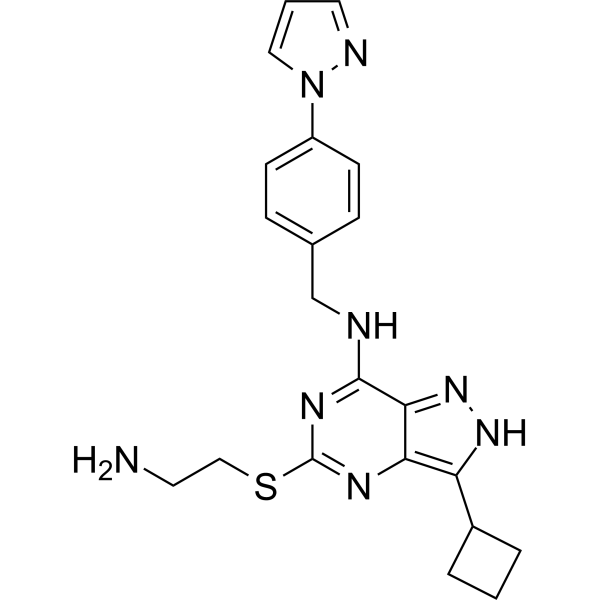 0 ImagesCat. No.: HY-150641CAS No.: 3031561-92-6CDK-IN-9 (compound 24) is a potent CDK inhibitor, also as a molecular glue inducing an interaction between CDK12 and DDB1, with an IC50 values of 4 nM for CDK2/E. CDK-IN-9 leads to polyubiquitination of cyclin K and its subsequent degradation. CDK-IN-9 induce apoptosis through dephosphorylation of retinoblastoma protein and RNA polymerase II.
-
YJZ5118
 0 ImagesCat. No.: HY-173273CAS No.: 3031861-18-1YJZ5118 is a selective CDK12/CDK13 inhibitor with IC50 values of 39.5 nM and 26.4 nM. YJZ5118 suppresses transcription of DNA damage response genes and induces DNA damage in tumor cells. YJZ5118 inhibits proliferation and triggers apoptosis. YJZ5118 inhibits RNA polymerase II Ser2 phosphorylation and increases Akt pathway activity. YJZ5118 exhibits synergistic effects with Akt inhibitors. YJZ5118 can be used for the research of cancer, such as prostate cancer.

-
Hsp90-IN-42
 0 ImagesCat. No.: HY-176279Hsp90-IN-42 is a heat shock protein 90 (Hsp90) inhibitor with an IC50 of 15.65 nM against human targets. Hsp90-IN-42 destabilizes EGFR and inhibits the activation of the EGFR-Akt signaling pathway. Hsp90-IN-42 suppresses the proliferation and migration of cancer cells, induces cell cycle arrest by downregulating CDK12 and CDK13, and triggers mild apoptosis via downregulating Bcl-2 and upregulating Bax. Hsp90-IN-42 inhibits tumor growth in xenograft mouse models. Hsp90-IN-42 can be used in research related to colorectal cancer.

- 1
- 2



