



NO Synthase Activator
-
Lithospermic acid (Standard)
 0 ImagesSynonyms: (+)-Lithospermic acid (Standard)
Lithospermic acid (Standard) is the analytical standard of Lithospermic acid. This product is intended for research and analytical applications. Lithospermic acid ((+)-Lithospermic acid) is a plant-derived polycyclic phenolic carboxylic acid isolated from Salvia miltiorrhiza, and has the anti-oxidative and hepatoprotective activity on carbon tetrachloride (CCl4)-induced acute liver damage in vitro and in vivo.
-
4-Methoxybenzyl alcohol (Standard)
 0 ImagesSynonyms: P-Methoxy-benzyl alcoho (Standard); (4-Methoxyphenyl)methanol (Standard)
4-Methoxybenzyl alcohol (Standard) (P-Methoxy-benzyl alcoho (Standard); (4-Methoxyphenyl)methanol (Standard)) is the analytical standard of 4-Methoxybenzyl alcohol (HY-W015777). This product is intended for research and analytical applications. 4-Methoxybenzyl alcohol (P-Methoxy-benzyl alcoho; (4-Methoxyphenyl) methanol) is a naturally derived volatile aromatic compound. 4-Methoxybenzyl alcohol upregulates the phosphorylation level of PI3K/Akt pathway proteins, downregulates the expression of pro-inflammatory factors, increases the content of tight junction proteins occludin and claudin-5, and alleviates structural damage to the blood-brain barrier. 4-Methoxybenzyl alcohol improves the decrease in viability and NO level of cerebral microvascular endothelial cells induced by oxygen-glucose deprivation/reperfusion, and reduces the release of lactate dehydrogenase. 4-Methoxybenzyl alcohol serves as a substrate in the two-phase persulfate-mediated electro-oxidation system, where it is directionally oxidized to p-anisaldehyde. 4-Methoxybenzyl alcohol acts as a substrate for wild-type fungal aryl alcohol oxidase. 4-Methoxybenzyl alcohol can be used in studies related to ischemic stroke, as well as in research across various fields such as chemical synthesis, including the synthesis of fragrances and flavorings.
-
Isosorbide dinitrate (Standard)
 0 Images
Isosorbide dinitrate (Standard) is the analytical standard of Isosorbide dinitrate. This product is intended for research and analytical applications. Isosorbide dinitrate (ISDN) is an NO donor that prevents LV remodeling and degradation of cardiac function following myocardial infarction (MI).
-
Efadirelaxin alfa
 0 ImagesCat. No.: HY-P992108CAS No.: 3061442-66-5Synonyms: RELAX10
Efadirelaxin alfa (RELAX10) is a highly selective agonist of relaxin/insulin-like family peptide receptor RXFP1. After subcutaneous administration in animal experiments, Efadirelaxin alfa exhibits a significantly prolonged terminal half-life (7 days in mice, 3.75 days in rats), and shows no activity against related receptors such as RXFP2 and RXFP3. Efadirelaxin alfa has significant anti-cardiac hypertrophy and anti-fibrotic effects. Efadirelaxin alfa effectively attenuates and reverses cardiac hypertrophy and collagen deposition by regulating the TGF-β1/Smad2 and AKT/eNOS signaling pathways. Efadirelaxin alfa improves cardiac systolic function without causing fluctuations in blood pressure or heart rate, demonstrating favorable safety. Efadirelaxin alfa is currently mainly used in studies related to heart failure.
-
Quinolinic acid-13C7
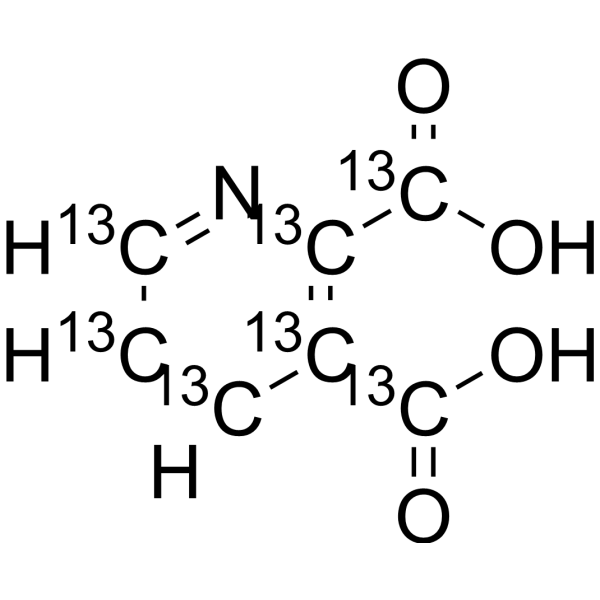 0 ImagesCat. No.: HY-100807S1CAS No.: 1346642-91-8
Quinolinic acid-13C7 is the 13C labeled Quinolinic acid (HY-100807). Quinolinic acid, an endogenous metabolite of tryptophan, is a N-methyl-D-aspartate receptor (NMDA receptor) agonist. Quinolinic acid increases glutamate efflux, induces the generation of ROS, activates nitric oxide synthase, produces excessive NO, leading to calcium ion influx and neuronal apoptosis.
-
Piceatannol 3'-O-glucoside (Standard)
 0 ImagesCat. No.: HY-N2237RCAS No.: 94356-26-0Synonyms: Quzhaqigan (Standard)
Piceatannol 3'-O-glucoside (Standard) is the analytical standard of Piceatannol 3'-O-glucoside. This product is intended for research and analytical applications. Piceatannol 3'-O-glucoside, an active component of Rhubarb, activates endothelial nitric oxide (NO) synthase through inhibition of arginase activity with IC50s of 11.22 μM and 11.06 μM against arginase I and arginase II, respectively.
-
Quinocetone (Standard)
 0 ImagesCat. No.: HY-123581RCAS No.: 81810-66-4
Quinocetone (Standard) is the analytical standard of Quinocetone (HY-123581). This product is used for research and analytical purposes. Quinocetone is an orally active animal feed additive used to increase the meat production of livestock and poultry. Quinocetone exhibits antibacterial activity against a variety of pathogenic microorganisms. Quinocetone exhibits tissue-specific (liver, lymphocyte) toxicity. Quinocetone induces autophagy in cells through the ATF6/DAPK1 pathway. Quinocetone activates the NF-κB and iNOS pathways, leading to cell apoptosis, hepatocyte vacuolar degeneration and fibrosis. Quinocetone can inhibit Nrf2/HO-1 and induce the generation of reactive oxygen species (ROS), leading to oxidative stress and DNA damage.
-
L-Arginine-15N4,d7 hydrochloride
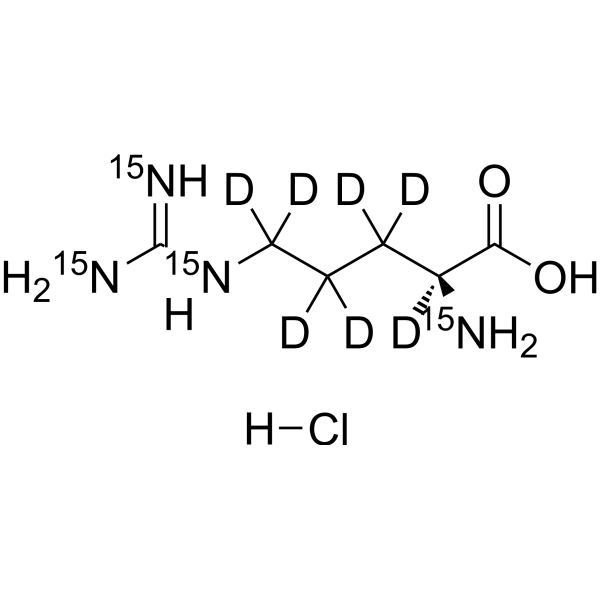 0 ImagesCat. No.: HY-N0455AS9Synonyms: (S)-(+)-Arginine-15N4,d7 hydrochloride
L-Arginine-15N4,d7 (hydrochloride) is the deuterium and 15N-labeled L-Arginine hydrochloride. L-Arginine hydrochloride ((S)-(+)-Arginine hydrochloride) is the nitrogen donor for synthesis of nitric oxide, a potent vasodilator that is deficient during times of sickle cell crisis.
-
CI-1018
 0 ImagesCat. No.: HY-19299CAS No.: 245329-99-1
CI-1018 is an orally active selective PDE-4 inhibitor, with IC50 values of 1.1 μM, 35.8 μM, and 73.4 μM against hPDE-4, canine PDE-4, and guinea pig PDE-4, respectively. CI-1018 induces iNOS expression and Apoptosis. CI-1018 induces vascular injury, medial necrosis, hemorrhage, edema, thymic atrophy, ketonuria, and weight loss. CI-1018 can be used in research related to asthma, vasculitis, and mesenteric vasculitis/arteriopathy.
-
Rosuvastatin lactone-d6
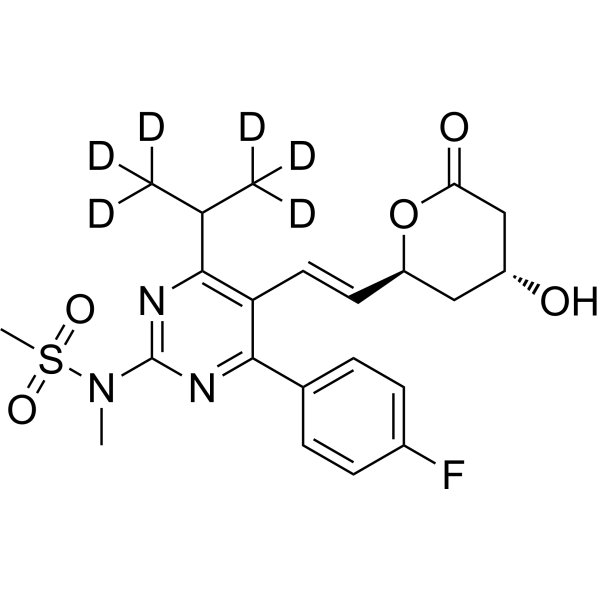 0 ImagesCat. No.: HY-138166S
Rosuvastatin lactone-d6 is the deuterium labeled Rosuvastatin lactone. Rosuvastatin lactone is a metabolite of Rosuvastatin (HY-17504A), a statin lipid-lowering agent and HMG-CoA inhibitor. Rosuvastatin lactone exhibits endothelium-independent and HMG-CoA reductase-independent vasorelaxant activity in rat aortic rings, and its vasorelaxant effect is jointly mediated by NO produced by inducible nitric oxide synthase (iNOS) located in vascular smooth muscle and activation of potassium channels. Rosuvastatin lactone itself has no lipid-lowering effect.
-
NCX1022
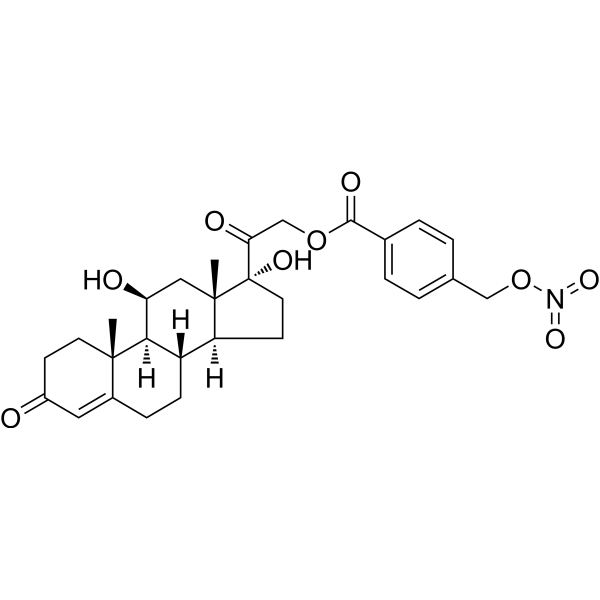 0 ImagesCat. No.: HY-U00187CAS No.: 571186-50-0
NCX1022 is an NO-releasing derivative of Hydrocortisone, which is the most widely used anti-inflammatory agent for the treatment of skin inflammation.
-
TP508
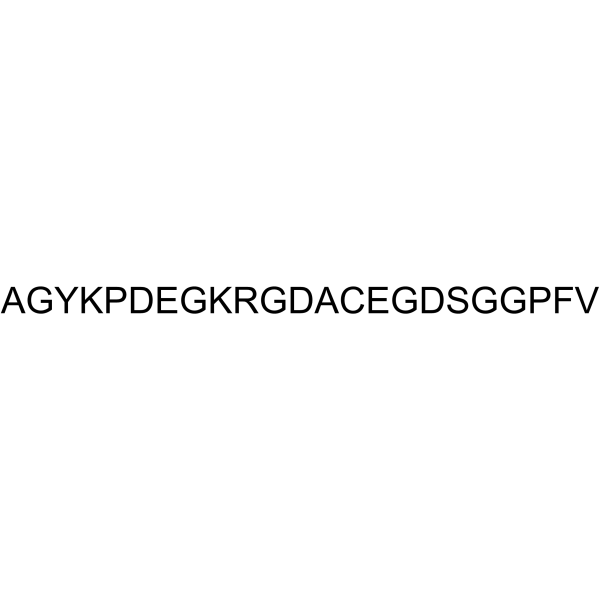 0 ImagesCat. No.: HY-P0316CAS No.: 121341-81-9
TP508 is a 23-amino acid nonproteolytic thrombin peptide that represents a portion of the receptor-binding domain of thrombin molecule. TP508 activates endothelial NO synthase (eNOS) and stimulates production of NO in human endothelial cells. TP508 activates endothelial cells and stem cells to revascularize and regenerate tissues.



