



Fluorescent Dye
Fluorescence is a phenomenon of photoluminescence in luminescence. When an atom is irradiated by light, some electrons around the nucleus jump from their original orbitals to higher energy orbitals under the influence of light energy, i.e., from the ground state to the first or second excited single-line state, etc. Due to the instability of the first or second excited singlet state, the electron returns from the excited singlet state to the ground state accompanied by released energy, resulting in fluorescence.
Fluorescent dyes can be covalently bound or physically adsorbed in the structure of the substance. The fluorescence properties allow for the characterization, localization and quantitative analysis of the labeled object. Fluorescent dyes have shown great potential for the detection of proteins, nucleic acids, cells, and immunoassays, attributed to the advantages in non-radioactive contamination, simple experimental operation and easy observation.
Fluorescent dyes have penetrated many fields such as pharmacology, physiology, environmental science, and information science, as well as functional studies of proteins and drug screening.
All Product Categories
-
Fluorescent Dye Related Products (4888)
Related Products (4888)

-
Antibodies (4)
-
ATTO 390 alkyne
 0 ImagesCat. No.: HY-D1924ATTO 390 alkyne is an alkyne derivative of ATTO 390 with maximum excitation/emission wavelengths: 390/476 nm. ATTO 390 alkyne is a click chemistry reagent, it contains an Alkyne group and can undergo copper-catalyzed azide-alkyne cycloaddition (CuAAc) with molecules containing Azide groups.
-
PSMA-1092
 0 ImagesCat. No.: HY-179330CAS No.: 2481214-35-9PSMA-1092 is a fluorescence probe targeting prostate-specific membrane antigen (PSMA) with a Ki of 80 pM. PSMA-1092 can be used for tumor localization and imaging, such as prostate cancer.
-
FAM labled Golodirsen sodium
 0 ImagesCat. No.: HY-132611DFAM labled Golodirsen sodiumis a FAM labled Golodirsen sodium.
-
FITC-PEG10000-MAL
 0 ImagesCat. No.: HY-D2800DFITC-PEG10000-MAL is a fluorescent dye composed of polyethylene glycol (PEG), FITC (HY-66019) and Maleimide (HY-W007324) (MAL). FITC-PEG10000-MAL can be used for fluorescent labeling and imaging.

-
Ac-Gly-Ala-Lys(Ac)-AMC
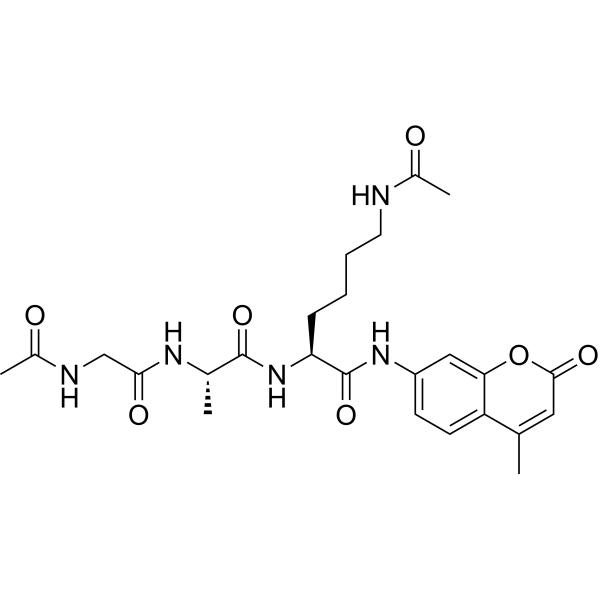 0 ImagesCat. No.: HY-P4416CAS No.: 577969-56-3Ac-Gly-Ala-Lys(Ac)-AMC is a fluorogenic substrate for the determination of protease activity. Ac-Gly-Ala-Lys(Ac)-AMC undergoes hydrolysis and releases the fluorescent product 7-amino-4-methylcoumarin (AMC). AMC is fluorescent under UV light and can emit a fluorescent signal.
-
Bz-VGR-AMC TFA
 0 ImagesCat. No.: HY-137897APurity: 98.47%Bz-VGR-AMC TFA is a fluorescent substrate for the trypsin-like activity of the 20S proteasome. Bz-VGR-AMCTFA can be used to measure the trypsin-like (β2) activity of the 20S proteasome (Ex/Em = 360/460 nm).
-
C12FDGlcU
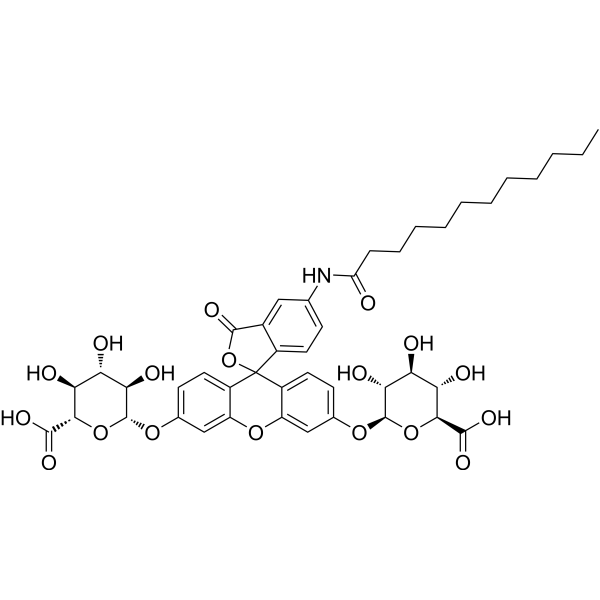 0 ImagesCat. No.: HY-D1578CAS No.: 423762-14-5C12FDGlcU is a lipophilic analog of fluorescein di-β-D-glucuronic acid. C12FDGlcU can be useful for the detection of β-glucuronidase (GUS) gene expression. C12FDGlcU can enter the cells and then be cleaved by β-glucuronidase, generating the yellow-colored, green-fluorescent fluorescein (Abs/Em of the reaction product: 495/518 nm).
-
FAM labled Inotersen sodium
 0 ImagesCat. No.: HY-132608BFAM labled Inotersen sodiumis a FAM labled Inotersen sodium.
-
2-Ethoxy-2-(2-naphthyl)ethanenitril
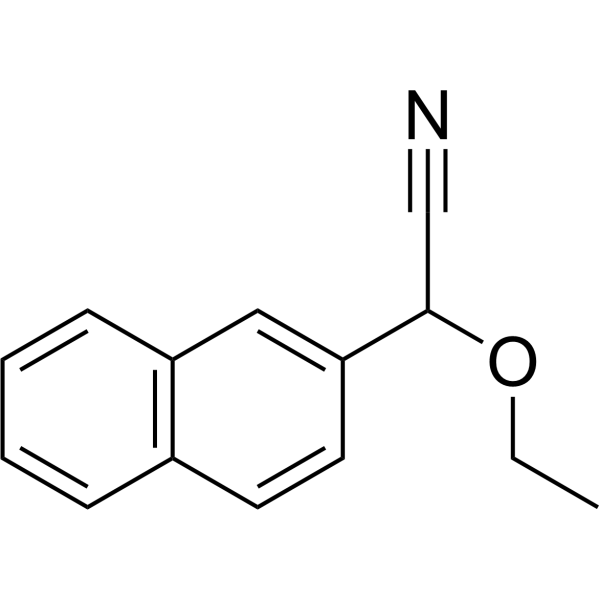 0 ImagesCat. No.: HY-D0094CAS No.: 33224-80-52-Ethoxy-2-(2-naphthyl)ethanenitril is a multifunctional dye. Dyes are important tools in biological experiments. They can help researchers observe and analyze cell structures, track biomolecules, evaluate cell functions, distinguish cell types, detect biomolecules, study tissue pathology and monitor microorganisms. Their applications range from basic scientific research to clinical A wide range of diagnostics. Dyes are also widely used in traditional fields such as textile dyeing, as well as in emerging fields such as functional textile processing, food pigments and dye-sensitized solar cells.
-
AF700-PEG12-DBCO
 0 ImagesCat. No.: HY-D3482AF700-PEG12-DBCO is a derivative of Alexa Fluor 700 featuring a DBCO (dibenzocyclooctyne) group for copper-free click chemistry (SPAAC) . Its PEG12 linker enhances hydrophilicity and provides increased spacer length. AF700-PEG12-DBCO is suitable for bioconjugation via copper-free click chemistry (Ex/Em = 702/723 nm) .
-
SGC5
 0 ImagesCat. No.: HY-D3394CAS No.: 1331918-67-2SGC5 is a fluorescence enhancer and membrane dissociator with millisecond-scale membrane dissociation kinetics, with an emission spectrum of 500-650 nm. SGC5 produces strong fluorescence upon binding to lipid membranes, exhibits fast partitioning dissociation kinetics at higher temperatures, and is unaffected by pH or cholesterol. SGC5 does not belong to the FM dye family and shows the highest membrane-bound fluorescence intensity among the tested styryl/FM dyes. SGC5 can be used to study synaptic vesicle cycling in neurons.
-
FFN-102 trifluoroacetate
 0 ImagesCat. No.: HY-129097CAS No.: 1234064-11-9FFN-102 trifluoroacetate is an analogue of biogenic neurotransmitters. FFN-102 trifluoroacetate is a pH-dependent fluorescent probe that labels dopamine cell bodies, axons, and presynaptic terminals.
-
Ulex Europaeus Agglutinin I-AF405
 0 ImagesCat. No.: HY-NP090CSynonyms: UEA I-AF405Ulex Europaeus Agglutinin I-AF405 (UEA I-AF405) is an AF405-labeled glehnia littoralis lectin I (UEA-I). Ulex Europaeus Agglutinin I exhibits specificity for cell surface glycoconjugates containing α-L-fucosylate. Ulex Europaeus Agglutinin I-AF405 can be used for vascular endothelial labeling, glycan imaging, and tissue staining studies (Ex/Em = 405/435 nm).
-
SNAP-649
 0 ImagesCat. No.: HY-D2944CAS No.: 1627942-39-5SNAP-649 is a DY-649P1-labeled SNAP tag fluorescent probe.
-
Phaseolus Vulgaris Erythroagglutinin
 0 ImagesCat. No.: HY-NP076Synonyms: PHA-EPhaseolus Vulgaris Erythroagglutinin (PHA-E) is a plant lectin that can be used as a probe to specifically bind biomolecules (such as polysaccharides, peptides, etc.).Phaseolus Vulgaris Erythroagglutinin (PHA-E) is a biological material or organic compound that can be used in life science research.
-
Fluo-2 AM
 0 ImagesCat. No.: HY-158746CAS No.: 1070771-36-6Synonyms: Fluo-2 acetoxymethyl ester; Fluo-2 ha; Fluo-2 high affinityFluo-2 AM (Fluo-2 acetoxymethyl ester) is a fluorescent dye, that can be used for detection of intracellular calcium ion concentration.
-
Vari Fluor 647A Carboxylic acid(free acid)
 0 ImagesCat. No.: HY-D1823Purity: 98.0%Synonyms: VF 647A Carboxylic acid(free acid)Vari Fluor 647A Carboxylic acid (VF 647A Carboxylic acid) free acid is a carboxylic acid derivative of Vari Fluor. Vari Fluor carboxylic acid derivatives are unactivated labeled fluorescent dyes for protein, antibody, and polysaccharide labeling that require carboxylic acid activation for use.
-
DiSC18(3)
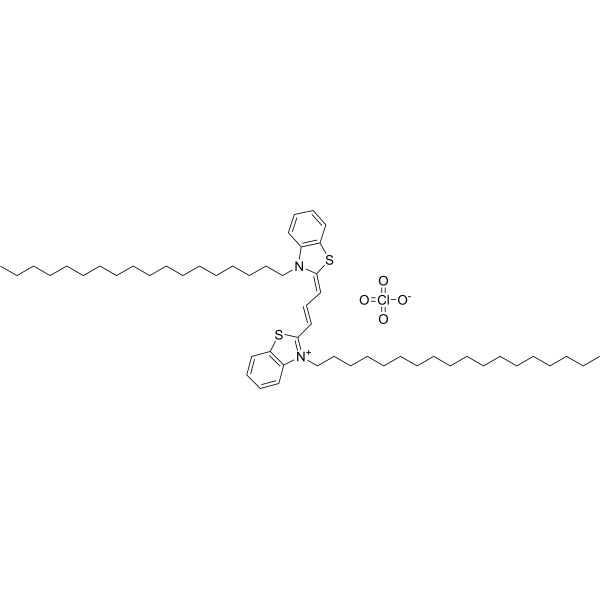 0 ImagesCat. No.: HY-D1626CAS No.: 53533-50-9Synonyms: 3,3'-Dioctadecylthiacarbocyanine perchlorateDiSC18(3) is a lipophilic carbocyanine dye for membrane labelling.
-
5-Bromomethyl-fluorescein
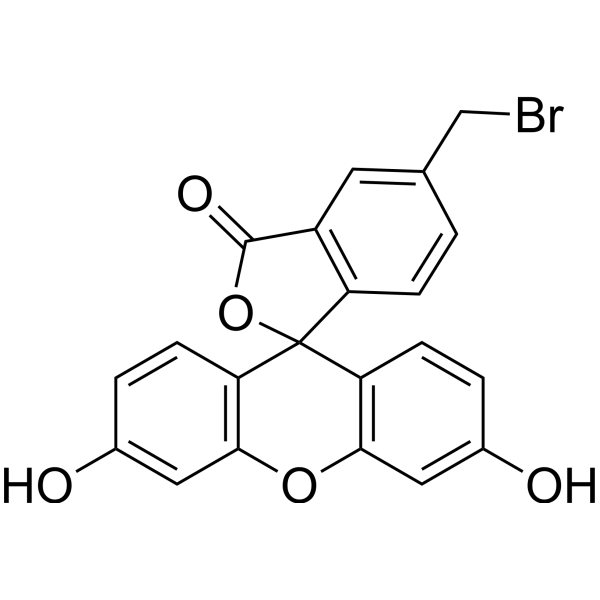 0 ImagesCat. No.: HY-D0037CAS No.: 148942-72-75-Bromomethyl-fluorescein is a multifunctional dye. Dyes are important tools in biological experiments. They can help researchers observe and analyze cell structures, track biomolecules, evaluate cell functions, distinguish cell types, detect biomolecules, study tissue pathology and monitor microorganisms. Their applications range from basic scientific research to clinical A wide range of diagnostics. Dyes are also widely used in traditional fields such as textile dyeing, as well as in emerging fields such as functional textile processing, food pigments and dye-sensitized solar cells.




