



Liposome
Liposomes (NPs typically 100–500 nm in diameter) are fabricated from the self-assembly of phospholipids, which consist of a polar phosphate head group and hydrophobic lipid tails. In aqueous environments, the hydrophobic tails self-orient, resulting in a spherical structure comprised of an aqueous core surrounded by a lipophilic bilayer membrane. Liposomes are both biocompatible and biodegradable (e.g., at certain pH and temperature), which can be controlled by modifying the lipid composition. Furthermore, liposomes are amenable to various modifications that improve their efficacy as drug delivery carriers.
All Product Categories
-
Liposome Related Products (1266)
Related Products (1266)

-
DSPE-PEG1000-CTT2
 0 ImagesCat. No.: HY-172466DSPE-PEG1000-CTT2 is a PEG compound which composed of DSPE and a gelatinase inhibitor (CTT2 (CTTHWGFTLC)). CTT2 (CTTHWGFTLC) has the ability to specifically target tumors. DSPE-PEG1000-CTT2 can be used for drug delivery.
-
PMPC
 0 ImagesSynonyms: PC(16:0/14:0); 1-palmitoyl-2-myristoyl-sn-glycero-3-phosphocholinePMPC is a phosphatidylcholine with asymmetrical fatty acid. Palmitic acid occupies sn-1 position while myristic acid is placed at the sn-2 position.
-
DOPE (GMP Like)
 0 ImagesCat. No.: HY-112005GLCAS No.: 4004-05-1Synonyms: Dioleoylphosphatidylethanolamine (GMP Like); 1,2-Dioleoyl-sn-glycero-3-phosphoethanolamine (GMP Like)DOPE (GMP Like) is the GMP Like class DOPE (HY-112005), and can be used as pharmaceutical excipients. GMP small molecules works appropriately as an auxiliary reagent for cell therapy manufacture. DOPE is a neutral helper lipid for cationic liposome and combines with cationic phospholipids to improve transfection efficiency of naked siRNA.
-
Lipid A6
 0 ImagesCat. No.: HY-168381CAS No.: 3037332-21-8Lipid A6 is a biodegradable alkyne lipid that can be used to synthesize lipid-like nanoparticles (LNPs) for delivery of mRNA.
-
DSPE-PEG5000-M2pep
 0 ImagesCat. No.: HY-172273BDSPE-PEG5000-Mal-Cys-YEQDPWGVKWWY is a PEG compound which composed of DSPE and a M2-polarized macrophages targeting peptide (M2pep, YEQDPWGVKWWY). M2pep is conjugated to a proapoptotic peptide as monovalent or multivalent ligands to concentrate the toxic effect of the peptide to M2 macrophages. DSPE-PEG5000-Mal-Cys-YEQDPWGVKWWY can be used for drug delivery.
-
DSPE-PEG2000-M2pep
 0 ImagesCat. No.: HY-172273ADSPE-PEG2000-Mal-Cys-YEQDPWGVKWWY is a PEG compound which composed of DSPE and a M2-polarized macrophages targeting peptide (M2pep, YEQDPWGVKWWY). M2pep is conjugated to a proapoptotic peptide as monovalent or multivalent ligands to concentrate the toxic effect of the peptide to M2 macrophages. DSPE-PEG2000-Mal-Cys-YEQDPWGVKWWY can be used for drug delivery.
-
1-Palmitoyl-2-10-pahsa-3-oleoyl-sn-glycerol
 0 ImagesCat. No.: HY-173548Synonyms: 16:0-10-Pahsa-18:1-TG1-Palmitoyl-2-10-pahsa-3-oleoyl-sn-glycerol (16:0-10-Pahsa-18:1-TG) is a triacylglycerol that contains Palmitic acid (HY-N08307), the fatty acid ester of hydroxy fatty acid (FAHFA) 10-PAHSA, and Oleic acid (HY-N1446).
-
Genevant CL1 monohydrochloride
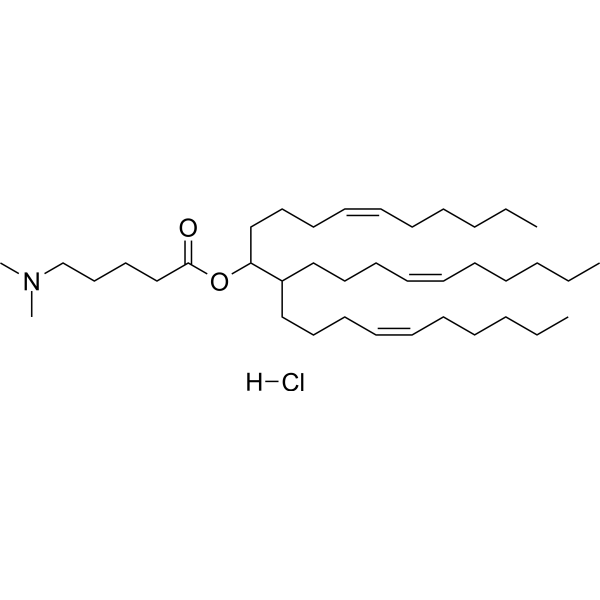 0 ImagesCat. No.: HY-46759AGenevant CL1 monohydrochloride is an ionizable lipid (pKa = 6.3) suitable for the preparation of lipid nanoparticles (LNPs) for delivering nucleic acid payloads and intramuscular vaccines. Genevant CL1 monohydrochloride is a component of lipid nanoparticle delivery systems for mRNA vaccines.
-
1-Thio-β-D-glucose Sodium Salt Dihydrate-13C6
 0 ImagesCat. No.: HY-W7484181-Thio-β-D-glucose Sodium Salt Dihydrate-13C6 is the 13C-labeled 1-Thio-β-D-glucose sodium (HY-115419). 1-Thio-β-D-glucose sodium is the sodium salt form of 1-Thio-β-D-glucose. 1-Thio-β-D-glucose forms hydrophilic self-assembled monolayer with metal, stablizes the lipid bilayer and protects the proteins from denaturation.
-
DSPE-PEG3400-NGR
 0 ImagesCat. No.: HY-172473ADSPE-PEG34000-NGR is a PEG compound which composed of DSPE and an Asn-Gly-Arg (NGR) peptide. NGR peptide can target tumor vascular antigen CD13. DSPE-PEG3400-NGR can be used for drug delivery.
-
DSG-PEG10000-CHO
 0 ImagesCat. No.: HY-183171DDSG-PEG10000-CHO is a conjugate composed of DSG, a PEG chain, and a terminal aldehyde group (-CHO). DSG-PEG10000-CHO combines the membrane compatibility of phospholipids with the flexibility of hydroxyl modification, making it suitable for research in biomaterial construction and drug delivery.
-
DSPE-PEG1000-PTP
 0 ImagesCat. No.: HY-172270DSPE-PEG1000-PTP is synthesised by conjugating the amino group of plectin-1 peptide (PTP) with DSPE-PEG-NHS ester via amide bonds. DSPE-PEG1000-PTP can be used to construct drug delivery vectors.
-
DPPE-PEG5-azide
 0 ImagesCat. No.: HY-174946ASynonyms: DPPE-PEG5-N3DPPE-PEG5-azide (DPPE-PEG5-N3) is a PEG-modified lipid containing an azide group. DPPE-PEG5-azide can undergo a copper-catalyzed azide-alkyne cycloaddition reaction (CuAAc) with molecules containing an alkynyl group. It can also undergo ring strain-driven alkyne-azide cycloaddition (SPAAC) reactions with molecules containing DBCO or BCN groups.
-
DPPE-PEG750
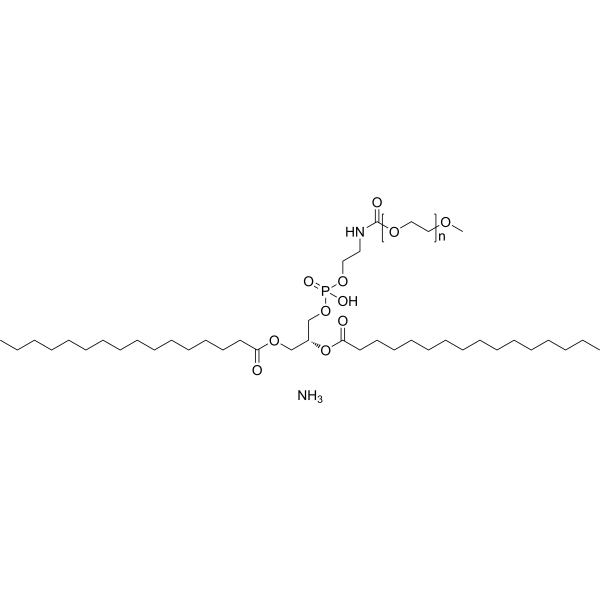 0 ImagesCat. No.: HY-144012CCAS No.: 474922-84-4Synonyms: 16:0 PEG750 PE; 1,2-Dipalmitoyl-sn-glycero-3-phosphoethanolamine-N-[methoxy(polyethylene glycol)-750] ammoniumDPPE-PEG750 is a PEG lipid functional end group used in the synthesis of liposomes (LPs) for the design of conjugated polymer nanoparticles. Through biotin modification and carboxyl terminus, lipid nanoparticles (LNPs) further coupling with other biomolecules can be achieved. Functionalized nanoparticles can be used for targeted labeling of specific cellular proteins. With streptavidin as a linker, biotinylated PEG lipid-conjugated polymer nanoparticles are able to bind to biotinylated antibodies on cell surface receptors, yielding the utility of fluorescence-based imaging and sensing.
-
DSPE-PEG1000-octreotide
 0 ImagesCat. No.: HY-172280DSPE-PEG1000-Octreotide is a PEG compound which composed of DSPE and a Octreotide (HY-P0036). Octreotide is a somatostatin receptor agonist. Octreotide has antitumor activity, mediates apoptosis and may also be used in disease studies in acromegaly. DSPE-PEG1000-Octreotide can be used for drug delivery.
-
Cho-Arg TFA
 0 ImagesCat. No.: HY-138912CAS No.: 1609010-56-1Cho-Arg TFA is a steroid-based cationic lipid with an L-Arginine headgroup. Cho-Arg TFA shows a remarkably high optimized plasmid DNA transfection efficacy.
-
DMG-PEG10000-COOH
 0 ImagesCat. No.: HY-200288DDMG-PEG10000-COOH is a conjugate composed of DMG, a PEG chain, and a terminal carboxyl group (-COOH). The carboxyl group in DMG-PEG10000-COOH can form an amide bond with a primary amine via EDC/NHS activation, enabling targeted modification of liposomes/nanoparticles.
-
O12-D3-I3
 0 ImagesCat. No.: HY-172328O12-D3-I3 is an ionizable cationic lipid. O12-D3-I3 can be used in the generation of lipid nanoparticles (LNPs) for siRNA delivery in vitro and in vivo. LNPs containing O12-D3-I3 enhances LNP endosomal escape for ferroptosis RNAi therapy of cancer.
-
DOPE-PEG10000-Amine
 0 ImagesCat. No.: HY-W1053112BSynonyms: DOPE-PEG10000-NH2DOPE-PEG10000-Amine (DOPE-PEG1000-NH2) is a conjugate composed of dioleoylphosphatidylethanolamine (DOPE), a PEG chain, and a terminal amino group (-NH2). The amino group in DOPE-PEG10000-Amine can chemically react with carboxyl groups, activated esters, etc., participating in various bioconjugation reactions for targeted modification of liposomes/nanoparticles.
-
Cholesterol-PEG2000-Folate
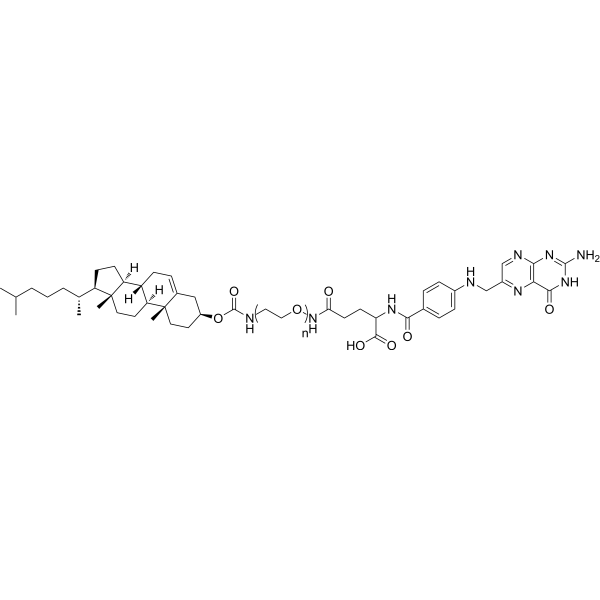 0 ImagesCat. No.: HY-W440715Cholesterol-PEG2000-Folate is an excipient and can be used for the preparation of folate-conjugated PEG-liposomes.



