



MOFs
Metal-Organic Frameworks
MOFs (Metal-Organic Frameworks) have significant applications in biomedicine, such as serving as drug carriers for targeted delivery and controlled release to enhance therapeutic efficacy and reduce side effects. They are also used in bioimaging, disease diagnosis, and catalytic therapies (e.g., for cancer treatment).
-
MOFs Related Products (3081)
Related Products (3081)

-
Cobalt phthalocyanine
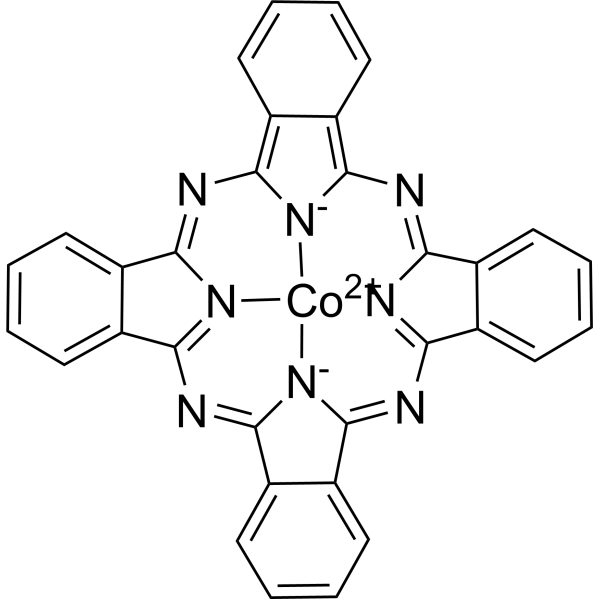 0 ImagesSynonyms: Cobalt(II) phthalocyanine; Cobaltous phthalocyanine; Phthalocyanine cobalt complexCobalt phthalocyanine is a catalyst of redox reaction, catalyzes aerobic regenerations of aldehydes and ketones from aldoximes and ketoximes. Cobalt phthalocyanine can be used in the development of electrocatalysts.
-
3-Formyl-4-hydroxybenzoic acid
 0 ImagesSynonyms: 4-Hydroxy-5-formylbenzoic acid3-Formyl-4-hydroxybenzoic acid (4-Hydroxy-5-formylbenzoic acid) is a metal-organic framework (MOF).
-
Pyridine-2,6-dicarboxylic acid
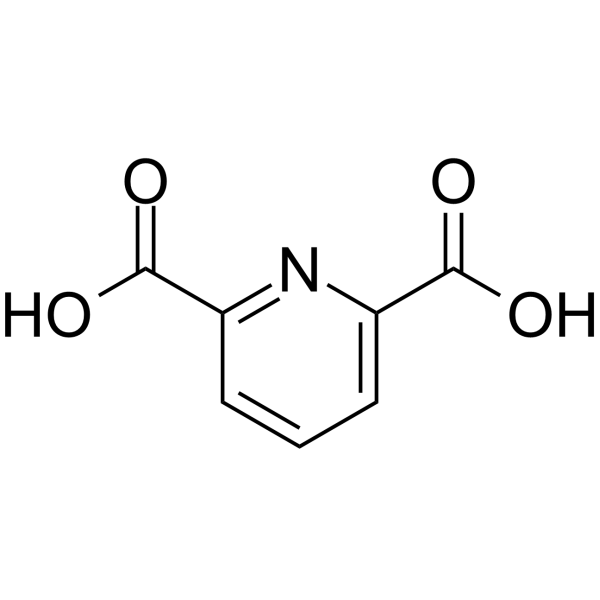 0 ImagesPyridine-2,6-dicarboxylic acid is a dicarboxylic acid containing a pyridine ring with unique chemical properties that make it an important ingredient in a variety of industrial processes. Pyridine-2,6-dicarboxylic acid is commonly used as a ligand for metal ions, a building block in the synthesis of pharmaceuticals and organic compounds, and a precursor in the production of pigments and dyes.
-
4,4'-Tfmbpy
 0 ImagesSynonyms: 4,4'-Bis(trifluoromethyl)-2,2'-bipyridine4,4'-Tfmbpy(4,4'-Bis(trifluoromethyl)-2,2'-bipyridine) is a metal-organic framework (MOF).
-
Niacin (standard)
 0 ImagesSynonyms: Nicotinic acid (standard); Vitamin B3 (standard)Niacin (Standard) is the analytical standard of Niacin. This product is intended for research and analytical applications. Niacin (Vitamin B3) is an orally active water-soluble B3 vitamin that is an essential nutrient for humans. Niacin (Vitamin B3) plays a key role in energy metabolism, cell signaling cascades regulating gene expression and apoptosis. Niacin (Vitamin B3) is also used in the study of cardiovascular diseases.
-
6,6'-Dimethyl-2,2'-bipyridyl
 0 ImagesCat. No.: HY-W004545CAS No.: 4411-80-7Synonyms: 6,6'-Dimethyl-2,2'-bipyridine6,6'-Dimethyl-2,2'-bipyridyl (6,6'-Dimethyl-2,2'-bipyridine) is a metal-organic framework (MOF).
-
Cobalt(II) TPP
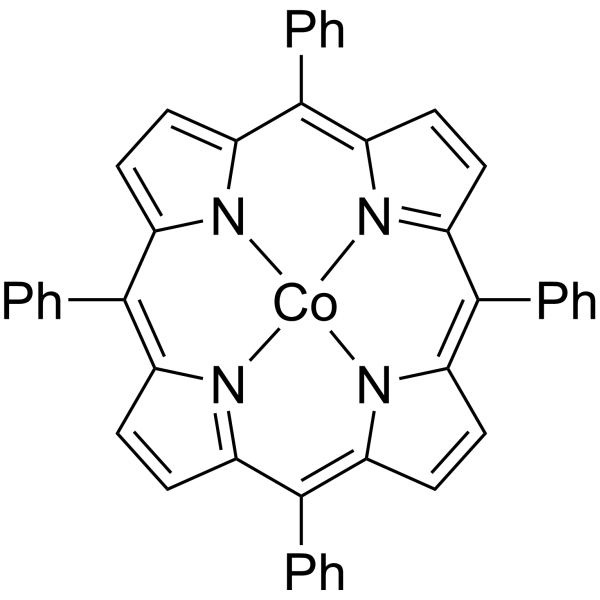 0 ImagesCat. No.: HY-W073013CAS No.: 14172-90-85,10,15,20-Tetraphenyl-21H,23H-porphine cobalt(II), commonly known as CoTPP or cobalt porphyrin, is a coordination compound. 5,10,15,20-Tetraphenyl-21H,23H-porphine cobalt(II) is widely used in various fields such as catalysis, sensing, and organic electronics because of its unique electronic and optical properties. An efficient catalyst for reactions including oxidation, reduction, and CH bond activation, moreover, it has been used as a fluorescent probe for detecting oxygen content in biological systems and as an active material in organic solar cells.
-
UiO 66
 0 ImagesCat. No.: HY-W075680CAS No.: 1072413-89-8UiO 66 is a metal-organic framework (MOF).
-
ZIF-67(Co)
 0 ImagesSynonyms: Monocobalt(II) bis(2-methyl-1H-imidazole); Cobalt 2-methylimidazole (ZIF-67)ZIF-67(Co) (Monocobalt(II) bis(2-methyl-1H-imidazole)) is a metal-organic framework (MOF).

-
4,4',4''-Nitrilotribenzoic acid
 0 ImagesSynonyms: 4,4',4''-Tricarboxyl triphenylamine4,4',4''-Nitrilotribenzoic acid (4,4',4''-Tricarboxyl triphenylamine) is a metal-organic framework (MOF).
-
1,4-Cyclohexanedicarboxylic acid
 0 ImagesSynonyms: cyclohexane-1,4-dicarboxylic acid; 1,4-Cyclohexanedicarboxylic acid

-
1,4-Bis(4-pyridinyl)benzene
 0 ImagesCat. No.: HY-W047045CAS No.: 113682-56-7Synonyms: 4,4'-(1,4-Phenylene)bispyridine1,4-Bis(4-pyridinyl)benzene (4,4'-(1,4-Phenylene)bispyridine) is a metal-organic framework (MOF).
-
Tris(2-pyridylmethyl)amine
 0 ImagesSynonyms: Tris(pyridin-2-ylmethyl)amineTris(2-pyridylmethyl)amine (Tris(pyridin-2-ylmethyl)amine) is a metal-organic framework (MOF).
-
6-Bromo-2,2'-bipyridyl
 0 ImagesCat. No.: HY-W004576CAS No.: 10495-73-5Synonyms: 6-Bromo-2,2'-bipyridine6-Bromo-2,2'-bipyridyl (6-Bromo-2,2'-bipyridine) is a metal-organic framework (MOF).
-
KG-548
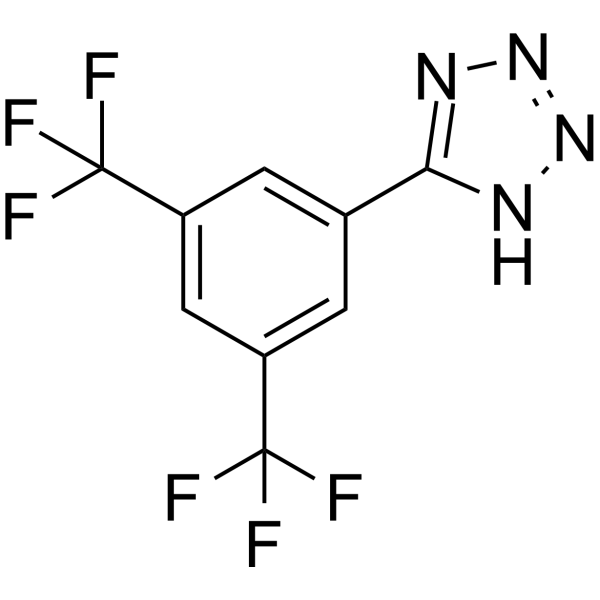 0 ImagesKG-548 is an ARNT/TACC3 disruptor and a HIF-1α inhibitor. KG-548 directly interferes with ARNT/TACC3 complex formation by competing with TACC3 for binding to the ARNT PAS-B domain. ARNT is the aryl hydrocarbon receptor nuclear translocator, also known as HIF-β.
-
2,9-Dibromo-1,10-phenanthroline-5,6-dione
 0 ImagesCat. No.: HY-W092234CAS No.: 943861-95-82,9-Dibromo-1,10-phenanthroline-5,6-dione is a metal-organic framework (MOF).
-
4'-Chloro-2,2':6',2''-terpyridine
 0 ImagesSynonyms: 4'-Chloro-α,α',α''-tripyridyl4'-Chloro-2,2':6',2''-terpyridine (4'-Chloro-α,α',α''-tripyridyl) is a metal-organic framework (MOF).
-
Dimethyl [2,2'-bipyridine]-4,4'-dicarboxylate
![Dimethyl [2,2'-bipyridine]-4,4'-dicarboxylate](https://file.medchemexpress.com/product_pic/hy-w004589.gif "Click to View Dimethyl [2,2'-bipyridine]-4,4'-dicarboxylate Product Detail") 0 ImagesSynonyms: 4,4'-Dimethoxycarbonyl-2,2'-bipyridineDimethyl [2,2'-bipyridine]-4,4'-dicarboxylate (4,4'-Dimethoxycarbonyl-2,2'-bipyridine) is a symmetric bipyridine derivative and metal-organic framework (MOF) ligand, which is applicable to research related to organic synthesis. Dimethyl [2,2'-bipyridine]-4,4'-dicarboxylate serves as a precursor for the preparation of metal complex linkers for oligonucleotide backbone intercalation.
0 ImagesSynonyms: 4,4'-Dimethoxycarbonyl-2,2'-bipyridineDimethyl [2,2'-bipyridine]-4,4'-dicarboxylate (4,4'-Dimethoxycarbonyl-2,2'-bipyridine) is a symmetric bipyridine derivative and metal-organic framework (MOF) ligand, which is applicable to research related to organic synthesis. Dimethyl [2,2'-bipyridine]-4,4'-dicarboxylate serves as a precursor for the preparation of metal complex linkers for oligonucleotide backbone intercalation.



