



NCoA-3 Antibody (YA4615)
(Synonyms: AIB; AIB1; ANIB1)Based on 1 Customer Validation
NCoA-3 Antibody (YA4615) is a Mouse-derived and non-conjugated IgG1 monoclonal antibody, targeting to NCoA-3.
-
Host:
Mouse
-
Isotype:
IgG1
-
Application:
WB, ELISA
-
Reactivity :
Human
-
Formulation:
Supplied in PBS with 0.05% sodium azide.
-
Conjugation:
Non-conjugated


To place orders, for customer services and technical support, please contact: MedChemExpress USA
Tel: 609-228-6898 E-mail: [email protected] [email protected]





Applications
| Application |
WB

WB: Western Blot
|
ELISA
ELISA: Enzyme Linked Immunosorbent Assay
|
|---|---|---|
| Dilution Ratio | 1:500-1:2000 | 1:10000 |


Product Details
NCoA-3 Antibody (YA4615) is a Mouse-derived and non-conjugated IgG1 monoclonal antibody, targeting to NCoA-3.
-
Host Mouse

-
Clonality Monoclonal

-
Species ReactivityHuman
-
Observed Molecular WeightObserved band size: 150-160 kDa
Note: Due to possible protein modifications or aggregation, the molecular weight should be confirmed by actual measurement, and the predicted value is for reference only.

-
Calculated Molecular Weight Predicted band size: 155 kDa

Purified recombinant fragment of human AIB1 aa 276-398.
affinity purified.
Non-conjugated
Unmodified
IgG1


Product Properties
-
Appearance
Solution
-
Formulation
Supplied in PBS with 0.05% sodium azide.
-
Concentration
Batch-dependent, Please check the COA for the concentration of each lot. Check Lot Concentration
-
Storage & Stability
Stored at -20°C for 1 year. Avoid repeated freeze / thaw cycles.
-
Shipping
Shipping with blue ice.


Verification Images
-
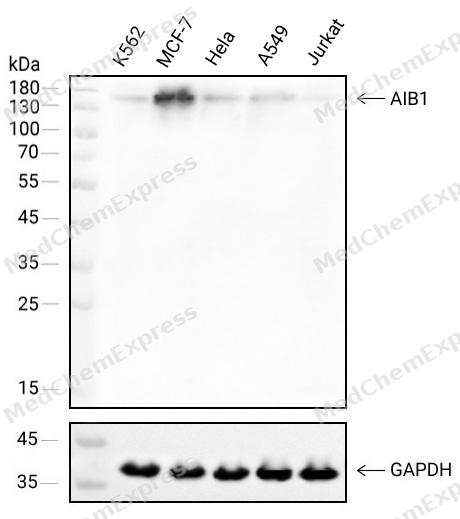 Western blot analysis of extracts from K562(lane 1(40μg) ),MCF-7(lane 2(40μg) ),Hela(lane 3(40μg) ),A549(lane 4(40μg) )and Jurkat(lane 5(40μg) ) using AIB1 antibody. Proteins were transferred to a NC membrane and blocked with 5% Skim milk in TBST for 2 hour at room temperature. The primary antibody ( 1/1000) and Loading control antibody (GAPDH,1/1000) was used in 5% Skim milk in TBST at 4°C overnight. Goat Anti-Mouse IgG-HRP Secondary Antibody (1/10,000) was used for 1 hour at room temperature.


Background
-
Function
NCoA-3 is a Nuclear receptor coactivator that directly binds nuclear receptors and stimulates the transcriptional activities in a hormone-dependent fashion. Plays a central role in creating a multisubunit coactivator complex, which probably acts via remodeling of chromatin. Involved in the coactivation of different nuclear receptors, such as for steroids (GR and ER), retinoids (RARs and RXRs), thyroid hormone (TRs), vitamin D3 (VDR) and prostanoids (PPARs). Displays histone acetyltransferase activity. Also involved in the coactivation of the NF-kappa-B pathway via its interaction with the NFKB1 subunit
-
Subcellular Localization
Cytoplasm; Nucleus
-
Expression
Tissue_specificity:Widely expressed. Highly expressed in the heart, skeletal muscle, pancreas, and placenta. Lowly expressed in the brain, and extremely lowly expressed in the lungs, liver, and kidneys. -
Isoforms & Post-Translational Modification
Q9Y6Q9 has 5 isomers: Q9Y6Q9-1: 155293 Da (predicted); Q9Y6Q9-2: 153797 Da (predicted); Q9Y6Q9-3: 154400 Da (predicted); Q9Y6Q9-4: 147499 Da (predicted); Q9Y6Q9-5: 154892 Da (predicted).
Acetylated by CREBBP. Acetylation occurs in the RID domain, and disrupts the interaction with nuclear receptors and regulates its function;Methylated by CARM1;Phosphorylated by IKK complex. Regulated its function. Phosphorylation at Ser-601 by CK1 promotes coactivator function -
Subunit
Present in a complex containing NCOA2, IKKA, IKKB, IKBKG and the histone acetyltransferase protein CREBBP (PubMed:11971985, PubMed:9346901).
-
SwissProt ID
-
Synonyms
AIB; AIB1; ANIB1


Documentation

 Powered by Bioz
