



Androgen Receptor Antibody (YA5824)
(Synonyms: Androgen receptor; Dihydrotestosterone receptor; Nuclear receptor subfamily 3 group C member 4; )
Based on 1 Customer Validation
Androgen Receptor Antibody (YA5824) is a Rabbit-derived and non-conjugated IgG monoclonal antibody, targeting to Androgen Receptor.
-
Host:
Rabbit
-
Isotype:
IgG
-
Application:
WB, IHC-P, ICC/IF, IP, ELISA
-
Reactivity :
Human, Mouse, Rat
-
Formulation:
Supplied in PBS, 50% glycerol, 0.05% Proclin 300, 0.05%BSA
-
Conjugation:
Non-conjugated


To place orders, for customer services and technical support, please contact: MedChemExpress USA
Tel: 609-228-6898 E-mail: [email protected] [email protected]





Applications
| Application |
IHC-P

IHC-P: Immunohistochemistry-Paraffin
|
WB
WB: Western Blot
|
ICC/IF
ICC/IF: Immunocytochemistry/
Immunofluorescence |
ELISA
ELISA: Enzyme Linked Immunosorbent Assay
|
IP
IP: Immunoprecipitation
|
|---|---|---|---|---|---|
| Dilution Ratio | 1:200-1:1000 | 1:2000-1:10000 | 1:200-1:1000 | 1:5000-1:20000 | 1:50-1:200 |


Product Details
Androgen Receptor Antibody (YA5824) is a Rabbit-derived and non-conjugated IgG monoclonal antibody, targeting to Androgen Receptor.
-
Host Rabbit

-
Clonality Monoclonal

-
Species ReactivityHuman, Mouse, Rat
-
Observed Molecular WeightObserved band size: 110 kDa
Note: Due to possible protein modifications or aggregation, the molecular weight should be confirmed by actual measurement, and the predicted value is for reference only.

-
Calculated Molecular Weight Predicted band size: 99 kDa

Protein A
Non-conjugated
Unmodified
IgG


Product Properties
-
Appearance
Solution
-
Formulation
Supplied in PBS, 50% glycerol, 0.05% Proclin 300, 0.05%BSA
-
Concentration
Batch-dependent, Please check the COA for the concentration of each lot. Check Lot Concentration
-
Storage & Stability
Stored at -20°C for 1 year. Avoid repeated freeze / thaw cycles.
-
Shipping
Shipping with blue ice.


Verification Images
-
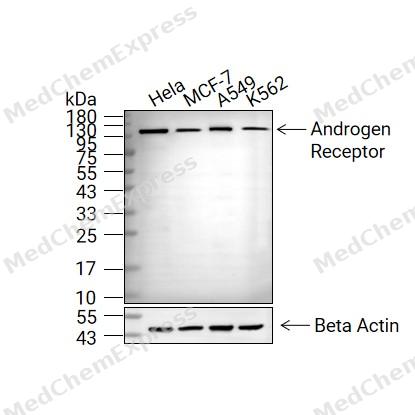 Western blot analysis of extracts from Hela (lane 2(20μg), MCF-7 (lane 3(20μg), A549 (lane 4(20μg) and K562 (lane 5(20μg) using Androgen Receptor Antibody (HY-P86132) Rabbit mAb. Proteins were transferred to a PVDF membrane and blocked with 5% non-fat milk in TBST for 2 hour at room temperature. The primary antibody (1/1000) and Loading control antibody (Beta Actin, HY-P80993, 1/10000) was used in 5% non-fat milk in TBST at 4°C overnight. Goat Anti-Rabbit IgG-HRP Secondary Antibody (1/10000) was used for 1 hour at room temperature.


Background
-
Function
Androgen receptor (AR) is a type of nuclear receptor that is activated by binding of either of the androgenic hormones testosterone or dihydrotestosterone in the cytoplasm and then translocating into the nucleus. Upon binding the hormone ligand, the receptor dissociates from accessory proteins, translocates into the nucleus, dimerizes, and then stimulates transcription of androgen responsive genes. The androgen receptor is most closely related to the progesterone receptor, and progestins in higher dosages can block the androgen receptor. The main function of the androgen receptor is as a DNA-binding transcription factor that regulates gene expression. Androgen regulated genes are critical for the development and maintenance of the male sexual phenotype. Mutations in this gene are also associated with complete androgen insensitivity (CAIS) .
-
Subcellular Localization
Nucleus; Cytoplasm
-
Expression
Tissue_specificity:It is primarily expressed in cardiac and skeletal muscle; it is also expressed (at the protein level) in basal and interstitial cells of the prostate. -
Isoforms & Post-Translational Modification
P10275 has 4 isomers: P10275-1: 99188 Da (predicted); P10275-2: 44643 Da (predicted); P10275-3: 67376 Da (predicted); P10275-4: 67659 Da (predicted).
Sumoylated on Lys-388 (major) and Lys-521. Ubiquitinated. Deubiquitinated by USP26. 'Lys-6' and 'Lys-27'-linked polyubiquitination by RNF6 modulates AR transcriptional activity and specificity;Phosphorylated in prostate cancer cells in response to several growth factors including EGF. Phosphorylation is induced by c-Src kinase (CSK). Tyr-535 is one of the major phosphorylation sites and an increase in phosphorylation and Src kinase activity is associated with prostate cancer progression. Phosphorylation by TNK2 enhances the DNA-binding and transcriptional activity and may be responsible for androgen-independent progression of prostate cancer. Phosphorylation at Ser-83 by CDK9 regulates AR promoter selectivity and cell growth. Phosphorylation by PAK6 leads to AR-mediated transcription inhibition;Palmitoylated by ZDHHC7 and ZDHHC21. Palmitoylation is required for plasma membrane targeting and for rapid intracellular signaling via ERK and AKT kinases and cAMP generation -
Subunit
Binds DNA as a homodimer. Part of a ternary complex containing AR, EFCAB6/DJBP and PARK7. Interacts with HIPK3 and NR0B2 in the presence of androgen. The ligand binding domain interacts with KAT7/HBO1 in the presence of dihydrotestosterone. Interacts with EFCAB6/DJBP, PQBP1, RANBP9, RBAK, SPDEF, SRA1, TGFB1I1 and RREB1. Interacts with ZMIZ1/ZIMP10 and ZMIZ2/ZMIP7 which both enhance its transactivation activity. Interacts with SLC30A9 and RAD54L2/ARIP4. Interacts with MACROD1 (via macro domain) (PubMed:19022849). Interacts via the ligand-binding domain with LXXLL and FXXLF motifs from NCOA1, NCOA2, NCOA3 and MAGEA11. Interacts (via nuclear receptor DNA binding domain and nuclear receptor ligand binding domain) with NCOA4 (PubMed:15563469, PubMed:8643607). The AR N-terminal poly-Gln region binds Ran resulting in enhancement of AR-mediated transactivation. Ran-binding decreases as the poly-Gln length increases. Interacts with HIP1 (via coiled coil domain). Interacts (via ligand-binding domain) with TRIM68. Interacts with TNK2. Interacts with USP26. Interacts with RNF6. Interacts (regulated by RNF6 probably through polyubiquitination) with RNF14; regulates AR transcriptional activity. Interacts with PRMT2 and TRIM24. Interacts with RACK1. Interacts with RANBP10; this interaction enhances dihydrotestosterone-induced AR transcriptional activity. Interacts with PRPF6 in a hormone-independent way; this interaction enhances dihydrotestosterone-induced AR transcriptional activity. Interacts with STK4/MST1. Interacts with ZIPK/DAPK3. Interacts with LPXN. Interacts with MAK. Part of a complex containing AR, MAK and NCOA3. Interacts with CRY1. Interacts with CCAR1 and GATA2. Interacts with ZNF318 (By similarity). Interacts with BUD31 (PubMed:25091737). Interacts with ARID4A (PubMed:23487765). Interacts with ARID4B (By similarity). Interacts (via NR LBD domain) with ZBTB7A; the interaction is direct and androgen-dependent (PubMed:20812024). Interacts with NCOR1 (PubMed:20812024). Interacts with NCOR2 (PubMed:20812024). Interacts with CRY2 in a ligand-dependent manner (By similarity)
-
SwissProt ID
-
Synonyms
Androgen receptor; Dihydrotestosterone receptor; Nuclear receptor subfamily 3 group C member 4;


Documentation
-
Data Sheet (234 KB)
-
SDS (252 KB)
- English - EN (252 KB)
- Français - FR (252 KB)
- Deutsch - DE (252 KB)
- Norwegian - NO (252 KB)
- Español - ES (252 KB)
- Swedish - SV (252 KB)
- Italian - IT (252 KB)
- Korean - KR (252 KB)
- Portuguese - PT (252 KB)
-
User Guide for Antibodies (1077 KB)

 Powered by Bioz
