



Aromatase Antibody (YA611)
(Synonyms: CYP19A1; ARO1; CYAR; CYP19; Cytochrome P450 19A1; Aromatase; CYPXIX; Cytochrome P-450AROM; Estrogen synthase)Based on 1 publication(s) in Google Scholar
Aromatase Antibody (YA611) is a Rabbit-derived and non-conjugated IgG monoclonal antibody, targeting to Aromatase.
-
Host:
Rabbit
-
Isotype:
IgG
-
Application:
WB, IP
-
Reactivity :
Human, Mouse, Rat
-
Formulation:
Supplied in 50 mM Tris-Glycine (pH 7.4), 0.15 M NaCl, 40% Glycerol and 0.05% BSA. Preservative: 0.01% Sodium azide
-
Conjugation:
Non-conjugated


To place orders, for customer services and technical support, please contact: MedChemExpress USA
Tel: 609-228-6898 E-mail: [email protected] [email protected]



Publications Citing Use of MedChemExpress (MCE) Aromatase Antibody (YA611)
More

Applications
| Application |
WB

WB: Western Blot
|
IP
IP: Immunoprecipitation
|
|---|---|---|
| Dilution Ratio | 1:500-1:1000 | 1:20 |


Product Details
Aromatase Antibody (YA611) is a Rabbit-derived and non-conjugated IgG monoclonal antibody, targeting to Aromatase.
-
Host Rabbit

-
Clonality Recombinant,Monoclonal

-
Species ReactivityHuman, Mouse, Rat
-
Observed Molecular WeightObserved band size: 50 kDa
Note: Due to possible protein modifications or aggregation, the molecular weight should be confirmed by actual measurement, and the predicted value is for reference only.

-
Calculated Molecular Weight Predicted band size: 58 kDa

Entrez Gene: 1588 Human ; 13075 Mouse ;
SwissProt: P11511 Human ; P28649 Mouse ; P22443 Rat
OMIM: 139300 Human
Synthetic peptide corresponding to Human Aromatase.The exact sequence is proprietary to MCE.
Endogenous
affinity purified
Non-conjugated
Unmodified
IgG


Product Properties
-
Appearance
Solution
-
Formulation
Supplied in 50 mM Tris-Glycine (pH 7.4), 0.15 M NaCl, 40% Glycerol and 0.05% BSA. Preservative: 0.01% Sodium azide
-
Concentration
Batch-dependent, Please check the COA for the concentration of each lot. Check Lot Concentration
-
Storage & Stability
Stored at -20°C for 1 year. Avoid repeated freeze / thaw cycles.
-
Shipping
Shipping with blue ice.


Publications (1)
-
Journal Impact Factor
-
Most Recent
-
Theriogenology
Granulosa cell dysfunction is associated with MCU-mediated mitochondrial calcium dyshomeostasis and reduced AKT phosphorylation in porcine cystic follicles. [Abstract]2026 Aug:260:117913. PMID: 41916042


Verification Images
-
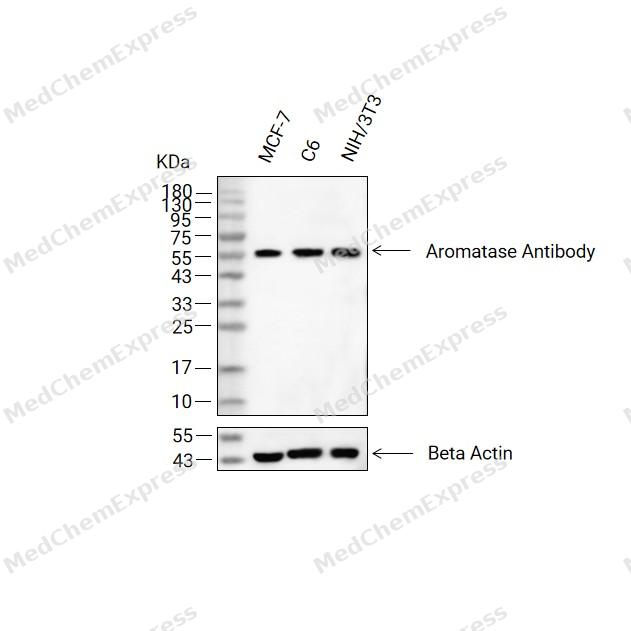 Western blot analysis of extracts from MCF-7(lane 2(20ug) , C6(lane 3(20ug) and NIH/3T3(lane 4(20ug) using Aromatase Antibody (HY-P80547) Rabbit mAb. Proteins were transferred to a PVDF membrane and blocked with 5% non-fat milk in TBST for 2 hour at room temperature. The primary antibody (1/1000) and Loading control antibody (Beta Actin, HY-P83730, 1/10000) was used in 5% non-fat milk in TBST at 4°C overnight. Goat Anti-Mouse/Rabbit IgG-HRP Secondary Antibody (1/10000) was used for 1 hour at room temperature.


Background
-
Function
Aromatase is an A cytochrome P450 monooxygenase that catalyzes the conversion of C19 androgens, androst-4-ene-3,17-dione (androstenedione) and testosterone to the C18 estrogens, estrone and estradiol, respectively. Catalyzes three successive oxidations of C19 androgens: two conventional oxidations at C19 yielding 19-hydroxy and 19-oxo/19-aldehyde derivatives, followed by a third oxidative aromatization step that involves C1-beta hydrogen abstraction combined with cleavage of the C10-C19 bond to yield a phenolic A ring and formic acid. Alternatively, the third oxidative reaction yields a 19-norsteroid and formic acid. Converts dihydrotestosterone to delta1,10-dehydro 19-nordihydrotestosterone and may play a role in homeostasis of this potent androgen. Also displays 2-hydroxylase activity toward estrone. Mechanistically, uses molecular oxygen inserting one oxygen atom into a substrate, and reducing the second into a water molecule, with two electrons provided by NADPH via cytochrome P450 reductase (CPR; NADPH-ferrihemoprotein reductase)[1][2][3][4].
-
Subcellular Localization
Endoplasmic reticulum membrane; Multi-pass membrane protein; Microsome membrane; Multi-pass membrane protein
-
Expression
Tissue_specificity:Widely expressed, including in human brain, placenta, skin fibroblasts, adipose tissue and gonads -
Isoforms & Post-Translational Modification
P11511 has 2 isomers: P11511-1: 57883 Da (predicted); P11511-2: 24518 Da (predicted).
Phosphorylated in vitro by PKA and PKG/PRKG1. These phosphorylations inhibit the catalytic activity as measured by estrone synthesis from androstenedione (36% decrease for PKA and 30% for PKG/PRKG1) -
SwissProt ID
-
Synonyms
CYP19A1; ARO1; CYAR; CYP19; Cytochrome P450 19A1; Aromatase; CYPXIX; Cytochrome P-450AROM; Estrogen synthase
-
Research Field
Cell Biology
Documentation
-
Data Sheet (261 KB)
-
SDS (252 KB)
- English - EN (252 KB)
- Français - FR (252 KB)
- Deutsch - DE (252 KB)
- Norwegian - NO (252 KB)
- Español - ES (252 KB)
- Swedish - SV (252 KB)
- Italian - IT (252 KB)
- Korean - KR (252 KB)
- Portuguese - PT (252 KB)
-
User Guide for Antibodies (1077 KB)
References
[1]. Baravalle R, et al. Impact of R264C and R264H polymorphisms in human aromatase function. J Steroid Biochem Mol Biol. 2017 Mar;167:23-32. [Content Brief]
[2]. Corbin CJ, et al. Isolation of a full-length cDNA insert encoding human aromatase system cytochrome P-450 and its expression in nonsteroidogenic cells. Proc Natl Acad Sci U S A. 1988 Dec;85(23):8948-52. [Content Brief]
[3]. Sohl CD, et al. Kinetic analysis of the three-step steroid aromatase reaction of human cytochrome P450 19A1. J Biol Chem. 2010 Jun 4;285(23):17734-43. [Content Brief]
[4]. Cheng Q, et al. Oxidation of dihydrotestosterone by human cytochromes P450 19A1 and 3A4. J Biol Chem. 2012 Aug 24;287(35):29554-67. [Content Brief]

 Powered by Bioz
